
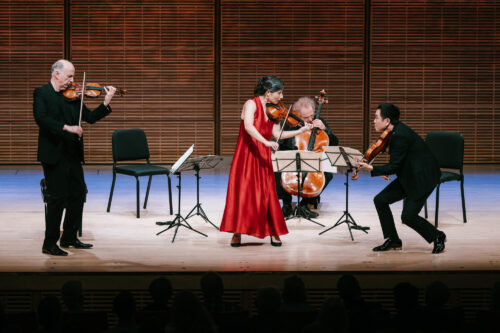
 United States Haydn, Assad, Debussy: Takács Quartet (Edward Dusinberre, Harumi Rhodes [violins], Richard O’Neill [viola], András Fejér [cello]). Zankel Hall at Carnegie Hall, New York, 4.3.2026. (DS)
Haydn – String Quartet No.3 in G minor, Op.74, ‘Rider’
Clarice Assad – Nexus (New York premiere)
Debussy – String Quartet in G minor, Op.10
The Takács Quartet brought an evening of wins to Carnegie’s Zankel Hall showcasing works that underscored their unmatched approach to the art of quartet playing.
They set the mood for the evening by starting with Haydn’s ‘Rider’ Quartet in G minor. The best interpreters of Haydn in the 21st century, the Takács Quartet cultivate the nuances in his works with a gentle enthusiasm that highlights the character and vast range of shading embedded in these profound musical storylines.
The Takács don’t just play; they seem to converse with the greatest of ease – knowing how to end each other’s sentences without ever interrupting. Micro moments in the Haydn, such as a short second violin solo or a punctuated viola line, were never buried. The Menuetto had a particularly beautiful, silky legato line typically reserved for a slow movement, but here it shimmered through the dance tempo. Haydn’s false ending in the last movement illuminated the Takács Quartet’s playful side as they took pleasure in presenting it theatrically, which incited some hesitant claps followed by quiet laughs from a happily tricked audience.
At the center of the program was the New York premiere of Clarice Assad’s Nexus, which she composed ‘by watching the Takács Quartet’s visceral, whole body approach to musical expression’ as explained in her concert notes.
In three movements, Assad deconstructs the actions of quartet playing and examines the often-tense process of building a relationship between individual musicians to team up as one cohesive, expressive voice. Over 25 minutes, she gives us the life cycle of a quartet. Edward Dusinberre introduced the work with the descriptors ‘mischievous’ and ‘dysfunctional’ – as if to say here is what really goes on behind the scenes.
Dusinberre then stepped away, leaving cellist András Fejér – the only remaining founding member of the group (who will retire after this season) – alone on the stage to begin the first section, ‘(Dis)Connect’, with a yearning, introspective melody. As each musician came back, they stood around separately, exchanging light virtuosic parts tinged with moments of musical bravado. Harumi Rhodes was stunning with a cadenza-like soloist moment standing at center stage (reminding us that she is not ‘just’ a second violinist).
As these choreographed movements unfolded, the players gradually settled into their chairs, falling into familiar quartet roles. Metamorphosizing melodies of classical form merged with samples of string textures alongside expressive gestures both physical and facial (including some occasional stomping by violist Richard O’Neill – perhaps the violist’s reminder of his crucial presence in the repertoire). Similar to a Jackson Pollock painting, Assad abstracted the musical process of quartet playing into a composition, which any other group would be hard-pressed to pull off so elegantly. It was a testament to the Takács players commitment to reflection and communication.
After the intermission, came Debussy’s one experimental leap into writing for string quartet. It dates from early in his career, before the familiar palette of impressionistic material had fully blossomed. An apt choice against the Assad, this tempestuous work is full of exploratory mood shifts, stinging passages and juxtapositions of color. One could hear Debussy figuring out ideas against the backdrop of more Romantic molds. The Takács played it with exquisite sensitivity and took care of its subtle sections, like O’Neill’s viola solo in the third movement which emerged as if wrapped in a glowing halo. The fourth movement flew by with complex, choppy passages signaling an emergence of near-modernist sound.
After a heartfelt standing ovation for Fejér, they sat for a quick encore. Dusinberre reminded us that Beethoven’s audiences were far less loving of new works and might have been envious of Assad’s approval that evening. They then treated us to a rollicking, free-spirited rendition of the Allegro molto from Beethoven’s ‘Razumovsky’ Quartet No.3 in C major. Hearing some Beethoven rounded out the evening’s full range of string quartet mastery.
Daniele Sahr
We just heard the Assad in Boulder’s Grusin Hall. So touching to see András on stage alone. Terrific review. My father was a music critic. He’d applaud you.
From Daniele Sahr for S&H: Thank you, Elizabeth!