
 United Kingdom Music Makers – Purcell, Arakelyan, Elgar: Dame Sarah Connolly (mezzo-soprano), Huddersfield Choral Society (director: Gregory Batsleer), Royal Northern Sinfonia / Ellie Slorach (conductor). Huddersfield Town Hall, Huddersfield, 14.3.2026. (PC)
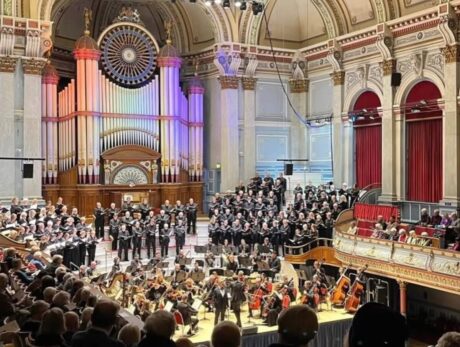
Purcell – Hail! Bright Cecilia (final chorus)
Kristina Arakelyan – Hymn to the Muses (world premiere)
Elgar – The Music Makers
Entitled ‘Music Makers’, the final concert of the Huddersfield Choral Society’s 190th season, featured three pieces celebrating the creation of music. The chorus was joined by the Royal Northern Sinfonia and conductor Ellie Slorach in all three works and also by mezzo-soprano Dame Sarah Connolly for the two main items on the programme, one of which was a new, large-scale work, commissioned by the choir and receiving its first performance.
As a curtain raiser, the chorus and orchestra presented the closing movement from Purcell’s ode, Hail! Bright Cecilia (1692). The scale and splendour of the framing invocations to St. Cecilia and the nobility of the contrapuntal and fugal episodes were effectively conveyed in this bold and sweeping account.
This was followed by the world premiere of Kristina Arakelyan’s Hymn to the Muses, a substantial, 35-minute work for mixed choir, mezzo-soprano soloist and a large orchestra, including triple woodwind, two harps and organ. It was written as a companion piece to Elgar’s The Music Makers, which was performed in the second half of the concert. As well as requiring virtually the same performing forces, both works share a common theme of creative inspiration.
Another important element in Hymn to the Muses is the creation story according to Greek mythology and the work began with a preludial ode to the Muses, setting paraphrased excerpts from Hesiod’s Theogony. This impressive opening movement combined grandeur and vigour, driven by pounding timpani, but there was delicacy and refinement, too, with a poetic use of harp figurations and a tender mezzo-soprano solo punctuated by florid, birdsong-like woodwind flourishes. In the ensuing, lightly scored recitative, the soloist introduced characters who would be the subject of subsequent movements.
The first of these, ‘Chronos (Time)’ was an atmospheric setting of Shakespeare’s Sonnet No.60 in which a judicious deployment of chiming tubular bells and glockenspiel and subtle harmonic shifts conjured up a mystical, numinous quality. Restless woodwind, lavish harp glissandos and dissonant organ figures signalled the arrival of ‘Chaos’, a thrillingly turbulent treatment of a passage from W. B. Yeats’s The Second Coming in which, at one point, the chorus chanted asynchronously above the orchestra’s forceful accents and ever-shifting metres. Eventually the clamour subsided as the choir’s basses grounded proceedings solemnly in preparation for ‘Gaia (Earth)’, a warmly radiant setting of John Clare’s sonnet Earth’s Eternity initiated by plaintive oboe phrases and featuring several eloquent passages for unaccompanied choir. In ‘Aether (Air)’, a fresh and occasionally folk-like movement to the text of Arthur Macy’s Thistle-Down; fluent writing for woodwind and harps ensured the material flowed naturally. An imposing Interlude for brass, laced with trumpet fanfares paved the way for The Water Spirit’s Song, which consisted of beautifully scored excerpts from Christina Rossetti’s poem of the same name. Alternating stanzas for soloist and choir, this gloriously lyrical air was a demonstration of the composer’s natural gift for word-setting. A second Interlude recalled music from the work’s opening section in preparation for the closing ‘Epilogue (the World’s Choir)’, which featured further paraphrased excerpts from Hesiod’s Theogony and gave the piece a satisfyingly cyclical aspect. A parting, roof-raising clarion call, ‘So let us sing with the Muses’ seemed to sum up the whole work’s energy and sincere directness.
Ellie Slorach secured a committed and polished performance, keeping the reading fluid and engaging and highlighting the score’s structural strength. Sarah Connolly and the Huddersfield Choral Society sounded genuinely inspired by the music and the alert and refined contributions from the Royal Northern Sinfonia were also noteworthy. The audience’s enthusiastic reception for this inspiriting new choral work was spontaneous and heartfelt.
After the interval, soloist, singers, orchestra and conductor returned to the stage for a powerful account of Elgar’s The Music Makers (1912), a setting for contralto, mixed chorus and orchestra of Alfred O’Shaugnessy’s Ode. In this deeply expressive rendering, the phrasing of the orchestral Prelude was superbly moulded, introducing the work’s two principal themes with an improvisatory freshness. The repeated choral refrain ‘We are the music-makers, And we are the dreamers of dreams’ was wonderfully rapt and the soloist’s fervent delivery of ‘They had no vision amazing’, which tells of ‘one man’s soul’ to the tune of ‘Nimrod’ was riveting and poignant. While the more exultant and aspirational music had great impetus, sufficient space was created to savour the more intimate, veiled episodes, a reminder that this is one of Elgar’s most personal utterances. The various quotations from the composer’s previous works were deftly handled and sounded especially poignant when evoked in counterpoint with one of the work’s main themes. Performers and conductor had the full measure of this elusive work’s potent blend of wistful melancholy and fiery ambition, and their cogently persuasive interpretation made a rewarding conclusion to an evening of top-fight music-making.
Paul Conway