
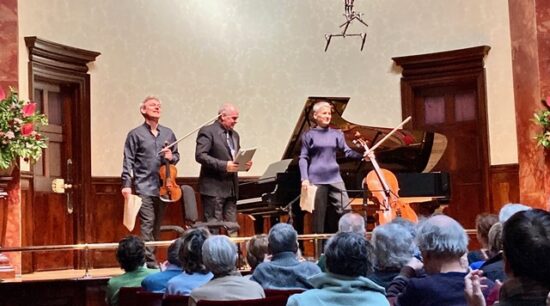
 United Kingdom Beethoven and Dvořák: Philippe Cassard (piano), Anne Gastinel (cello), David Grimal (violin). Wigmore Hall, London, 22.3.2026. (LJ)
Beethoven – Piano Trio in D major Op. 70 No. 1 ‘Ghost’ (1808)
Dvořák – Piano Trio in E minor Op. 90 ‘Dumky’ (1890-1)
Beethoven’s Piano Trio in D major, Op.70 No. 1, and Dvořák’s Piano Trio in E minor, Op.90, are perhaps better known by their respective monikers: ‘Ghost’ and ‘Dumky’. In fact, they are two of the most well-known trios of all time. Both contain instantly recognisable melodies and both flicker between light and dark. They each have moments of exquisite tenderness, lyricism, and sensitivity. Equally, they each possess a relentlessly macabre spirit. The opening of the second movement from the ‘Dumky’ (Poco adagio) even contains echoes of the second movement of the ‘Ghost’ (Largo assai ed espressivo). Hence, the decision on the part of Philippe Cassard, Anne Gastinel, and David Grimal to couple these pieces for this Sunday morning recital at the Wigmore Hall made complete sense.
Beethoven’s ‘Ghost’ Trio is a wonderfully structured piece. The melancholy atmosphere of the central movement (which is in D minor) is perfectly flanked by the two outer movements. This slow movement is where the piece gets its better-known title: ‘Ghost’. Carl Czerny wrote about this movement that it ‘resembles an appearance from the underworld. One could think not inappropriately of the first appearance of the ghost in Hamlet.’ To create this deeply atmospheric soundscape, the instrumentalists must make sense of tremolos, chromatic textures, dynamic contrasts, and silences without tipping into melodrama or sentimentality. Despite several opportunities to resolve the tension within this movement and an extensive final cadence, Beethoven resists resolution, carrying the tension into the Presto finale. In their performance of this movement, Cassard, Gastinel, and Grimal were brilliant. Cassard’s dynamic contrast worked particularly well against Gastinel’s refinement.
Admirers of the work of Nobel Prize winning author Samuel Beckett may associate Beethoven’s ‘Ghost’ Trio with Beckett’s play of the same name, which he wrote for television in the mid-1970s. The connection is as obvious as it seems, with Beckett directly using excepts from Beethoven’s second movement in his teleplay. More specifically, as I demonstrate in my book on Beckett, the author uses the music as a catalyst that connects the living with the dead, and as an auditory metaphor for a man’s inconclusive longing, perhaps for a lost love (typical of Beckett, we don’t find out). Cassard, Gastinel, and Grimal evoked this unresolved tension within the piece when playing the final three pizzicato notes much more quickly than in other performances, such as that by the Beaux Arts Trio, heard on their 1965 recording for Decca.
Dvořák’s ‘Dumky’ is named after the Slavonic ‘dumka’, a folk song with fast and slow contrasting sections. Just before leaving Bohemia, Dvořák performed this piece frequently, suggesting that (though he received Jeannette Thurber’s invitation to go to the US after he finished composing this trio) he considered it a sort of farewell piece, with subsequent works like his ‘New World’ Symphony (1893) marking a new horizon in his life and compositional style. In composing six movements, Dvořák freed himself from the constraints of the sonata form. This gives the work its brooding yet light character. As he wrote to his friend Alois Göbl in 1890, this new piece ‘would be both happy and sad’.
The difficulty when performing the ‘Dumky’ is in balancing the mournful, lamenting passages with the bright and even bouncy sections. This must be done without the juxtaposition sounding farcical or the shift between tempos becoming too abrupt. Jean-Guihen Queyras, Isabelle Faust, and Alexander Melnikov achieve this balance in their 2005 recording of the work for Harmonia Mundi. Cassard, Gastinel, and Grimal also accomplished this balancing act, even if they had a false start with Cassard restarting the piece after playing the wrong opening note. This may have flustered Cassard slightly and the trio’s performance of the Dvořák was not quite as compelling as the Beethoven due to a slight distance between the three instrumentalists’ musical intentions.
Each musician brought a unique colour to these trios by Beethoven and Dvořák. Anne Gastinel contributed a deep romanticism – a mood enhanced by her 1690 Testore cello, which has an earthy, woody sound – and sense of joy where appropriate. It was incredible to watch Gastinel create such sonority and beauty out of her characteristically economical movements. Philippe Cassard is best known for his performances of Debussy and as Natalie Dessay’s exclusive pianist. His playing, therefore, had a spontaneity and his expressivity; his left-hand during the ‘Ghost’ added much timbre and depth. Grimal is now best known for conducting Les Dissonances. He was unafraid to play at the limits of his instrument, adding a great deal of texture to the ‘Dumky’ in particular. For the audience, it felt as though the trio were exploring these two works, questioning their meanings, offering (rather than enforcing) an interpretation. During Beethoven’s ‘Ghost’ Trio this approach was especially gratifying.
Lucy Jeffery