
 United Kingdom Various: Maxim Vengerov (violin), Philharmonia Orchestra / Mark Wigglesworth (conductor). Royal Festival Hall, London, 22.3.2026. (AV-E)
Grażyna Bacewicz – Divertimento for String Orchestra (1965)
Tchaikovsky – Violin Concerto in D major (1878)
Walton – First Symphony in B-flat minor, (1935)
The renowned Maxim Vengerov substituted for Georgian-born violinist Lisa Batiashvili, who withdrew for health reasons; as had the conductor, Santtu-Matias Rouvali, replaced by the esteemed Mark Wigglesworth. Or, to quote Lady Bracknell: ‘To lose one parent, Mr. Worthing, may be regarded as a misfortune; to lose both looks like carelessness.’ Yet such double misfortune felt strangely predestined: was it a part of ‘God’s plan’ that both original artists were struck down simultaneously, simply to clear the stage for the alchemic aesthetic alignment of Wigglesworth and Vengerov?
Embarrassingly, I had never heard of the Polish composer Grażyna Bacewicz (1909–1969), whose Divertimento for Strings was composed in 1965, only a few years before her death. Under Wigglesworth’s incisive direction, the Philharmonia strings were in steely, razor-sharp form, their volant playing cutting the air with a surgical, ethereal exactness during the opening Allegro. Yet, amidst this ferocity, the movement danced delightfully with an elfistical-eloquence; the ensemble captured a stark sense of wilderness-wit, navigating the jagged rhythms with a shape-shifting sharpness.
The gravitational pull of the Adagio saw the Philharmonia strings shift into an eerie and enigmatic subterranean stratum, with that earlier wilderness-wit withering away into a sedated and secreted sensation of a subterranean subterfuge, feeling light-years away from the earlier, daredevil-darting. The strings here recalled the raw emotional power and unsettling dissonances of Penderecki’s Threnody to the Victims of Hiroshima. While Bacewicz retains a more classical structure than her younger contemporary, her string writing employed haunting, sliding tones to create a sense of profound, underlying dread — a descent into a shadowy space where every note carried the weight of her final years.
The closing Giocoso brought the strings back to the surface with a newfound, almost goblin-uncouthness in their biting accents and rustic drive. The textures here were agitated and angular, defined by a jagged, stabbing thrust that felt both primitive and meticulously calculated. Under Wigglesworth’s bastion-baton, the Philharmonia attacked the rhythmic cells with a metalic, percussive drive, reclaiming the Divertimento title with a spirited, somewhat defiant display of a ‘neo-classical’ expressionism. It was a perambulating performance that felt anciently modern, proving Bacewicz to be a timeless titan whose worldly works need to be played much more often in concert.
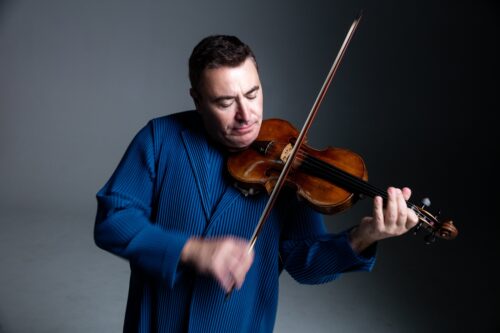
The entrance of Maxim Vengerov for Tchaikovsky’s Violin Concerto was met with a relishing hero’s welcome. Once the applause subsided, Vengerov displayed total control and a flawless command throughout all three movements. His playing was defined by a noticeably lighter touch than in years past; it was a ‘perfumed’ performance of refined, physical grace that eschewed the aggressive tension of his earlier interpretations. In its place was a luminous, sweeter tone — a silken purity that seemed to float effortlessly fleeting around and about the Philharmonia’s rich orchestral palette.
The periscopic performance was further elevated by a world-class woodwind section in flawless form. Each solo was forward-projected with immense clarity and character, poetically sculpted to mirror Vengerov’s own moulded phrasing with a breath-catching fluidity. Wigglesworth secured a deeply expressive response from the winds, ensuring their textures were never mere accompaniment but a vital, breathing part of the narrative. In the Canzonetta, the interplay between the flute, oboe, and Vengerov’s hushed violin was particularly moving — a series of delicately arched lines that created a chamber music intimacy, feeling both fragile and assured. For an encore, Vengerov treated us to the second movement of Wieniawski’s Second Violin Concerto. It was played with a relishing reserve which was alluringly intoxicating, the melody unfolding with a seductive, slow burn serenity.
The afternoon concluded with a perspicacious performance of Walton’s Symphony No.1. There is a threatening sense of dread and malice running throughout this lurid and bleak symphony, which could very well be nicknamed ‘Malice’, and far from the Barbara Cartland pulp-fiction ‘romance adventure’. In a 1977 interview with André Previn, Walton discussed the emotional core of the work in vibrant, unsentimental terms: ‘I think a lot of one’s energies match the sort of sexual energy… It’s a lot more to do with love, it’s a very strong, vibrant kind of love, it’s not a soft kind of love at all.’
In the Allegro assai, Wigglesworth perfectly projected such philosophy of love by adopting a notably broad pacing and maintaining a rather coy reserve, the opening evolution was treated as a form of symphonic foreplay. Rather than rushing toward immediate resolution, the interpretation allowed the tension to coil with a deliberate and intense pressure, mirroring a complex and unsettling love affair. This was a darker, more brooding, and more sinister, rendition than is usual for this great work; Wigglesworth’s approach was meticulously measured and exhilaratingly enlightening in its unsettling brooding, digging into the score’s more menacing moods and the painful ache of unrequited love.
The Scherzo arrived not as a reprieve, but as an anxious, frantic eruption of neurotic desire. Wigglesworth leaned into the con malizia marking with a predatory instinct, transforming the movement’s rhythmic displacement into the breathless, erratic pulse of sexual dread. This was a bedroom farce as a battlefield — a volatile cycle of pursuit and retreat where the snapping brass and biting strings felt like the sharp intake of breath before a confrontation. There was no ‘Mills & Boon’ romance here, only the kinetic, high-voltage friction of two forces trapped in a gravitational pull they can neither satisfy nor escape.
In the Andante con malinconia, this fever broke into a cold, aching sweat. The tension shifted from outward aggression to a hollowed-out yearning, a visceral portrayal of the loneliness that exists even within a claustrophobic embrace. Wigglesworth’s expansive pacing laid bare the raw nerves of this misery in music which was the ‘vibrant love’ Walton spoke of, stripped of its finery and reduced to its pulse, vibrating with the terrified realisation that such a consuming passion carries the inherent threat of total annihilation.
In the Maestoso, Wigglesworth leaned into the movement’s ‘grandiloquent’ abysmal nature, treating the sudden grandeur as a bludgeoning, iron-clad mask hammered over the psychological wounds of the previous movements. The fugal sections crackled with a febrile vivacity, yet beneath the surface brilliance, there was an underlying nervous tension that suggested a love affair being violently shackled rather than naturally resolved. It was a ‘stridently optimistic’ conclusion that possessed a bruising, predatory quality, as if the manic music was trying to outrun its own suffocating desire.
As the work reached its peak, the two timpanists played in unison strikingly mirroring the conclusion of Mahler’s Third Symphony. These closing last few seconds were extremely nerve-wracking, with Wigglesworth utilising Grand Pauses (G.P.) and caesuras to create a sense of massive, structural rupture. These breathtaking gaps gave the silence full weight, halting the music from ‘rushing onwards’ and forcing the listener to experience the ‘shattering’ impact of each subsequent chord in the final cadence. The effect was strikingly akin to the ending of Sibelius’s Fifth Symphony, famous for its isolated final chords separated by dead silence — ending without an end in sight.
(For here, in the very last bars, Walton uses fermatas — symbols that look like an eye [𝄐] placed over rests. This allows the conductor to extend the ‘silence’ beyond its written value, holding the audience in a state of suspended animation, not knowing what will happen next: and nothing ‘does’ happen next. This sense of anticipated dread was akin to Walton’s own admission to the work’s volatile and often violent ‘vibrant energy’, with those anxious gaps uncannily akin to the holding back of a sexual climax).
The warm handshake exchanged between the two timpanists just after the final blow was a fitting, human acknowledgement of two souls who had finally emerged united in spiritual bliss from a carnal collapse, marking the end of a wonderfully fulfilling afternoon of high-calibre music-making.
The packed-solid audience surrendered to a feverish, ecstatic surge, as if those final pulverising blows had finally punctured the suffocating seal of the predatory performance. It was a visceral, collective exhale — the sound of a crowd finally released from the grip of a bruising and vibrant love that had been so violently extinguished.
Alexander Verney-Elliott
P.S. It would be remiss of me not to mention the toddler in the back of the stalls who provided an intermittent, wailing obligato on and off throughout the afternoon, making it a concert ‘for all the family’.