 United States ‘US at 250’ – David Lang, the wealth of nations: Fleur Barron (mezzo-soprano), Davóne Tines (bass-baritone), New York Philharmonic Chorus, New York Philharmonic / Gustavo Dudamel (conductor). David Geffen Hall, New York, 21.3.2026. (RP)
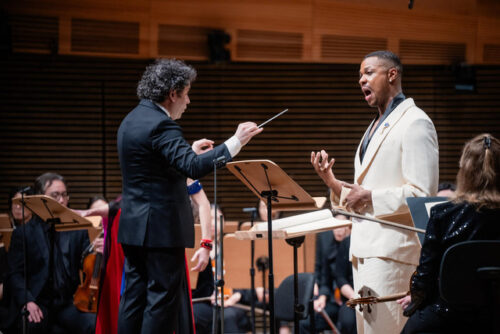
Adam Smith’s 1776 book The Wealth of Nations sparked a revolution 250 years ago. Today, many would deem it dangerously progressive. This foundational text of the American experiment inspired David Lang’s oratorio of the same name, which received its world premiere with Gustavo Dudamel conducting the New York Philharmonic, New York Philharmonic Chorus, mezzo-soprano Fleur Barron and bass-baritone Davóne Tines. The result was a powerful, moving exploration of crucial issues that still vex society.
In The Wealth of Nations, Smith argued that British trade restrictions on the American colonies were unjust and economically inefficient. His words are supplemented here with texts by Franklin Delano Roosevelt, Frederick Douglass, Ralph Waldo Emerson, Edith Wharton, Eugene Debs and Maria W. Stewart. (For PBS viewers, quotes from Smith can be heard throughout Ken Burns’s latest documentary, The American Revolution.)
The evergreen themes that fueled Lang’s imagination include the distribution of wealth, the role and importance of workers and a sovereign’s duty to protect all members of society from oppression. The first section of Lang’s the wealth of nations introduces these themes as abstract concepts through passages primarily drawn from Smith’s book. Later, the narrative becomes more direct and personal with a shift to political speeches, an extract from Edith Wharton’s novel The House of Mirth, Stewart’s rousing abolitionist speech and Debs’s defiant statement after he was convicted of violating the Sedition Act in 1918.
It is safe to assume that few have read Adam Smith, but Lang’s musical model is known to most – Handel’s Messiah. Smith was a young man living in Scotland when the oratorio premiered in 1741, so he was almost certainly aware of it. Lang suggests that if Smith had considered setting his writings to music, Messiah would have been his guide. Aside from structural similarities and the names of the opening sinfony and the musical interlude midway through, unsurprisingly titled pifa, few will recognize the connection without the program notes.
Many of Lang’s signature strokes are contained in the wealth of nations, musical and otherwise. One of the latter is his use of lowercase in titles. Musically, the oratorio is a prime example of his singular take on post-minimalism. There are the expected repetitive passages throughout, usually expanding on a single word or phrase, as well as lyrical passages, including stunning a cappella settings for the chorus. The real attention grabbers are the massive, ear-shattering musical punctuation marks that Lang employs to drive home the meaning of particular lines of text.
For such a weighty topic, Lang interjects humor and irony throughout. In the section ‘what is money’, Lang’s setting of Smith’s musing on want and need is bouncy, jarring and taunting. A more somber but equally biting setting follows, ‘that what I want’ (also by Smith), first sung by the soloists and ending with an ironic, matter-of-fact chorale-like setting of the short text, ‘give me that which I want and you shall have this which you want’.
Two of the most intense passages are the excerpts from Wharton’s The House of Mirth and Lang’s adaptation of FDR’s 1938 speech to the US Congress on curbing monopolies. The Wharton was a dialogue between Lily and Lawrence, with the chorus supplying the commentary. In assertive vocal strokes, Barron as Lily and Tines as Lawrence probed the tension between Lily’s need for the material comfort she was raised to expect and her attraction to the intellectual, carefree existence that Lawrence represents. It ended on an acerbic tone, as Tines sang that although the rich may feign oblivion to money, they breathe it as naturally as air
FDR’s words are blunt: if there are ever men rich enough to own the country, they will. Lang’s setting for mezzo-soprano solo is at times beautiful and haunting but always imbued with raw emotion. Barron’s direct, pointed delivery of the words in her rich, scintillating voice conveyed the urgency that Lang captured in the music. It was countered by meltingly beautiful passages for the strings and a particularly evocative horn solo.
The New York Philharmonic Chorus, prepared by its director, Malcom J. Merriweather, sang with rich sound and commitment. In ‘the real price of everything’, they produced a sound that was big, open and all-American, with the violins and flutes contributing a sprightly folklike tune. In the unattributed text ‘enough’, the chorus sang of a piece of bread, a coat and a place to rest one’s head being sufficient with pure, stunning simplicity. Tine’s vibrant baritone added to the poignancy with his soaring, pleading echo of the desire for such simple needs.
Lang dedicated the wealth of nations to ‘the New York Philharmonic and everyone who works there – musicians, administration, staff, crew, janitors, maintenance, ushers, catering, security. Everyone.’ They form a microcosm of the society that Lang scrutinized with such probity and imagination.
Rick Perdian
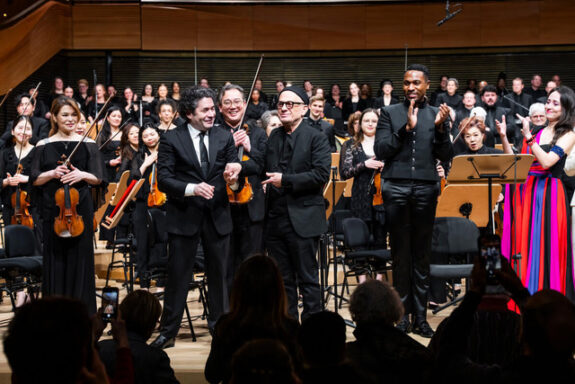
Featured Image: [front l-r] Gustavo Dudamel (conductor), David Lang (composer), Malcom J. Merriweather (Director NY Phil Chorus) and Fleur Barron (mezzo-soprano) © Chris Lee