 Germany Händel, Alcina: Soloists, Philharmonisches Orchester Regensburg / Andreas Kowalewitz (conductor). Theater Regensburg, 21.3.2026. (AB)

Today Baroque Opera is served by a wealth of specialised baroque ensembles and singers whose names dominate the international circuit. All the more remarkable, then, was the achievement of Theater Regensburg at the premiere of Alcina: what emerged here was not merely a respectable attempt of a medium-sized house at a canonical work, but a genuine triumph, vocally, musically, and theatrically, realised almost entirely with the house’s own forces. One understands immediately why Regensburg was named Opera House of the Year in 2025.
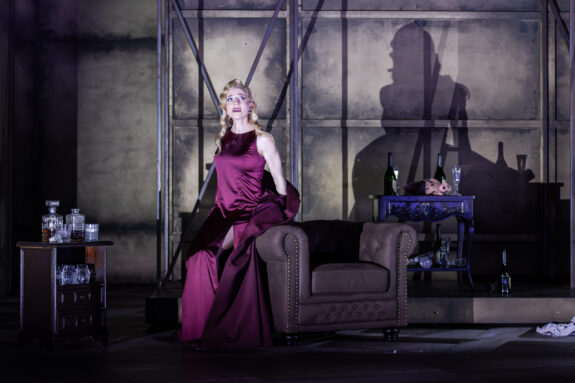
Manuel Schmitt’s staging takes a radical approach to the work. Little remains here of the enchantment and magical seductiveness usually associated with Alcina, the sorceress who lures men into her realm and, with the help of her sister Morgana, transforms discarded lovers into animals. In Regensburg, this world has been stripped of fairy-tale sheen and relocated to a sinister sex-and-gaming club where wealthy, life-weary men seek the ultimate thrill. Alcina rules over this establishment, whose members lose themselves in drugs, sex, and violence. Love has little room to survive in such a place.
Within this framework, the plot is presented with notable directness. Ruggiero has, at the beginning of the opera, checked into Alcina’s club and surrendered himself to its narcotic routines. His fiancée Bradamante, disguised as her own brother Ricciardo and aided by Melisso, arrives to rescue him from this state of dependency. Morgana, for her part, falls in love with the disguised Bradamante, provoking the jealousy of her lover Oronte. Through the resulting entanglements, Ruggiero gradually emerges from his intoxicated stupor, and he and his bride attempt to escape the destructive hold of Alcina’s world of weariness.
Schmitt, together with conductor Andreas Kowalewitz, has also intervened decisively in the score. Large cuts have been made, and the character of Oberto has been removed altogether. The result is a tauter dramatic structure in which the opera’s emotional centre shifts. Actual Love is no longer the dominant force; in its place stand lust, violence, addiction, and emotional dependency. Some in the audience may regret what is lost in terms of baroque richness and digression (and Schmitt received some boos from those), but the conceptual consistency of the result is hard to deny.
That consistency is strongly supported by the visual side of the production. Julia Katharina Berndt’s cool, austere set and Wanja Ostrower’s lighting create a bleak atmosphere of emotional frost and moral exhaustion. The stage does not attempt to visualise magic in any literal sense; instead, it proposes closed and disturbing social spaces in which all human relations are transactional, exploitative, or damaged. The production’s effect is therefore very different from that of Handel’s opera as traditionally understood. This is no longer a Zauberoper (magic opera) leading towards catharsis and renewal.
The final scenes make that particularly clear. Alcina is shot, Ruggiero returns to the club, and there is no sense of release. The most radical cut of all is the omission of the jubilant final chorus and ballet. Regensburg’s version ends instead in the orchestral minor chords of the Entrée.
Musically, the evening proved extremely successful as well. Kowalewitz has an unerring sense for the effect of smaller forces and guided the performance with intelligence and theatrical instinct. Under his direction, the orchestra developed a pleasingly slender yet colourful sound, one that evoked baroque style without pretending to a doctrinaire historical authenticity and without denying the modern instruments from which it was produced. The playing had clarity, rhythmic alertness, and welcome transparency. Particularly charming was the accompaniment of Melisso’s recitatives with portative organ.
The singing was excellent throughout, and particularly distinguished in the central roles. Kirsten Labonte gave Alcina both authority and vulnerability, shaping the role with vocal amplitude and emotional focus. She did not present a merely decorative enchantress, but a woman whose power is inseparable from fragility, and whose collapse becomes the staging’s emotional centre. Rahel Brede’s Ruggiero was equally convincing, sung with assurance, expressive intelligence, and a strong sense of the character’s progression from intoxicated submission to painful awakening.
Scarlett Brede, as Morgana, brought brightness, volatility, and charm to the stage. Her performance captured both the role’s flirtatious energy and the hurt beneath it. Polina Artsis, the only guest among the principal cast, fully justified her presence: her Bradamante had firmness, dramatic impetus, and vocal brilliance, particularly in the more confrontational passages. Konstantin Igl gave Oronte a sharply profiled presence, while Jonas Atwood’s Melisso offered steadiness and warmth.
What made the evening memorable, though, was not any single interpretative intervention, but the very high level at which the whole production was sustained. The distinction of this Alcina lay in the fact that a smaller German opera house could realise such a vocally wonderful, musically thoughtful, and theatrically coherent Handel performance almost entirely from within its own ensemble and orchestra. That is the real magic of this Alcina. And it is more than powerful enough to outlast any number of missing stage spells, and the strongest possible argument that Regensburg’s promotion to Staatstheater from next season is entirely deserved.
Andreas Bücker
Featured Image: Kirsten Labonte (Alcina) © Sylvain Guillot
Production:
Direction – Manuel Schmitt
Set designs & Costumes – Julia Katharina Berndt
Lighting – Wanja Ostrower
Dramaturgy – Ronny Scholz
Cast:
Alcina – Kirsten Labonte
Ruggiero – Rahel Brede
Morgana – Scarlet Pulwey
Bradamante – Polina Artsis
Oronte – Konstantin Igl
Melisso – Jonas Atwood