
 United Kingdom Haydn: Aylen Pritchin and Tim Crawford (violins), Iris Juda (viola), David Waterman (cello), Ruth Padel (poet), Wigmore Hall, London, 3.4.2026. (AK)
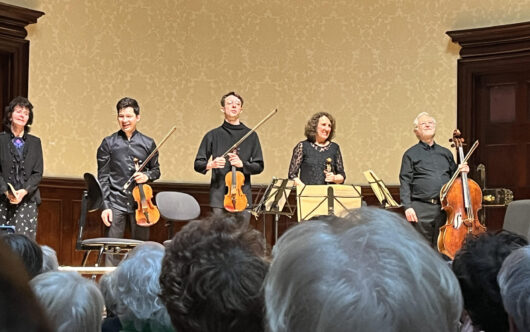
Haydn – Die Sieben letzten Worte unseres Erlösers am Kreuze (The Seven Last Words of Our Saviour on the Cross) Op.51 arrangement for string quartet (1787)
Cellist David Waterman organised a beautiful and chronologically most appropriate concert by presenting Haydn’s Seven Last Words with poems recited between Haydn’s movements.
This year the first and second day of the Jewish Passover, celebrating Jewish freedom from Egyptian slavery some five thousand years ago, fell on Thursday 2nd April and Friday 3rd April respectively while the solemn Christian Good Friday holiday commemorating Jesus’s crucifixion some two thousand years ago also fell on 3rd April.
I attended both Passover celebrations closely followed by this Good Friday concert, giving me the opportunity to intensely feel and deeply consider cruelty, fight for freedom as well as salvation in past and present times.
Commissioned by the Cadiz cathedral for Good Friday services, Haydn originally composed his Seven Last Words for orchestra (1786) but later recomposed it for keyboard (1787) for string quartet (1787), and finally in an oratorio form for soli, choir, and orchestra (1796).
Without doubt (to my mind), the intimate form of the string quartet expresses best Haydn’s response to the seven sentences drawn from the Gospel. Supposedly deeply religious, Haydn seems to accept the pain of the story with peace and serenity, giving the first violin seven beautiful slow-movement declarations.
At our concert, first violinist Aylen Pritchin delivered the story with utmost discipline, without any sentimentality and with unforced tone. His beautiful cantabile playing did full credit to the story and Haydn. Pritchin had the ultimate support in second violinist Tim Crawford whose sensitivity to his role was second to none. Crawford accompanied the first violin’s cantilena story telling as if he was one and the same with the solo violinist although simultaneously playing different notes. Strong support also came from the lower strings. David Waterman’s rock solid and discreet command on his beautiful cello gave much pleasure to my ex-cellist ears.
The problem (for me) came with the poetry reciting between Haydn’s seven slow movements. Most probably they were beautiful poems with highly appropriate poetic texts. Unfortunately, Ruth Patel was miked, causing some echo interference or similar. I only heard some words but almost never a full sentence. My guest to my left and a lady to my right told me that they too could not hear the text.
The extensive programme notes were written by Ruth Patel who clearly put much thoughts into the programme and into selecting the poems for the occasion. However, nowhere does she specify the titles of her poems although she clarifies that she ends each of the poems with the sentence which is followed by the respective Haydn movement. Wonderful idea but only if one can hear both text and music.
We are told that the poems read between the Haydn movements come from the sequence ‘Seven Words and an Earthquake’ from Patel’s poetry collection Learning to Make an Oud in Nazareth (2014). Usually, we get song texts provided in song recitals; I wish we would have had the Patel poems printed in our programme notes. Or at least their titles (or first lines), as we were given the titles of each Haydn movement.
Introduzione
Sonata I Pater, dimitte illis, quia nesciunt, quid faciunt
Sonata II Hodie mecum eris in Paradiso
Sonata III Mulier, ecce filius tuus
Sonata IV Deus meus, Deus meus, ut quid dereliquisti me?
Sonata V Sitio
Sonata VI Consummatum est
Sonata VII In manus tuas, Domine, commendo spiritum meum
Il Terremoto
Final impression? A beautiful, spellbinding concert with a very disciplined and fully focused audience. The largely inaudible poetry reading between movements gave me time for reflection on Passover, Good Friday, wars in past and present and personal resolutions. I am very glad I attended! Even in retrospect, I would have not liked to be anywhere else on this Good Friday afternoon.
Agnes Kory