
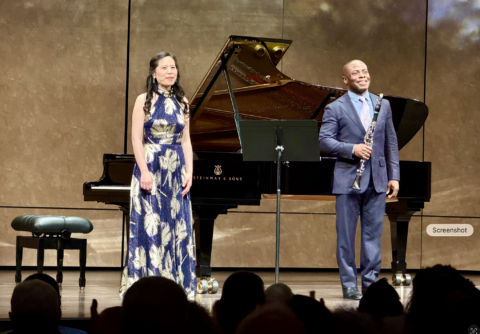
 United States Various: Anthony McGill (clarinet), Gloria Chien (piano). San Francisco Performances, Herbst Theatre, San Francisco, 3.4.2026. (HS)
Debussy – Première Rhapsodie
Messager – Solo de concours
Saint-Saëns – Sonata in E-flat major for Clarinet and Piano
R. Schumann – Fantasiestücke, Op.73
Brahms – Clarinet Sonata No.2 in E-flat major
Encore: Price – Adoration
Many clarinet soloists can execute almost anything the instrument is asked to do. Anthony McGill stands out among clarinet virtuosos for complete command of tonal colors, subtle shading of dynamics and a superior musician’s ability to shape it all into something delectable.
Those attributes were abundant in his recital with pianist Gloria Chien of works by Romantic-era French and German composers. McGill, principal clarinet of the New York Philharmonic, reveled in all aspects of music by Debussy, Messager, Saint-Saëns, Robert Schumann and Brahms. Chien, a busy musician who also serves as artistic director of several chamber music festivals, has collaborated with McGill for almost two decades.
The partnership paid big dividends in the way they breathed the music as one. Every phrase had a purpose, and rhythms surged and ebbed just enough to lift the music to a higher plane. It was glorious to just sit back and let the sound carry away an unusually rapt audience.
They opened with Debussy’s deceptively approachable Première Rhapsodie, eight minutes of gauzy harmonies, liquid clarinet melodies and sudden explosions of notes that bubble up with uncanny naturalness. Written in 1909 as a test piece for young clarinetists at the Paris Conservatory concours (competitive exams), it can expose a player’s ability to sing sweetly and turn abruptly into the technical challenges of rapid-fire phrases. McGill made it feel refreshingly easy although every clarinetist in the audience no doubt tensed in anticipation of each spin.
Another piece written for the conservatory’s concours, this one by André Messager in 1899, was also designed to test a player’s ability to execute and communicate challenging clarinet music though not quite as distinctively as Debussy’s. McGill delivered it with the same charm that he and Chien achieved in their 2010 recording.
These test pieces made for a natural transition to Saint-Saëns’s Sonata in E-flat major for Clarinet and Piano. Part of a set of three sonatas for woodwind instruments, written in 1921 shortly before the composer’s death, the sonata squeezes in a mini-tour (about 15 minutes) of what clarinets do best. McGill relished the contrast in the opening Allegretto between the skipping lyrical theme and the bursts of virtuosic writing in the development that followed. That carried over to the brief second movement, a scherzo that bounced along with glee. Even better was the somber Lento, which showed off the rich sound of the clarinet’s lower register against Chien’s ability to make the bass end of the piano sound clearly and transparently. It created a wonderful sonority until the music continued in both instruments’ highest register and sunniness produced a totally different glow. The finale, full of rapid runs, never devolved into show-off music until it emphasized the joyfulness of the slam-bang finish.
In its brief three movements, Robert Schumann’s Fantasiestücke seemed to foreshadow the more expansive sonata by Brahms which followed. Somehow, McGill and Chien found sonorities that felt, well, Brahmsian, especially in the slow-paced first movement. Lyrical passages sang with a bittersweet cast throughout the piece.
Brahms’s Clarinet Sonata No.2 in E-flat major is one of the hallmarks of clarinet literature and the centerpiece of McGill’s and Chien’s 2021 album, Here With You. Chien’s ability to find clarity and transparency in the Brahms harmonies (which can get stuffy in other pianists’ hands) brought an incandescence to the proceedings that allowed McGill to soar with the rounded melodies. Like the Saint-Saëns piece, this sonata for clarinet was among Brahms’s last works, written in 1894 for a clarinetist he had met when his Symphony No.4 premiered in 1891.
It is a warm piece, especially the opening Allegro amabile, in which McGill lavished some of his richest tone on the long melodies. The contrast in dynamics with the ultra-quiet second theme brought out twilight colors. The contrast between the energetic beginning of the Allegro appassionato movement and its sotto voce second theme made for a breathtaking moment. The Andante con moto set up a big finish with four impeccably executed lyrical variations before a final rush to a lively coda.
The encore, McGill’s arrangement of Adoration by Florence Price, glowed with simplicity and serenity. Written for organ, the piece, especially in arrangements for strings, has become a favorite of the African-American mid-20th-century composer’s works. In McGill’s hands, it felt like a quietly sonorous balm.
Harvey Steiman