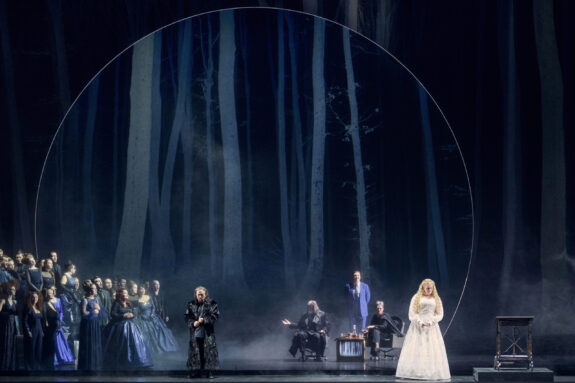
 Germany 2026 Baden-Baden Easter Festival – Wagner, Lohengrin: Soloists; Czech Philharmonic Choir of Brno, Vienna Philharmonia Chorus, Mahler Chamber Orchestra / Joanna Mallwitz (conductor). Festspielhaus Baden-Baden, 31.3.2026. (DM-D)
On the first sound of the Prelude, a white light framing the stage brightened up. In line with the crescendo, tree trunks were projected on to a scrim at the ramp. A circular structure gradually emerged, and a body crouching on the floor in the middle of the stage became visible. The circular structure was revealed as a kind of tunnel. In the course of the Prelude, the projection was dimmed, the white frame brightened and dimmed to darkness at its end.
When the projection screen rose, the Brabantians were assembled on the stage. Fanfares from the sides of the orchestra pit introduced the arrival of the King, dressed in a regal robe, while the Herald wore a contemporary blue business suit. Elsa, in a white dress, entered from stage right on being summoned. Lohengrin arrived on a disc emerging from the circular tube structure seen at the start. Fairy tale lighting was projected onto the disc, in stark contrast to Lohengrin dressed all in white. For the battle episode, Gottfried stuck a sword into the disc’s surface, reminiscent of Wotan leaving the sword in the ash tree. Telramund was unable to pull it out, Lohengrin did so with ease, and with that he had won.
For the second act, the basic structure of the set remained the same. The whereabouts of Telramund and Ortrud were signified by a large double bed, revolving and lit differently to reveal Elsa in her abode. For the joint approach to the wedding, Elsa and Lohengrin came from the illuminated disc in the background. For Telramund and Ortrud’s temptations, the projection onto the backdrop ceased, only to reappear in the form of the iris of an eye projected onto the disc for the wedding ceremony, carried out by the King. At the end of Act II, Lohengrin and Elsa walked into the bright light of the disc, looking back over their shoulders at Ortrud who stood looming ominously in the foreground as the orchestra played the temptation motif.
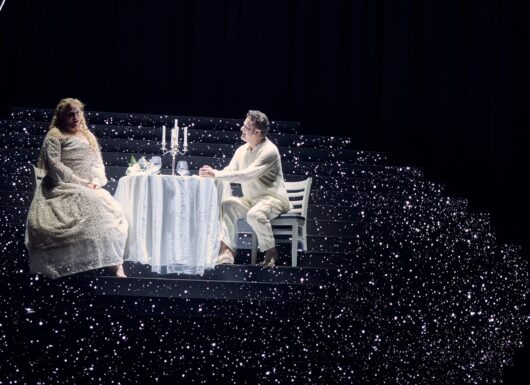
For the third act, the ladies of the Bridal Chorus wore black or blue evening gowns. While singing the famous ‘Traulich geführt’, they stood in near darkness at the back of the stage. The bridal chamber was an arrangement of table and chairs on the disc, which appeared to be floating at an angle in mid-air. Its floor glistened and sparkled. Telramund appeared from the right, Ortrud from the left to attack Lohengrin once Elsa had asked the forbidden question. Lohengrin killed Telramund by raising his right arm, causing an instant flash of lightning projected onto the screen behind and surrounding the disc.
For the transition to the final scene, the production revealed the stage hands shifting the set components – the fairy tale impression of the visual aspect of the production was thus momentarily lost, only to be restored, but with a different impact, as soon as the Brabantians had gathered and the King launched his ‘Habt Dank’. For Lohengrin’s farewell to Elsa they were on the stage on their own with a curtain lowered to hide the others. Lohengrin left the stage toward the wings and sang his final lines from the balcony. Gottfried was then discovered waking up on the bed that had already featured in Act II.
I have described many of the abundant visual impressions of this production, because they were so memorable, poignant and intriguing. The design team created true magic on the stage. ARTE was to broadcast the production in due course, and I wonder whether the images on screen would come across as vividly as in the theatre. For me it was not necessary to translate the impressions into an intellectually comprehensible linear narrative.
The music matched the production, insofar as director Johannes Erath’s attention to detail was reflected in the way conductor Joanna Mallwitz approached the score, and Piotr Beczała finely chiselled every sound of his singing. (Erath is a former assistant to Willy Decker.) In Mallwitz’s reading, every bar of the score came across as carefully shaped and moulded, leaving nothing to chance or momentary inspiration. Many unexpected moments resulted from this methodical approach. Volumes were well-balanced in line with the singers’ individual needs and vocal abilities, ranging from gentle accompaniment to joint celebration of full throttle singing and orchestral music, both for moments of highly passionate drama as well as equally gripping emotional turmoil. Beczała’s Lohengrin was a master class in vocal technique at the highest level from beginning to end. Every moment of sound was placed, developed and executed with utmost attention and mindfulness, down to increasing or decreasing baritonal heft on individual notes, with full ongoing awareness and expression of wider and wider arcs of melodic lines.
In some productions of Lohengrin, the Elsa is sung by a soprano on the cusp of her development towards lighter, lyrical Wagner roles. On this occasion, with Rachel Willis-Sørensen, we had a singer with many heavier roles in her repertory. This brought particular vocal richness to her Elsa, where the art was often found in her holding back where others need to push their voices, and enriching her portrayal of the role with an abundance of supple, rich and voluminous sound produced with complete beauty and ease.
Veteran baritone Wolfgang Koch contributed a sturdy and very musical Telramund, Tanja Ariane Baumgartner gave her all as Ortrud, taking her voice to its limits in the process, without shifting to a position that an ugly character cannot sing beautifully. Stalwart Wagnerian bass Kwangchul Youn added yet another distinguished portrayal of King Henry to his impressive CV; Samuel Hasselhorn as the King’s Herald suggested that he will have a strong career ahead, with the larger Wagner roles suited to his powerful baritone.
Daniel Meyer-Dinkgräfe
Featured Image: 2026 Baden-Baden Easter Festival’s Lohengrin © Martin Sigmund
Production:
Director – Johannes Erath
Stage design – Herbert Murauer
Costume design – Gesine Völlm
Lighting design – Joachim Klein
Video – Bibi Abel
Chorus directors – Petr Fiala, Eduard Kostelnik, Miriam Zuziaková (Czech Philharmonic Choir of Brno). Walter Zeh, Thomas Böttcher (Vienna Philharmonia Chorus)
Cast:
Heinrich der Vogler – Kwangchul Youn
Lohengrin – Piotr Beczała
Elsa von Brabant – Rachel Willis-Sørensen
Friedrich von Telramund – Wolfgang Koch
Ortrud – Tanja Ariane Baumgartner
The King’s Herald – Samuel Hasselhorn
Four Brabantine Nobles – Jan Kožnar, Vladislav Agamuradov, Filip Novotny, Václav Jeřábek (soloists of Tschechischer Philharmonischer Chor Brünn)
Four Bridesmaids – Lisa Barletta, Orsolya Gheorghita, Rotraut Geringer, Barbara Egger (soloists of Vienna Philharmonia Chorus)