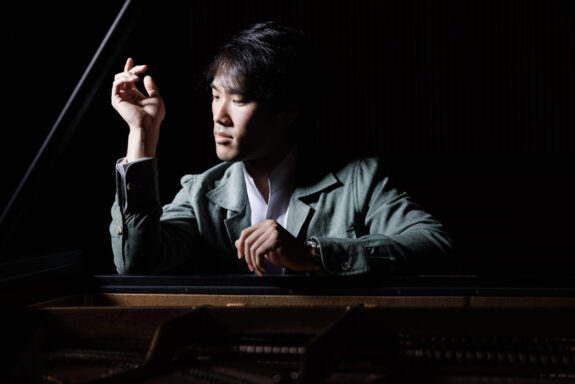
 United Kingdom Britten, Ravel, Tchaikovsky: Bruce Liu (piano), Philharmonia Orchestra / Ryan Bancroft (conductor). Royal Festival Hall, London, 12.4.2026. (AV-E)
Britten – Four Sea Interludes from Peter Grimes (1945)
Ravel – Piano Concerto in G (1929-1931)
Tchaikovsky – Symphony No.5 in E minor (1888)
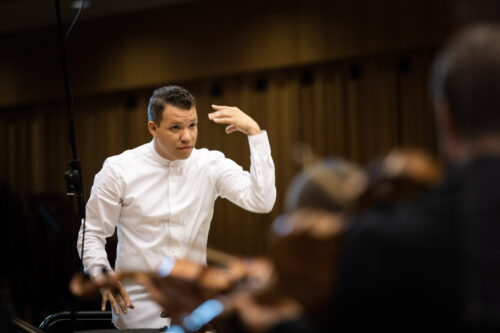
Ryan Bancroft and the Philharmonia Orchestra began their Sunday afternoon concert with Benjamin Britten’s Four Sea Interludes. Bancroft appeared entirely in his aqueous element, alighting with a fluid, wave-like authority that immediately anchored the Philharmonia to Britten’s salt-sprayed world.
In ‘Dawn’, high violins and fluorescent flutes were hauntingly harrowing, while strings sliced with the clinical lethality of a Gillette razor blade cutting through air into sea. This shipwrecked sharpness stood in stark relief against heaving brass swells capturing the Sea’s brooding benevolence, while ‘Sunday Morning’ gloriously glittered with a buoyant bell-tolling chime.
The ‘Moonlight’ interlude arrived as a static suspension, held firm in a state of lunar liquidity that felt both vitreous and viscous. Bancroft tempered the Philharmonia into a glacial cavern, where whimpering woodwind chords hung like suspended ice-shards — frozen-firm and dagger-sharp.
In the terrifyingly turbulent ‘Storm’, Bancroft steered the Philharmonia through a seething surge of spray and spume, projecting a pulsating and perturbing power without ever capsizing into brutish bombast. In these symphonic seascapes alone, Bancroft proved himself a master of the score’s treacherous tides and colliding currents in nautically navigating this soaking score.
As a global luminary, Bruce Liu has established himself as an incandescent interpreter of Ravel’s Concerto in G. From the very first whip-crack opening that ignited the Allegramente, Liu’s playing was an iridescent incantation of light-infused magic, projecting marked maturity, noetic nuance, and a subtle sophistry. He was sprightly whilst suave, agile yet athletic; indeed, such was the limpidity of liminal Liu’s touch that the work frequently transcended its form, emerging almost as a Triple Concerto for Piano, Trumpet, and Harp. Jonathan Holland’s jazzy trumpet, played with a ‘blues’ inflection, and the crystalline presence of Heidi Krutzen’s harmonised harp were so commandingly etched that they became Liu’s partners in a sophisticated, three-way conversation of equals.
Indeed, the work’s unique invention is that the wind, brass, harp, and percussion were all soloists in their own right. The Adagio assai hung on a luminous line of melody melting into time long lost, supported by a silken orchestral tapestry, before the Presto finale arrived as a technical tour de force.
Merin Rhyd’s trombone added drunk ‘donkey bray’ glissandos to a breathless race that left the hall hypnotised. This was a ‘desert island’ account of evanescent elegance. It is profoundly depressing that such pure perfection was not captured for posterity, as it rivalled and surpassed so many other recordings of this wondrous work.
Liquescent Liu’s encore, Debussy’s Rêverie, was met with a sedated, secular silence; it possessed an eerie evanescence of vivacious vertigo, as if the haunted, hushed hall were being slowly submerged in a lavender liquid of ambushed amnesia-ambulation.
Bancroft’s reading of the Tchaikovsky Fifth Symphony was rather a mixed bag of curate’s cracked eggs. The opening Andante seemed too slack and ponderous, with unnecessarily long pauses between the initial phrases of the ‘Fate’ theme. Rather than a haunting introduction, the low-register clarinets felt static and breathless, as if the music were stuttering rather than flowing. By stretching the space between the dark string chords and the woodwind responses to the breaking point, the conductor sacrificed the ominous forward-motion that should lead us into the Allegro con anima, leaving the movement’s foundations feeling brittle and insecure.
In the Andante cantabile, the haunting horn solo — played with a golden, flawless tone — anchored a movement of immense romantic warmth. However, the unfolding forward momentum was abruptly sabotaged following a massive brass climax where Bancroft enforced an elongated ‘Grand Pause’. This was a ‘mind the gap’ moment — a five-second pause that extinguished the music’s glowing embers at peak intensity, leaving the audience in a state of nervous anticipation: had the symphony already ended?
Depressingly, the finale returned to inconsistency, its structural arc undermined by underpowered timpani. This was evident from the very start of the Andante maestoso; the great rolls that anchor the brass fanfares should culminate in fortissimo accented strokes, yet here they were barely audible. These timpani ‘thuds’ are vital structural anchors intended to provide the movement’s triumphant heartbeat, but their absence left the introduction sounding hollow and too soft-core and safe.
This pathetic lack of attack persisted into the transition following the stately E major statement of the ‘Fate’ theme; this moment demanded an earth-shattering timpani roll to ignite the Allegro vivace, yet the timpanist was effete and anaemic, robbing the movement of its essential, volcanic forward-thrust.
This lack of weight continued through to the martial timpani march toward the end — a defiant, driving solo pulse that should have mirrored the loud, hard strokes heard in Yuri Temirkanov’s recording with the St Petersburg Philharmonic on RCA. Instead, these timorous timpani strokes lacked a hard-edged strike, failing to anchor the orchestra for the home stretch.
The closing coda was similarly sabotaged by an excessively broad tempo; as the orchestra reached those iconic ‘da-da-da-da’ chords, the pacing slowed to a crawl. That was a cruel interpretive choice which negated all the preceding sweat and struggle, only to arrive at a stuttering, anti-climactic finish. Despite this turgid end, a deluge of drenched adulation erupted from a delighted audience.
As a young conductor, Bancroft has the time to outgrow these wilful mannerisms — the kind of self-indulgent distortions that marred Leonard Bernstein’s 1988 Tanglewood performance of Tchaikovsky’s Fifth.
Alexander Verney-Elliott
Featured Image: Pianist Bruce Liu Bartek Barczyk
Could someone please tell Mr Verney-Elliott that writing a review is not a challenge to stuff in as many examples of alliteration as possible. It reads as if the only virtuosity he wants us to be aware of is his own.
Difficult to know what to say. Speaking as a musician this isn’t music criticism, its a display of verbose purple prose.
Jim for S&H: I’m sure AV-E could come up with some suitable purple prose to answer this himself if he wanted to but I would like to know what the rules of ‘music criticism’ are because surely it is a highly subjective endeavour? Perhaps technical expertise is easier to agree on but why should two and more people hear music in the same way and then adequately put that experience into words. Without any significant music education in what I write I hide behind the defence that ‘a musicologist can read music but not necessarily hear it’. (I would have liked to debate that privately with Graham D had an email been supplied.)