
 United States Various: Seong-Jin Cho (piano). Stern Auditorium, Carnegie Hall, New York, 12.4.2026. (ES-S)
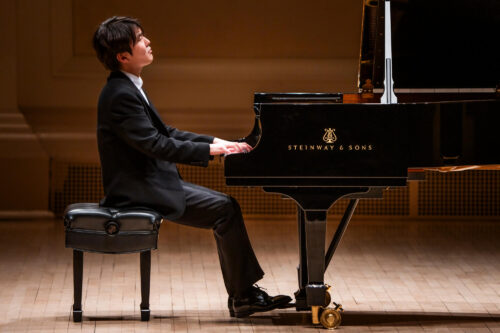
Seong-Jin Cho presented a program at Carnegie Hall whose coherence took shape not so much from stylistic unity as from sustained engagement with inherited forms. Across Bach, Schoenberg, Robert Schumann and Chopin, the recital traced how structures rooted in dance and gesture can be preserved, reinterpreted or progressively transformed.
The opening Partita No.1 in B-flat major by Johann Sebastian Bach established a framework defined by clarity and proportion. Each movement retained a distinct character without becoming isolated, in a reading that dispensed with pedaling and sharpened the contours. The Prelude proceeded with quiet exploratory poise, its voices carefully balanced, while in the Allemande and Courante articulation defined continuity more decisively than tempo. The Sarabande unfolded with restraint, allowing its melodic line to expand against a spare harmonic ground, and the Gigue emphasized contrapuntal interplay, its energy grounded in structural elegance.
Nearly two centuries later, Arnold Schoenberg approached similar formal models from a markedly different perspective. What connects this music to Bach is not surface resemblance but a shared concern with proportion, refracted through a different expressive lens. In the Suite Op.25, the Baroque model remained intact, its internal logic recast in a language in which tonal reference points were largely suspended. Seong-Jin Cho articulated this structure with finely controlled strands, even as the musical surface appeared more fragmented. Rhythmic profiles could be abrupt, even angular, yet under his hands they retained an underlying design, as if the dance forms persisted in altered guise. Moments of delicacy, particularly in the upper registers, reappeared with a finely calibrated touch, while more forceful passages emphasized contrast without abandoning discipline. Tonal references surfaced only intermittently, like faint, half-formed traces in the early abstract works of Wassily Kandinsky, with whom Schoenberg had shared a close artistic dialogue earlier in his career.
Composed roughly midway between the works by Bach and Schoenberg that framed it on the program, Schumann’s Faschingsschwank aus Wien brought a more overtly theatrical dimension. Cho maintained clear direction in the opening movement, sustaining propulsion without excess weight and articulating its episodic, quasi-rondo structure with precision, its recurring material returning with a lightness that avoided insistence. The Romanze turned inward, its lyricism refined through subtle inflection, while the central movements introduced a more mercurial character, balancing volatility with control. At the core, the Intermezzo deepened the expressive range without disrupting the work’s overall coherence, its intensity held within a carefully measured design. By the final Allegro, virtuosity emerged under his hands not as display but as the cumulative result of the work’s shifting expressive states.
The second half, devoted to fourteen waltzes by Frédéric Chopin, followed an order devised by Seong-Jin Cho himself, drawing on the central body of the composer’s output in the genre while leaving aside several early and comparatively slight works to focus on those in which he most fully reimagines the form. Neither chronological nor organized around tonal contrast, the sequence also included subtle adjustments to customary dynamics and moved forward mostly attacca, punctuated by occasional, meaningful pauses. It functioned not as a succession of discrete pieces but as a field of transformation, in which differences of character and texture came gradually into focus with no sharp delineation. Across the whole, one state evolved into another; faster waltzes settled into slower ones, their energy retained and redirected. Repetition became a vehicle for variation, each return inflected differently in touch, timing, ornamentation or emphasis.
Cho’s exploration took its point of departure in the relative simplicity of the early E minor Waltz, Op. posth. Two waltzes of greater brilliance followed – Op.34 No.3 and Op.64, No.1 – projecting outward energy before a succession of more inward-leaning pieces, including Op.69 and Op.70, preparing the turn toward the A minor Waltz, marking a more explicit point of introspection. Heard in the middle of the cycle, it assumed the role of a fulcrum, its restraint gathering and concentrating what had previously been in motion. From there, moments of illumination acquired heightened definition. In the B minor Waltz, the pianissimo shift to B major registered as a sudden clearing of space, its radiance prepared not through contrast but through accumulation. Placed at the close, the ‘Grande valse brillante’ in E-flat major did not function as display in any conventional sense, its brilliance refracted through the transformations that preceded it and seeming more held in reserve than projected.
The encore, the Nocturne Op.9, No.2, offered a final change of perspective. Freed from the constraints of dance, the melodic line unfolded in sustained continuity, shaped with quiet control. In this context, it functioned less as an addition than as a quiet extension of the recital’s central concern: the transformation of musical gesture into something more inward.
If Paul Verlaine placed music before all things, Cho’s playing suggested a quiet paraphrase: de la mesure avant toute chose.
Edward Sava-Segal
J. S. Bach – Partita No.1 in B-flat major, BWV825
Schoenberg – Suite for Piano, Op.25
R. Schumann – Faschingsschwank aus Wien, Op.26
Chopin – Waltz in E minor, Op. posth.; Waltz in F major, Op.34, No.3; Waltz in D-flat major, Op.64, No.1, ‘Minute’; Waltz in A-flat major, Op.69, No.1; Waltz in C-sharp minor, Op.64, No.2; Waltz in G-flat major, Op.70, No.1; Waltz in B minor, Op.69, No.2; Waltz in A minor, Op.34, No.2; Waltz in A-flat major, Op.64, No.3; Waltz in F minor, Op.70, No.2; Waltz in D-flat major, Op.70, No.3; Waltz in A-flat major, Op.42; Waltz in A-flat major, Op.34, No.1; ‘Grand valse brillante’ in E-flat major, Op.18
Encores: Chopin – Nocturne Op.09, No.2 in E-flat major; Alfred Grünfeld – ‘Soirée de Vienne’, Op.56