
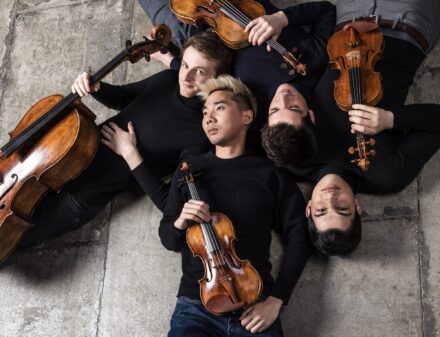
 United Kingdom Haydn, Tchaikovsky: Quatuor Arod (Julien Szulman, Alexande Vu [violins], Tanguy Parisot [viola], Jérémy Garbarg [cello]). Wigmore Hall, London 13.4.2026. (CSa)
Haydn – String Quartet in G, Op.76 No.1
Tchaikovsky – String Quartet No.1 in D, Op.11
It has been a remarkable journey for Quatuor Arod, founded in 2013 by four music students at the Conservatoire de Paris. In the space of 13 years this still-youthful ensemble has achieved global status and unstinting critical acclaim – winning several international competitions, performing in some of the world’s greatest concert halls and securing a recording contract with Erato/Warner Classics on the way. Fans of J.R.R. Tolkien’s The Lord of the Ring will immediately recognise ‘Arod’, the group’s adopted moniker, as the mythical horse who carried Legolas across Middle-Earth, and now a famous literary symbol for partnership, elegance, and grace. These qualities, allied with muscular control, sinewy articulation and a lustrous glossy tone were fully evident in the quartet’s lunchtime Wigmore Hall recital and fully justified the choice of name.
The one-hour programme comprised two pieces: Haydn’s bright, witty and classically structured String Quartet in G, Op.76 No.1, and Tchaikovsky’s expansive and expressively Romantic Quartet No.1 in D, Op.11. Although sitting at opposite ends of the stylistic and emotional musical spectrum, both works were linked by a common theme: the desire by their composers to create works which were truly original.
The Quartet in G was one of six be published in 1799. Nicknamed ‘Jack in-a-box’ it represents late Haydn at his most joyful and startlingly original. Professor Philip Ross Bullock, in his illuminating programme note, cites Haydn’s friend and diarist Charles Burney who noted the set’s ‘invention, fire and good taste’. Burney also claimed that he ‘had never received more pleasure from instrumental music’. This doubtless held true for many in the audience. From the first striking chords of the introductory Allegro con spirito, where translucently textured playing began a perfectly balanced musical conversation, to the final bars of the last movement, the playing was consistently superb. A solemn and perfectly modulated account of the prayer-like Adagio, particularly a heartrending exchange between Julien Szulman’s violin and Jérémy Garburg’s cello, reminded one of the contemplative harmonic shifts found in the late quartets of Haydn’s pupil, Beethoven. Such moments made the playfully pithy and brilliantly dispatched Menuetto. Presto the more exhilarating. The finale, a gracious yet humorous Allegro in which the quartet’s technical skills simplified the music’s complexities, was given an elegant reading and ended with a moment of delicate wit.
The lightly hidden emotional depths of late Haydn gave way to a highly charged performance of Tchaikovsky’s String Quartet No.1 in D. Ross Bullock reminds us of an occasion in December 1876 when the composer, listening to the Andante cantabile of this work in the company of Leo Tolstoy, witnessed the great Russian novelist burst into tears. Not the only one! Open weeping was hard to supress on listening to the Arod’s deeply affecting account of the second movement, such was its immediacy and the ensemble’s connection to the audience. The work’s outer movements too, were wonderfully realised. The opening Moderato e semplice was lush and velvet smooth, and the Scherzo buoyant and energetic, while the rhythmic dance of the Finale was a tightly and cohesively driven surge of energy. Quatuor Arod may not quite have rivalled the wizardry of Legolas or the prowess of his legendary steed, but their sure-footed playing and enchanting musical finesse cast a magic of their own.
Chris Sallon