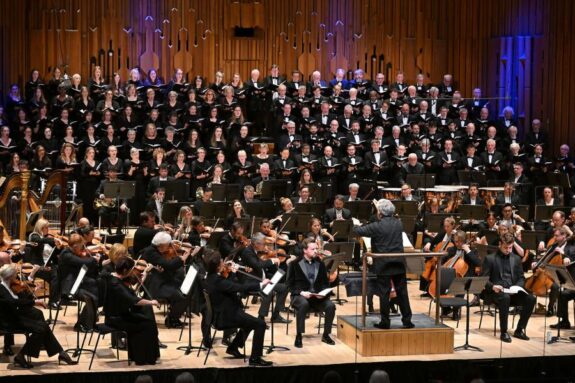
 United Kingdom Elgar, The Dream of Gerontius: Emily D’Angelo (mezzo-soprano), David Butt Philip (tenor), William Thomas (bass), London Symphony Chorus (chorus director: Mariana Rosas), London Symphony Orchestra / Sir Antonio Pappano (conductor). Barbican Hall, London, 21.4.2026. (JR)

In a pre-concert interview Sir Antonio Pappano said he had always dreamt of conducting Elgar’s choral masterpiece (Stephen Johnson in the programme note called the work, with good reason, a ‘national monument’) and Pappano was thrilled that his dream was now coming true. He was able to assemble a veritable dream team of soloists, backed up by the superb forces of the London Symphony Chorus and Orchestra.
Let me start with the splendid soloists. Canadian mezzo-soprano Emily D’Angelo (what a fitting name!) sang the part of the Angel; her rich deep mezzo fitted the part to perfection and more than once brought to mind Janet Baker on the revered 1975 Boult recording. Gloriously rich in her lower register, she was also able to soar thrillingly into her ‘Alleluias’. (I need to add how she looked the part too in a flowing white gown, brought right up-to-date with, possibly incongruous, black Doc Martens boots.) D’Angelo has sung leading roles at Covent Garden and in Vienna, and in both Mahler’s Second and Third Symphonies. In May she sings Octavian in Der Rosenkavalier at the Baden-Baden Festival.
David Butt Philip sang the role of Gerontius to perfection. Ailing in voice when close to death, but strong of voice when defiant (‘I will address him, Mighty One my Lord’), his vocal stamina was unfailing, particularly with ‘Sanctus fortis’ and ‘Take me away’ as he is led away from his briefest of glimpses of the Almighty (we can only guess at what he actually sees). Butt Philip has sung Siegmund at La Scala, Florestan in Vienna and the Met. Elgar was very much a Wagnerian, and Butt Philip’s heroic tenor suits the part of Gerontius (and Wagner roles) very well.
Last but by no means least, young British bass William Thomas is fast making a name for himself. His rich, sonorous voice (he sang Sparafucile in Rigoletto at Covent Garden) lent real gravitas to his dual roles of Priest and the Angel of the Agony. Diction by all soloists was crystal clear, one hardly needed to follow the text in the programme.
The London Symphony Chorus were on top form, ably rehearsed by Mariana Rosas, for whom this was a first Gerontius – you would never have guessed that, judging by the precision with which the chorus delivered the dynamics, text and phrasing throughout. Tenors and basses were spot on as Devils, hurling out the consonants; full throttle on ‘Triumphant still’, battling bravely and successfully against the full might of the LSO’s formidable brass section. The ladies of the chorus were rhythmic and angelic in ‘To us His elder race’, high notes sparkled. Dynamics were impressive, especially when singing softly and gently. The chorus celebrates its 60th anniversary this year and will give a special concert at Milton Court on May 23rd. Among other pieces (two new commissions), they will perform Duruflé’s contemplative Requiem.
The orchestra were on very fine form, Benjamin Marquise Gilmore stepping in at short notice as Leader for Roman Simovic who had just suffered injuries from a cycle accident. I was particularly taken by the loud thumps of the bass drum, not a feature I recall from other performances. Their explosion when God appears in a blinding flash (to Gerontius), is marked fffz-p by Elgar and was spectacularly well executed.
Pulling it all together with style, Antonio Pappano clearly revered the work as much as many in the audience. His baton-less hands caressed the music and maintained the balance between orchestra, chorus and soloists to perfection throughout. From the slowest of starts, he built up the Prelude with deep emotion and spiritual tone, foreshadowing the journey of the old man (and his soul) from deathbed to his day of judgment. This was a Gerontius of the very highest quality, and left many in the audience moved, whatever their faith (or even lack of faith). Mariana Rosas confided in the programme that she often sheds a tear in Part Two.
As an aside, Gerontius is rarely performed outside Britain, although I think performances may be increasing. I sang in one in Zurich, the Elgar Society admirably being financially generous to those who spread the word abroad. Gerontius is seared in the the LS Chorus’s memory; they have performed the work 26 times, including two performances in 1983 under Yevgeny Svetlanov, who didn’t speak a word of English but was bowled over by the work.
The performance will be well worth watching again when released on Marquee TV.
John Rhodes
Featured Image: The London Symphony Orchestra’s The Dream of Gerontius © LSO/Mark Allan
John, This is an excellent and accurate review of the concert. I too was particularly impressed by the soloists and chorus.