
 United Kingdom Mozart, The Magic Flute: Soloists, Orchestra of the Royal Opera House / Marie Jacquot (conductor). Recorded (directed by Rhodri Huw) at the Royal Opera House, Covent Garden on 20.10.2025 and viewed at Cineworld Newport, Isle of Wight, 21.4.2026. (DH)
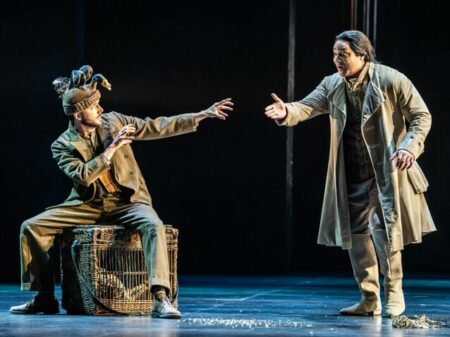
The Magic Flute is an opera that ought to be impossible to stage well. Masonic ritual, Enlightenment treatise, knockabout pantomime — the work pulls in so many directions at once that the temptation for directors is to either flatten the disparities into a single governing concept or simply give up and let the chaos reign. Sir David McVicar’s 2003 production for the Royal Ballet and Opera, which reached its 400th performance during the run of performances in which this broadcast was recorded, does neither. It trusts the contradictions. And it is this, I think, that explains why the staging has endured so handsomely.
In McVicar’s reading we get fairy tale and philosophical drama, slapstick and solemnity, the variety of perspective beautifully exploited, but never at the expense of narrative clarity. And the work’s theatrical roots are gloriously evident. There is genuine physicality in the comedy; dazzling, inventive use of puppetry (the opening serpent-dragon remains a coup de théâtre); and transformative stage effects brought to life by John Macfarlane’s designs and Paule Constable’s atmospheric lighting. Nor is there any misguided attempt to ground the notorious character reversals of Sarastro and the Queen of the Night between the two acts in psychological backstory. ‘Just keep up’ seems to be McVicar’s message here, and it works.
This is the third time I have seen this production. Both previous occasions were enjoyable; this one felt special. Ruth Knight, the revival director, interviewed before the cinema broadcast, spoke of the staging with intimate understanding and affection, and both qualities were evident throughout the evening. The pantomimic elements I have mentioned were timed to perfection and genuinely funny. The spoken exchanges were an idiomatic delight (and none of the cast are native German speakers). And the singing and acting were first-class across the board.
I should single out Huw Montague Rendall’s Papageno, the performance of the evening in dramatic terms. He inhabits the role as few I have seen, bundling comedy, pathos and pride winningly together. His voice has a natural, infectious lyricism ideally suited to Mozart, but what sets this Papageno apart is the unforced quality of the characterisation — the bird-catcher’s vanity, his cowardice, his tenderness are all there without any one of them being pushed. Lucy Crowe and Amitai Pati were a compelling Pamina and Tamino, warm and vivid in their exchanges and beautifully matched vocally. Crowe brought real poise and emotional weight to ‘Ach, ich fühl’s’. Pati, making his Royal Opera debut, found a touching ardour in ‘Dies Bildnis’ that set the tone for everything that followed. Kathryn Lewek’s Queen of the Night was formidable — technically flawless, the coloratura dispatched with thrilling precision, but the characterisation never tipping into pyrotechnics. Soloman Howard’s Sarastro was nobility personified, the tone warm and magisterial even if some of the very lowest notes lost a little definition. Gerhard Siegel made the most of Monostatos’s cartoonish villainy, relishing the role’s theatrical possibilities without ever overplaying them. As well as these fine individual contributions I should pay tribute to the wider cast, because this was the finest ensemble Magic Flute I have experienced, every interaction alive and purposeful.
I have saved the conductor until last. Marie Jacquot, making her Covent Garden debut, gave a thrilling, profoundly musical account of the score in which every detail seemed etched on her sensibility. Period-informed in the most positive way — crisp articulation, fleet tempos, transparent textures — Mozart’s grandeur was powerfully and lucidly conveyed by the Royal Opera Orchestra, but there was tenderness too in their playing, a responsiveness to the drama that made you newly aware of how much colour and feeling Mozart packs into his orchestral writing. The Royal Opera Chorus, responsive to Jacquot’s every demand, were also excellent.
The production returns next season over the Christmas period. I have a feeling it is going to make for superb seasonal entertainment.
Dominic Hartley
Featured Image: Lucy Crowe (Pamina) and Amitai Pati (Tamino) © Johan Persson
Creatives:
Director – David McVicar
Revival Director – Ruth Knight
Designer – John Macfarlane
Lighting designer – Paule Constable
Movement director – Leah Hausman
Cast:
Pamina – Lucy Crowe
Tamino – Amitai Pati
Papageno – Huw Montague Rendall
Queen of the Night – Kathryn Lewek
Sarastro – Soloman Howard
Monostatos – Gerhard Siegel
First Lady – Hannah Edmunds
Second Lady – Ellen Pearson
Third Lady – Emma Carrington
Speaker of the Temple – Matthew Rose
Papagena – Marianna Hovanisyan
First Priest – Harry Nicoll
Second Priest – Wyn Pencarreg
Third Priest – Nigel Cliffe
First Man in Armour – Stuart Jackson
Second Man in Armour – Graeme Broadbent
First Child – Remi Bianchi
Second Child – Georgiana Bamford
Third Child – Phoenix Matthews
I second the reviewer about this revival.
I must also single out one performer H M Rendall as Papageno who was the best I’ve ever seen and heard.
It would be hard to imagine the role bettered.