
 United States Tchaikovsky, Eugene Onegin: Soloists, Chorus and Orchestra of the Metropolitan Opera / Timur Zangiev (conductor). Metropolitan Opera, New York, 20.4.2026. (ES-S)
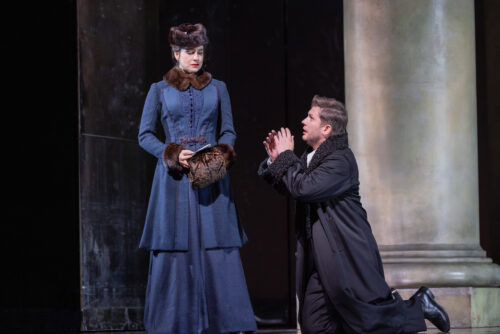
At the Metropolitan Opera, Eugene Onegin has long invited a familiar critical premise: that, despite its title, the opera ultimately belongs to Tatiana. In past revivals, that imbalance was often the result of overwhelming star presence. Here, however, the center of gravity shifts for a different reason. Asmik Grigorian does not simply dominate the performance: she reshapes its scale from within, establishing Tatiana as a psychological pivot of the drama.
Grigorian’s interpretation avoids plush tonal luxuriance. Instead, her singing unfolds through contrast: a bright, forward soprano that opens freely at the top, set against a darker, more inward lower register. The effect is not one of seamless vocal line but of expressive tension, as if each phrase were being actively negotiated rather than simply sustained. This proves especially compelling in the Letter Scene, where her phrasing resists a purely lyrical flow. Gesture and sound are tightly linked: a sudden expansion of tone mirrors a surge of feeling, while moments of restraint register as physical withdrawal as much as musical softening. The scene becomes less a set piece than a process, unfolding in real time.
What distinguishes her most clearly is the sense of continuity she brings to the evening. Within the opera’s succession of discrete scenes, Grigorian sustains a consistently evolving inner line. Her acting – the stillness of her expression, her hand movements, even her posture – enhances the legibility of the character’s inner life. This has structural consequences. Scenes that can feel episodic – particularly the name-day celebration – are instead shaped by the continuity of her presence, lending the performance a cohesion not always inherent in the work.
In the final act, Grigorian’s Tatiana acquires the external poise of Gremin’s wife, but the earlier tensions are still palpable. They persist as an undercurrent, surfacing in small hesitations and sudden intensifications of tone. The closing duet avoids grand tragic culmination; instead, it unfolds as a layered confrontation between past and present selves. The line ‘happiness was within our reach’ emerges not as retrospective lament but as something still actively felt.
In these circumstances, Iurii Samoilov’s Onegin occupies a more uncertain dramatic space, with the role’s tendency towards reactiveness remaining evident. Yet Samoilov proves a compelling presence, his singing firm and textually clear and his characterization marked by a measured restraint that suits the early scenes. The transition to the desperation of the final act is handled with control, the emotional trajectory emerging gradually, if not always cumulatively. The final confrontation, accordingly, remains weighted toward Tatiana’s experience, though Samoilov sustains a musically assured line throughout.
Stanislas de Barbeyrac offers a Lenski of a different profile from the more overtly ardent tradition. In the name-day scene, his jealousy nonetheless erupts in overtly physical terms, twice hurling Olga to the floor, an unnecessary directorial accent. His tenor, clean and controlled, favors clarity over expansiveness, and his ‘Kuda, kuda’ unfolds less as an outpouring of grief than as a poised meditation. The restraint proves effective, lending the role a reflective inwardness. The musical line remains finely judged, and this reflective approach aligns with the performance’s overall tonal palette.
Among the supporting roles, Alexander Tsymbalyuk lends Gremin a grounded authority, his dark-grained bass and unforced legato shaping the aria with calm assurance, providing a moment of tonal poise before the emotional volatility of the final duet. Maria Barakova’s Olga is lively without caricature, her warm, even mezzo-soprano lending the character a natural presence that avoids exaggeration. Tony Stevenson’s Triquet is neatly characterized. Larissa Diadkova and Elena Zaremba bring authority to Filippyevna and Larina respectively, though their mezzos show signs of wear, the tone at times losing some of its former focus.
In the pit, Timur Zangiev, making his debut at the Metropolitan Opera, proves attentive to the work’s shifting scale. His tempos generally favor forward motion though not at the expense of detail, and the orchestra maintains a degree of transparency that allows inner lines to register clearly. Dialogues between singers and individual instruments emerge clearly without being isolated from the broader texture. At its best, the playing supports the sense of psychological continuity established on stage, though certain transitions – particularly between the more intimate scenes and the larger social tableaux – remain slightly segmented.
Deborah Warner’s production, introduced at the Metropolitan Opera in 2013, continues to reveal both its strengths and its unresolved tensions. The contrast between the more detailed naturalism of the opening act and the increasingly stylized later scenes persists, though the staging benefits from a clear emphasis on interpersonal relationships. However, certain directorial choices – such as Gremin’s somewhat gratuitous physical interaction with Tatiana during his address to Onegin – complicate that emphasis. There is a quiet elegance in Tom Pye’s scenery for the Larin household, while the congested array of heavy columns with single chairs placed in front of them proves consistently distracting, particularly for the dancers in the polonaise. In the larger ensemble scenes, the proliferation of extras further dilutes the dramatic line, adding to a sense of visual overcrowding. Jean Kalman’s lighting remains one of the production’s most effective elements, shaping space and mood with precision, particularly in the duel and final scenes.
It may be time for a new staging, but the strength of the cast makes this revival a compelling endeavor.
Edward Sava-Segal
Featured Image: A scene from Act I of Tchaikovsky’s Eugene Onegin © Evan Zimmerman/Met Opera
Production:
Production – Deborah Warner
Revival director – Paula Williams
Sets – Tom Pye
Costumes – Chloe Obolensky
Lighting – Jean Kalman
Projection – Ian William Galloway, Finn Ross
Choreographer – Kim Branstrup
C. Graham Berwind III Chorus director – Tilman Michael
Cast:
Tatiana – Asmik Grigorian
Olga – Maria Barakova
Lenski – Stanislas de Barbeyrac
Madame Larina – Elena Zaremba
Filippyevna – Larissa Diadkova
Eugene Onegin – Iurii Samoilov
Monsieur Triquet – Tony Stevenson
Prince Gremin – Alexander Tsymbalyuk
Zaretsky – Richard Bernstein
Captain – Ben Brady