 Switzerland Richard Strauss, Arabella: Soloists, Chorus of Zurich Opera, Zurich Philharmonia / Markus Poschner (conductor). Zurich Opera, 18.4.2026. (AL-L)
Richard Strauss wrote two operas centred on a profoundly dysfunctional family in which two sisters are the dominant dramatic forces. The better-known of the two is Elektra. The other, Arabella, is ostensibly a ‘lyrical comedy’, yet the Waldner household — gambling-addicted father, scheming mother, one daughter dressed as a boy to save the cost of a second debutante — is hardly less compromised than the house of Atreus, albeit in a Viennese rather than a Greek key. One wonders, on reflection, which family is the more scandalous.
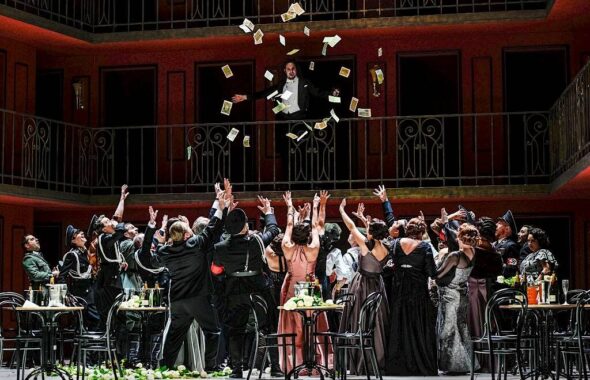
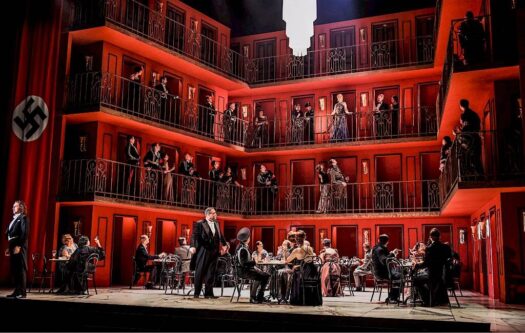
Robert Carsen’s production, revived here at the Zurich Opera after its premiere four years ago, is an accomplished piece of theatrical thinking. The setting is a grand old Viennese hotel, and Carsen’s characteristic ease with large spaces and crowd movement is evident throughout: the action unfolds fluently, and a nicely managed comic moment in Act III — in which the hotel guests pour out of their rooms demanding that the principals keep their voices down — was both well-staged and genuinely funny. Gideon Davey’s designs have the requisite period lustre, and Peter van Praet’s lighting serves the intimate scenes with discretion.
Yet Carsen’s directorial intelligence deserts him in one significant respect. The three officers are dressed in SS uniforms, and the interlude between Acts II and III becomes an aggressively choreographed confrontation between figures in Nazi dress and others in Bavarian Lederhosen, complete with Nazi salutes. Nothing in Hofmannsthal’s libretto and nothing in Strauss’s score provides the slightest justification for this intrusion. One can understand the temptation — Strauss’s compromised relationship with the Nazi regime is a legitimate biographical issue — but grafting that history onto Arabella, a work conceived and completed before 1933, is a category error. The gesture feels less like a serious reckoning than a cheap provocation, designed to impress rather than to illuminate.
Arabella is, in any case, a far more demanding score than its salon surface suggests. From the opening pages, where the flutes carry fiendishly complex figures against a bass clarinet moving in an independent rhythm beneath them, Strauss requires an ensemble precision and textural transparency that are extraordinarily difficult to sustain. Markus Poschner and the Zurich Philharmonia had an effortful evening. On several occasions the difficulty of the score proved simply overwhelming, producing a muddiness of ensemble that a work of this delicacy cannot absorb. Act III brought further problems: the extended parlando passages that carry much of the opera’s dramatic weight need to move briskly, calling for a release in tempo for the lyrical set pieces and pressing forward through the declamatory stretches. Poschner’s tempos were consistently too slow, making those passages ponderous and draining them of momentum. Strauss is deceptively demanding, and the score exacts its price without mercy.
The vocal results were similarly mixed. The surprise of the evening — and perhaps its central disappointment — was Diana Damrau’s Arabella. Damrau is a great artist, and a starry name that Zurich is right to pursue. But the voice does not possess the creamy soprano fullness that Strauss’s heroine demands: there is no glow, no weight of tone, without which the long-breathed melodic lines — the very substance of Arabella’s character — cannot coalesce. She works intelligently with the words and produces exquisitely studied piano effects, but the essential phrasing is absent. Conceptually, too, the portrayal felt more like a Rosalinde — vivacious, a little frivolous — than the uniquely self-possessed young woman who is, as Hofmannsthal conceived her, the only fully adult presence in the opera. Whether the constraints of a revival rather than a new production account for some of this shallowness of characterisation is difficult to say, but the result felt incomplete.
Anett Fritsch’s Zdenka offered a strong dramatic presence — those who heard her formidable heroine in Hindemith’s Cardillac (review here) at this house earlier this season will not have been surprised by her commitment — but the voice produced unexpectedly hard and shrill high notes, and there were intonation problems in the Act I duet with Arabella, which also suffered from a lack of balance between the two voices. Stephanie Houtzeel’s Adelaide and Irène Friedli’s card player were serviceable, without leaving any particular impression. Yewon Han’s Fiakermilli was a genuine delight: faultless seductive coloratura, real tone, real technique and the hint of a future Zerbinetta.
The men told a different story almost without exception. Johan Krogius brought a firm, attractive voice to Graf Elemer, making more of the role than it usually receives, and Felix Gygli (Count Dominik) and Brent Michael Smith (Count Lamoral) filled those remaining officers with pleasing solidity. Pavol Breslik’s Matteo is a known quantity in opera houses across Europe and did not disappoint here. Wolfgang Bankl was a sonorous, thoroughly credible Graf Waldner, his diction admirably clear throughout.
But the evening belonged without serious competition to Michael Volle’s Mandryka. Volle may now look the part of the character’s uncle rather than Mandryka himself, but the voice remains an instrument of extraordinary power. Projection, technique — and Mandryka sits surprisingly high for a baritone, with exposed passages that demand a seamless transition into Kopfstimme — and stamina: Volle sang the final scene with the same undiminished force as the first. More than that, he inhabits the words and the dramatic situation with the total intelligence that his Hans Sachs and his Wotan have long demonstrated on stages across Europe. It was a masterly portrayal, and it almost made one wonder whether the opera might more honestly carry his character’s name in its title.
The lovers are duly reunited, the glass of water offered and accepted. One only wished the rest of the evening had been as persuasive as the man who received it.
Antoine Lévy-Leboyer
Featured Image: Zurich Opera’s Arabella (from the premiere) © Toni Suter
Cast:
Arabella — Diana Damrau
Zdenka — Anett Fritsch
Mandryka — Michael Volle
Matteo — Pavol Breslik
Count Waldner — Wolfgang Bankl
Adelaide — Stephanie Houtzeel
Count Elemer — Johan Krogius
Count Dominik — Felix Gygli
Count Lamoral — Brent Michael Smith
Fiakermilli — Yewon Han
Card player — Irène Friedli
Production:
Director — Robert Carsen
Set and Costume design — Gideon Davey
Lighting — Peter van Praet
Chorus master – Ernst Raffelsberger