 Switzerland Hindemith, Cardillac: Soloists, Chorus and Orchestra of Zurich Opera / Fabio Luisi (conductor). Zurich Opera House, 21.2.2026. (AL-L)
One hundred years after its premiere in Dresden, Hindemith’s Cardillac remains a rarity on the operatic stage. Seen and Heard International has reviewed it in two recent productions, in Vienna (here) in 2022 and in Antwerp (here) in 2019, and it has been captured on film in notable accounts from Paris under Kent Nagano and from Munich under Wolfgang Sawallisch in a celebrated Jean-Pierre Ponnelle staging – both now available in older video formats. The Zurich Opera House is therefore to be commended for staging it as a new production, and the result largely justifies the enterprise.
At ninety minutes across three acts, the opera is concise and dramatic, with not a moment wasted. Hindemith’s score is unmistakably German in its harmonic language, yet it carries its own fingerprint: the motoric rhythmic drive, the distinctive and at times acerbic use of woodwinds, the densely layered brass – all mark this as the work of a composer who had already found his voice. The orchestration is thick, and there were moments during the evening when the singers and chorus found themselves competing with the pit, yet the music always held the attention.
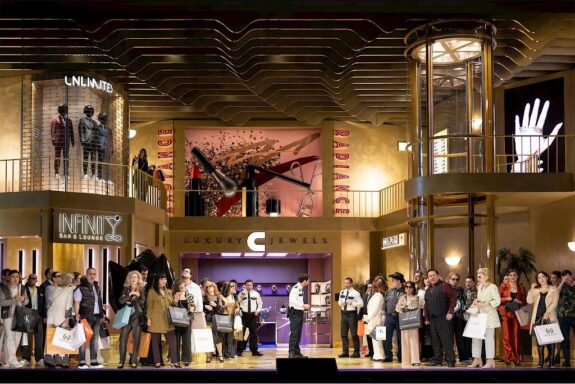
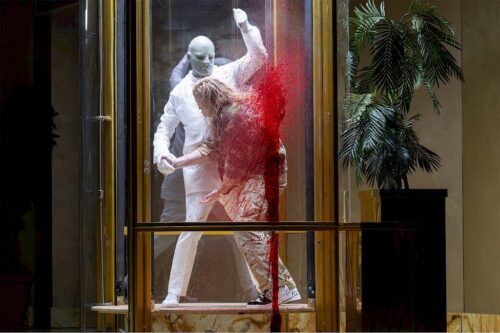
Kornél Mundruczó’s production transposes the action to a contemporary luxury mall, with Cardillac’s jewellery shop as its centrepiece. The Parisian crowd are modern-day influencers – selfie-obsessed, parading around with designer bags whose branding has been carefully disguised, presumably for copyright reasons – and the conceit works rather well. A scene in which Cardillac refuses to sell his wares to a group of haughty brand ambassadors has a touch of dark comedy, and the final image was both apt and resonant: his daughter and the officer selling off all of Cardillac’s stock to a queue of fashionistas waiting in line with the reverence of communicants approaching the altar, a fitting visual rhyme for the music’s quasi-religious close. Less subtle was the copious stage blood at the end of the first act, though it certainly made its point. This modernisation is a considerable step above Mundruczó’s recent operatic outings – more convincing than his Munich Tosca (here) and more engaged than his Lohengrin (here) at Bavarian State Opera. The crowd choreography and Personenregie were handled with the assurance one would expect from a director who has won prizes at Cannes – the cinema training shows in the precision of the individual gesture and the fluency with which the stage picture is controlled.
Fabio Luisi’s evident affection for the score brought out a good deal of its inner detail. He shaped the rhythmic argument with clarity and drew committed playing from the orchestra throughout. The balance between pit and stage was not always ideal – the brass and woodwind writing is particularly demanding in this regard – but the performance never lost its forward momentum or its dramatic focus.
The vocal standards were consistently high – no small achievement in music of this difficulty. Gábor Bretz brought to the title role the dark, weighty bass-baritone of a singer who has already taken on Wotan: the voice carries authority and power, and his portrayal of the obsessive goldsmith was dramatically well-focused. Anett Fritsch gave the role of Die Tochter a dramatic edge, her tone cutting through the orchestral texture when the music demanded. Of the two tenor roles – both taxing – Sebastian Kohlhepp sang Der Kavalier with firm projection and pleasing tone, though one might have wished for a little more variety of colour; and Michael Laurenz, whose experience as Mime in numerous productions of the Ring has sharpened his feeling for text, was notably fine as Der Offizier, his diction clear and his characterisation subtly ambiguous.
The outstanding performance of the evening came from Dorottya Láng as Die Dame. The Hungarian mezzo-soprano brought a warmth and attention to phrasing to her role which set her apart from an already very capable cast, and her words were consistently clear and well-projected. She is a singer of true quality, already known to audiences who have heard her in Das Lied von der Erde with the Berlin Philharmonic under Sakari Oramo (who stepped in for an ailing Daniel Barenboim). Those who have not yet encountered her should seek the opportunity.
It speaks well for Zurich that this difficult and rarely performed work has been staged with such evident care, and the house was full and attentive throughout – a reminder that adventurous programming need not mean empty seats.
After the performance, on Sechseläutenplatz, the square outside the opera house, the scene was less reassuring: groups of young people, glued to their smartphones, parading branded clothes, bags and accessories with studied glee, as though label affiliation conferred membership in a tribe – and as though the brand itself might supply what a personality could not.
Cardillac would have understood them perfectly.
Antoine Lévy-Leboyer
Featured Image: Zurich Opera’s Cardillac © Monika Rittershaus
Cast:
Der Goldschmied Cardillac – Gábor Bretz
Die Tochter – Anett Fritsch
Der Offizier – Michael Laurenz
Der Goldhändler – Stanislav Vorobyov
Der Kavalier – Sebastian Kohlhepp
Die Dame – Dorottya Láng
Der Führer der Prévôte – Brent Michael Smith
Der König – Stanislav Hnat
Production:
Director – Kornél Mundruczó
Set designer – Monika Korpa
Lighting designer – Elfried Roller
Chorus master – Klaas-Jan de Groot
Dramaturgy – Kathrin Brunner, Kata Wéber