
 United Kingdom Bartók, Britten, Shostakovich: Gábor Bretz (baritone), Dorottya Láng (mezzo-soprano), BBC Scottish Symphony Orchestra / Elim Chan (conductor). City Hall, Glasgow, 16.4.2026. (GT)
Britten – Four Sea Interludes from Peter Grimes
Shostakovich – Hamlet Suite, Op.116a
Bartók – Duke Bluebeard’s Castle
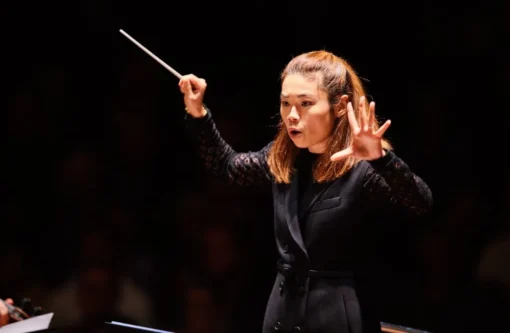
The Hong Kong-born conductor Elim Chan was acclaimed, in her five-year spell, as the Principal Guest Conductor of the Royal Scottish National Orchestra, between 2019 and 2024, since which she has become a freelance conductor working with many of the world’s finest orchestras. In Scotland, her repertoire ranged widely from Mozart and Beethoven to Shostakovich and Stravinsky. This programme seemed ideal for her, so it was surprising that in the opening Britten interludes from Peter Grimes, the work seemed a little disappointing. In ‘Dawn’, the flutes were excellent, and yet the tubular bells were drowning out the strings. ‘Moonlight’ was laboured and lacked any distinct harmonic feeling, while the ‘Storm’ seemed hurried in tempo, with some of the detail not heard clearly.
If the Britten work was somewhat disappointing, the opening bars of the Shostakovich film music for Hamlet were gripping and dramatic. The violence of the music was astonishing and shocking. As in her past spell in Scotland, Elim Chan revealed that she is a supreme interpreter of Shostakovich’s music. She brought out all the excitement of the score and kept superb momentum, never allowing the tempos to slow. The fast-moving score was difficult to follow as Chan kept the playing going without any breaks. The sudden close of the Fortinbras’s March came too soon for many in the hall, in what was an incredible display of orchestral playing by the orchestra. As she was with the RSNO, she constantly forces the tempos with her right hand and the expression through her left hand. The percussion was top class, joined by the excellent brass group, who were singled out by Chan at the end for praise. It was curious that the piece advertised and featured in the programme was Shostakovich’s Op.32a incidental music to Hamlet, a much weaker piece than the film music for Grigori Kozintsev’s classic 1964 film of Hamlet. Yet wherever the errors were made, at least the orchestra and conductor had the same score in front of them. They produced one of the best performances in Glasgow for some time.
Composed between 1911 and 1925, Bartók’s sole opera, Duke Bluebeard’s Castle, was influenced by Wagner and Debussy in its theme of redemption and in his orchestration, at times evoking Tristan und Isolde in the pairing of two contrasting figures and in a deep psychological drama. Called ‘a mystery’ by the composer, it was based, as was his second stage work, The Miraculous Mandarin, on a libretto by Béla Balázs, and was influenced by symbolism and was intended for an opera by his compatriot Kodály. Despite several changes after the 1918 premiere, it was not until the revised version of 1936 that Bluebeard’s Castle was acclaimed as a masterpiece.
The Hungarian mezzo-soprano Dorottya Láng briefly introduced the opera before the musical opening. The initial passages were exquisite, from the threatening ideas of the strings and brass. The theme felt slightly tentative before waves of sound flowed, creating an atmospheric mood. Chan paid close attention to the woodwind, percussion, and brass sections in conjuring the right structure in expression. We heard soulful ideas from the bassoons, flute, oboe, clarinet, and the magical harp of Helen Thompson. Georgina Powell shone on the bassoon, playing with exceptional harmony. There were outstanding contributions from the flute of Matthew Higham, Rosie Stanforth on the oboe, Yann Ghiro on the clarinet, the horn of Chris Gough and the trumpet of Hedley Benson.
The orchestra dominated the early passages, but the singing became more intense when Judith reached the fifth door with a great orchestral burst of sound as Bluebeard opened his kingdom into view, heard against beautifully expressive harmonies; grand and spectacular as we heard from Bluebeard about ‘Silken meadows’. Láng’s Judith was powerful in her expression and often captivating in her characterisation of the lovelorn and increasingly suspicious wife. She was the most eloquent singer until the seventh door, when suddenly the stoical Bluebeard of Gábor Bretz became more animated and started telling of his past wives and loves. Bartók’s score gives the most attractive singing to the mezzo and Láng gave a wonderful performance against the initially monotonic Bluebeard. This is until the secrets of the seventh door are revealed, as is the futility of his marriage and the castle is consumed by the night: ‘Henceforth all shall be darkness…darkness…darkness’ and the final door closes.
There was much beauty in the performance with sharp bursts of passion against the darkly threatening menace of the castle’s hidden, terrible secrets. Under Elim Chan’s direction, the orchestra reached outstanding levels of musicianship in what is among the best performances of this year so far. She managed the switches between the harmonic pattern of pentatonic chords and diatonic chords securely. Bartók’s score is full of familiar romanticism, with hints of Debussy, while other elements remind one of Richard Strauss, but the most important element throughout was of Romanian and Slovak folk music. This was a tremendous afternoon concert of works which fitted together well, sharing the theatre with a cinema and a memorable event.
Gregor Tassie