
 United States Various: Alexandre Kantorow (piano). Stern Auditorium, Carnegie Hall, New York, 21.4.2026. (ES-S)
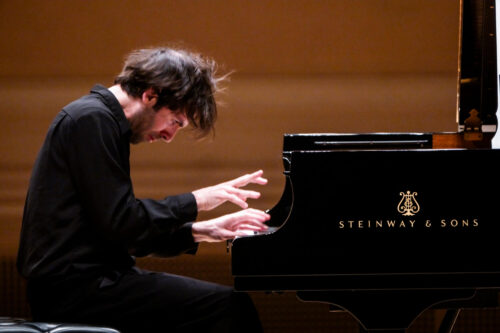
Liszt – Variations on Weinen, Klagen, Sorgen, Zagen (after J.S. Bach), S.180
Medtner – Piano Sonata in F minor, Op.5
Chopin – Prelude in C-sharp minor, Op.45
Alkan – Prelude No.8 in A-flat minor, Op.31, ‘La Chanson de la folle au bord de la mer’
Scriabin – Vers la flamme, Op.72
Beethoven – Piano Sonata No.32 in C minor, Op.111
Encore: Liszt – ‘Liebestod’ from Tristan und Isolde (after Wagner), S.447
At Carnegie Hall, Alexandre Kantorow presented a program that favored variation and transformation over customary contrasts, reaching a point where the music no longer moves toward a goal but settles into a suspended, almost floating state. It brought together familiar landmarks and less frequently heard works, without establishing any hierarchy.
In his reading of Franz Liszt’s Variations on Weinen, Klagen, Sorgen, Zagen – based on a theme from Johann Sebastian Bach’s Cantata BWV 12 – Kantorow set the terms of the overall endeavor with unusual clarity, emphasizing a cumulative design over a succession of opposing segments. The descending chromatic line did not present itself as a theme to be developed but as a constraint from which the music repeatedly attempts to break free, the closing chorale emerging as a fragile outcome. The variations unfolded as stages in an intensification process; their force built through control of texture and line. Contrapuntal strands remained audible even at moments of maximum density.
Nikolai Medtner’s Piano Sonata in F minor carried that sense of inward pressure into a more densely argued form. Kantorow clarified the work’s architecture, allowing its recurring motifs to function as points of orientation. The opening movement did not follow a stable trajectory; its material continually reconfigured. The march-like Intermezzo introduced a more defined profile but remained harmonically unsettled, while the Largo divoto sustained its intensity through restraint, its line shaped with minimal inflection and subtle harmonic shading. In the final movement, the return of earlier material did not yield resolution so much as consolidation, the sonata closing within the same expressive field established at the outset.
After the interval, three more concise pieces, played almost attacca, continued in the same vein.
Kantorow treated Chopin’s Prelude in C-sharp minor as an unstable space of harmonic drift. The left-hand undulating figuration remained deliberately understated, allowing the short, directionless phrases of the upper line to register through their gradually shifting colors. In the extended cadenza-like passage near the end, any sense of culmination was held in check; the music was allowed to dissipate, losing definition as it approached silence.
The separation of registers became structural in Charles-Valentin Alkan’s ‘La chanson de la folle au bord de la mer’, with its low, oppressive, tolling chords set against a fragmented, distant and disembodied line in the treble. Kantorow maintained control over these extremes, allowing the tension to arise from their coexistence rather than contrast alone. A central surge intensified the pressure; when the opening pattern returned, the music collapsed back into the same narrow space from which it had briefly expanded.
Scriabin’s Vers la flamme extended that sense of constriction into a continuous, unbroken escalation. Kantorow paced the work carefully, avoiding any premature climax as the music tightened around its obsessive half-step motion, taking on an increasingly eerie, almost hallucinatory quality. The texture thickened incrementally, the dynamic range expanding without rupture; even at its most intense, the sound remained focused. The final surge materialized as the inevitable outcome, not an explosion.
Beethoven’s Piano Sonata No.32 brought the recital’s central concerns – the interplay of constraint and intensification, integration and dissolution – into a single, more tightly focused form. The opening movement retained a strong sense of direction; its volatile contrasts sharply articulated without disrupting the overall continuity or adding excessive weight. It was in the Arietta, however, that the program’s underlying design came fully into focus. The variations did not proceed as discrete elaborations but as a steady transformation of texture and temporal flow, each successive stage reducing the sense of forward motion as the music glided toward a state of suspension.
A single encore brought Kantorow’s combination of technical command and poetic sensibility – which had underpinned the entire recital – even more into view. At the same time, Franz Liszt’s transcription of Richard Wagner’s ‘Liebestod’ was clearly not the result of a momentary impulse but an integral part of the program as conceived by the pianist, both a closing parenthesis to the opening work and a prolongation of what had been attained in the final bars of Beethoven’s last sonata. Liszt’s transfiguration culminated in a luminous B major sonority that suggested, if not resolution, then a possible moment of redemption for the evening’s full arc.
Edward Sava-Segal
Una reseña, de.una performance ,que deja el sentimiento conjugado con una explicación que llena la expectativa buscada.Gracias.
[Translation] A review of a performance that conveys a feeling while providing an explanation that meets expectations. Thank you.