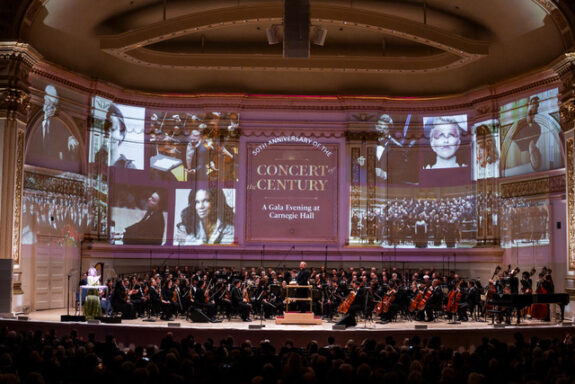
 United States Various, ‘50th Anniversary of the Concert of the Century’: Soloists, Oratorio Society of New York (director: Kent Tritle), NYO-USA All-Stars / Yannick Nézet-Séguin (conductor). Carnegie Hall, New York, 5.5.2026. (RP)

Performers: Renée Fleming (soprano and host), Joyce DiDonato (mezzo-soprano ), Isabel Leonard (mezzo-soprano), Audra McDonald (vocalist), Michael Feinstein (vocalist and piano), Emanuel Ax (piano), Andy Einhorn (piano), Lang Lang (piano), Daniil Trifonov (piano)
‘This is no ordinary structure. It is not erected for gain.
Its owners seek not to reap high profits from the community
But to perform a great good for the community’.
American industrialist and philanthropist Andrew Carnegie, who funded the entire construction of Carnegie Hall, wrote those words. They greeted the audience at the ‘50th Anniversary of the Concert of the Century’ and continue to ring true to this day.
The ‘Concert of the Century’ in 1976 commemorated the 85th anniversary of the Hall’s opening on 5 May 1891 and was preserved for posterity by Sony Classical. History repeated itself 135 years later to the day, although the 2026 concert will be available primarily for streaming, which has eclipsed both the LP and the CD in the past 50 years.
The 1976 concert featured some of the world’s greatest musicians, including Martina Arroyo, Leonard Bernstein, Dietrich Fischer-Dieskau, Vladimir Horowitz, Yehudi Menuhin, Mstislav Rostropovich, Isaac Stern and the New York Philharmonic. It was organized by Stern, who is credited with saving Carnegie Hall from the wrecking ball in 1960. A 44-story red porcelain enamel office tower was planned for the site.
The world has changed since 1976 but Carnegie Hall’s mission has not. It has always welcomed the world’s greatest classical musicians as well as the superstars of popular music to its stages. Judy Garland’s 1961 concert is legendary, as were the Beatles’ two sold-out appearances in 1964 during their first US visit. The hall is just as likely now, as in the past, to host crooners singing hits from the Great American Songbook, jazz greats or Broadway stars. Hip hop is heard there, too, as well as a steady stream of premieres of new works by the composers of today.
What has evolved over the past 50 years is Carnegie Hall’s focus on the future, especially in training the next generation of musical talent. Much of the credit goes to Sir Clive Gillinson, the Executive and Artistic Director of Carnegie Hall, a position he has held since 2005. Its reach has expanded exponentially through the Weill Music Institute which, each year, draws on Carnegie Hall’s resources to bring music education and social impact programs to more than 800,000 people in the New York City metropolitan region, across the United States and around the world, as well as many more online.
People filled Carnegie Hall for the ‘50th Anniversary of the Concert of the Century’ to hear great music, not a history lesson. There was plenty of the latter, though, in montages of photographs and videos projected above the stage, plus anecdotes from the artists, including Renée Fleming who hosted as well as performed. As for the music, Carnegie Hall assembled some of the greatest stars of today to provide the entertainment.
Yannick Nézet-Séguin led the NYO-USA All Stars, made up of alumni of Carnegie Hall’s National Youth Orchestra of the United States of America, in the Overture from Bernstein’s Candide to open the concert. That bolt of adrenaline was exceeded by an equally supercharged performance of the Allegro molto vivace from Tchaikovsky’s ‘Pathétique’ Symphony. It is hard to imagine it ever sounding more triumphant.
That extravaganza of brilliance and power was supplanted by the more heavenly sounds of Fleming singing the ‘Laudate Dominum’ from Mozart’s Vesperae solennes de confessore with the Oratorio Society of New York. Finding a home for the chorus was a motivation for Carnegie to build the hall, and it performed at the first concert in 1891.
Due to illness, Evgeny Kissin was unable to perform Chopin as scheduled, so the concert took a more intimate turn with Joyce DiDonato and Emmanuel Ax partnering in two of Mahler’s most exquisite song, ‘Ich atmet’ einen linden Duft’ and ‘Ich bin der Welt abhanden gekommen’. Stillness reigned in the hall as DiDonato’s spinning lines and sensitive vocal colorings were matched in emotional depth by Ax’s inward-looking, expressive playing on the piano.
A quick turn to the world of jazz was made with Daniil Trifonov performing the Allegro agitato from Gershwin’s Piano Concerto in F, with quick being the operative word. Trifonov’s virtuosity was on full display with fleet-fingered passages vying with flowing, sinewy lyricism. Nézet-Séguin and the NYO-USA All Stars further fueled the excitement, even if precision was hit or miss.
Cooler sensibilities again prevailed with Audra McDonald singing Duke Ellington’s ‘Sophisticated Lady’ with Andy Einhorn at the piano. They then performed the late Michael Tilson Thomas’s head-spinning arrangement of Gershwin’s ‘Fascinating Rhythm’, which McDonald recorded with Thomas and the San Francisco Symphony in 1998. McDonald noted that Thomas appeared over 100 times at Carnegie Hall and acknowledged her debt to him for encouraging her to pursue a concert career.
Michael Feinstein, famed as the ‘Ambassador of the Great American Songbook’, has performed regularly at Carnegie Hall for decades. He paid tribute to Judy Garland, accompanying himself in Jerry Herman’s own salute to her in his rework of ‘That’s Entertainment’. Joined by Nézet-Séguin and the NYO-USA All Stars, Feinstein sang a soul-searing ‘How Do You Keep the Music Playing?’ A question that Carnegie Hall has been answering for over a century.
No performer approached Lang Lang in audacity and power, except perhaps for the conductor and his orchestra. It was a once-in-a-lifetime experience to hear the pianist tear up the keyboard in the Allegro con fuoco from Tchaikovsky’s Piano Concerto No.1. For sheer brilliance, however, Isabel Leonard took the prize in her dazzling performance of ‘Non più mesta’ from Rossini’s La Cenerentola. She dispatched this coloratura showpiece with all the wit, precision and dazzle that it demands.
More recent history was evoked with Valerie Coleman’s Seven O’Clock Shout, which Nézet-Séguin and The Philadelphia Orchestra performed on the opening night of the 2020/21 season. The concert marked the return of live music to Carnegie Hall after the COVID-19 pandemic shutdown. With photographs of masked essential workers projected above the stage, Seven O’Clock Shout found Nézet-Séguin at his most sensitive, mining the poignant memories and emotions that Coleman expressed in the work.
The concert ended with all of the artists on stage to perform ‘Make Our Garden Grow’ from Bernstein’s Candide. This best of all possible worlds, of which Pangloss spoke in the Voltaire satire on which Bernstein based his opera, has been made manifest at Carnegie Hall for over 135 years. The Carnegie Hall of today continues to fulfill and often exceed the lofty ambitions of its founder.
Rick Perdian
Featured Image: Reneé Fleiming (host), Yannick Nézet-Séguin (conductor) and the NYO All Stars © Chris Lee
Bernstein – Overture & ‘Make Our Garden Grow’ from Candide
Tchaikovsky – Allegro molto vivace from Symphony No.6 in B minor, Op.74, ‘Pathétique’; Allegro con fuoco from Piano Concerto No.1 in B-flat minor, Op.23
Mozart – ‘Laudate Dominum’ from Vesperae solennes de confessore, K.339
Mahler – ‘Ich atmet’ einen linden Duft’, ‘Ich bin der Welt abhanden gekommen’ from Rückert-Lieder
Gershwin – Allegro agitato from Piano Concerto in F; ‘Fascinating Rhythm’ from Lady, be Good!
Ellington – ‘Sophisticated Lady’
Stephen Schwartz – ‘That’s Entertainment’ (arr. Jerry Herman)
Michel Legrand – ‘How Do You Keep the Music Playing’ from Best Friends
Rossini – ‘Non più mesta’ from La Cenerentola
Valerie Coleman – Seven O’Clock Shout