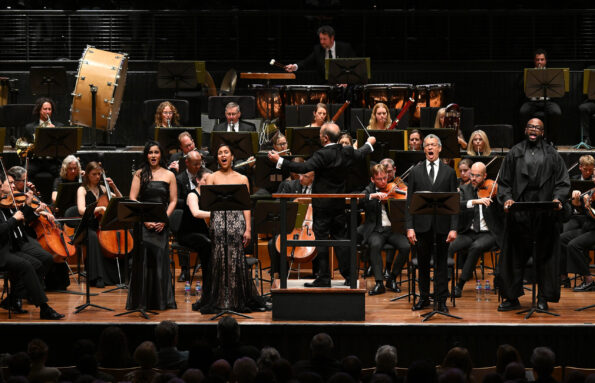
 United Kingdom Copland, Tippett: Talise Trevigne (soprano), Anita Montserrat (mezzo-soprano), Joshua Stewart (tenor), Roderick Williams (baritone), Bournemouth Symphony Chorus (director: Gavin Carr), Bournemouth Symphony Orchestra / Mark Wigglesworth (conductor). Lighthouse, Poole, 13.5.2026. (CK)
Copland – Appalachian Spring
Tippett – A Child of Our Time
Last year the Bournemouth Symphony Orchestra and Chorus ended their season with a blazing performance of Walton’s Belshazzar’s Feast. This year they closed with another 20th-century English choral classic (and, dare I say it, a finer work): Tippett’s A Child of Our Time.
In his end-of-term speech the BSO’s Chief Executive Dougie Scarfe pointed to the relevance of the work in our own time, though he wisely refrained from being specific. Tippett was moved to write the work by Kristallnacht, the Nazi pogrom against the Jews, but his purpose is universal: ‘And a time came when in the continual persecution one race stood for all’ (as a homosexual in pre-war England, and a conscientious objector imprisoned in Wormwood Scrubs, Tippett knew a thing or two about persecuted minorities). We do not have to look far in our own geopolitical landscape to notice a great irony here: but the gentleman in the Balcony who twice tried to impose his anti-Israel view on the performance was entirely missing Tippett’s point.
The performance itself was intense, inspired, and, in places, heartbreaking. The chorus is at the core of Tippett’s vision, and they were magnificent throughout. The opening movement set the standard, the voices seeming to emerge from an inchoate murmur to a harsh fortissimo: The world turns on its dark side. Their sound was truly terrifying in the turba chorus, ‘Burn down their houses, beat in their heads’: it was dramatically effective that they rose to their feet for this chorus as individuals, then in groups, so that they sang not as a well-drilled chorus but as an assembled mob. They were incisive in the uneasy Chorus of the Oppressed; and the five Spirituals that distil the narrative’s emotional force were – as they should be – overwhelming, sung with tenderness and fire.
The orchestra too were on their best form, making the quieter moments tell as much as the passionate outbursts – the lovely passage for flutes and solo viola the first of many. Tippett’s orchestra is not large: but the great moments – the flaring trumpets in Steal Away – had visionary power.
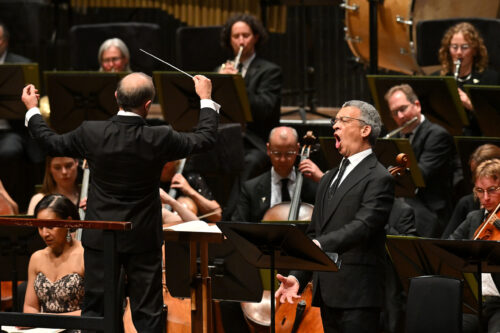
The work needs fine soloists, and it got them: all of them expressing pain, protest, outrage, compassion, as Tippett’s setting of his own libretto demands. The baritone, like the Evangelists in Bach’s Passions, bears the narrative burden: Roderick Williams was its ideal interpreter. What memories he has given us, helping to launch the season with a thrilling performance of Zemlinsky’s Lyric Symphony, and returning just a couple of weeks ago with his unforgettable collection of English songs, fellow-travellers with Schubert’s Winterreise.
Mezzo-soprano Anita Montserrat has a voice with just the right timbre to communicate the gravity and urgency of Tippett’s message; she delivers the work’s first and last solo arias and did so compellingly. Soprano Talise Trevigne was also perfect, her vocalise at the end of her first aria floated beautifully as the chorus stole in with Steal Away, shining above the other soloists in the gently ecstatic transition to the final Spiritual.
Finest of all, perhaps, was the New Orleans-born tenor Joshua Stewart: anguished in I have no money for my bread, trumpet-tongued in declamation, moving and dignified in launching the final ensemble: I would know my shadow and my light, so shall I at last be whole. The final Spiritual, Deep River, is almost unbearably moving; there will have been others beside me in the audience in tears. I thought of a long-ago BBC Prom performance under Colin Davis at the end of which a young man beside me had to be helped out of the Arena by his friend.
I haven’t mentioned Mark Wigglesworth: his conducting was committed and expressive, urgent where necessary, and he ensured that both the beauty and the drama of Tippett’s conception struck home: the performance was his triumph as much as anyone’s. Beauty is also the keynote of Copland’s Appalachian Spring, of which he and the BSO gave a wonderful performance before the interval. Beginning like an awakening of consciousness, the music acquires a gentle transcendence through its simplicity and candour: Wigglesworth paced it to shining perfection, through its lively dances and its rainbow-like treatment of the Shaker tune Simple Gifts to its quiet close – its benedictory Amen cadences as simple and profound as the Alleluias in Vaughan Williams’s Fifth Symphony, heard here a week ago (review here).
A quiet close to the season, but an unforgettable one. Excitement, too, at the plans announced for next season, including Roads to Joy, Wigglesworth and the orchestra’s survey of the Beethoven symphonies leading to the bicentenary of the composer’s death next year. And, of course, a great deal more.
Chris Kettle
For more information about the Bournemouth Symphony Orchestra’s new season click here.
Featured Image: Bournemouth Symphony Orchestra’s A Child of Our Time © Mark Allan