
 United Kingdom Shostakovich, Dvořák: Steven Osborne (piano), Aaron Azunda Akugbo (trumpet), Scottish Chamber Orchestra, Maxim Emelyanychev (conductor). Usher Hall, Edinburgh 14.5.2026. (SRT)
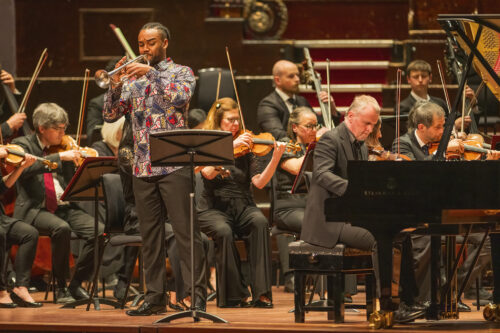
Shostakovich – Symphony No.9; Piano Concerto No.1
Dvořák – Symphony No.9, ‘From the New World’
The final concert of the Scottish Chamber Orchestra’s season featured not one, but two Ninth Symphonies, both of which were wonderfully played, even though they sit slightly out with the SCO’s normal wheelhouse. Dvořák’s warhorse sounded fresh and lean, with discrete string vibrato and the occasional slur to add very nineteenth century colour to a symphony that has huge twenty-first century appeal. Yet this wasn’t a simple ‘period’ reading: instead, the SCO’s Principal Conductor, Maxim Emelyanychev, burnished his Romantic credentials by drawing some majestic climaxes from the orchestra, particularly in the hell-for-leather finale, while eliciting some deliciously rich solos along the way. That said, Emelyanychev kept a lean approach to tempi, with a faster-than-usual Largo that drew its beauty not only from the marvellous cor anglais solo (chapeau, Katherine Bryer) but from its dialogue with the downy soft sound of the orchestral strings.
If Dvořák’s Ninth Symphony is normally heard on a larger orchestra than the SCO, then the nimble-footed mischief of Shostakovich’s Ninth plays much more to their agility and humour, and the outer movements of the symphony, as well as the insanely virtuosic central Presto, seemed to cock a snook in the way a theatre or café orchestra might do. There was weight aplenty in the soulful Moderato second movement, however, and in the Largo, heavy with momentous brass and a bassoon solo of operatic intensity (chapeau encore, Cerys Ambrose-Evans), the mask of mischief seemed stripped away to reveal fathomless emotional depths beneath.
That balance of mischief and depth was finely held in Shostakovich’s First Piano Concerto, not least thanks to pianist Steven Osborne, who seemed to begin the first movement with mellifluous politeness. It didn’t take long to appreciate, however, that hair-brained anarchy was bubbling just below the surface, and when it exploded to the surface, as it frequently did, it tended to unleash a crazy orchestral gallop that tore across the score. However, Osborne managed to sound uncannily poetic in the lyrical second movement, in which he was met by string playing of heart-stopping subtlety and gentleness. You have to feel for the trumpeter in this concerto. He gets his own billing, and stands at the front next to the piano, yet for huge chunks of the work he has nothing to do. That didn’t seem to bother trumpeter Aaron Azunda Akugbo too much, however, who moved in and out of the texture with jazzy breeziness, sounding particularly fine in the poignant muted moments of the slow movement.
Simon Thompson