 United Kingdom Korngold, Mahler: Ray Chen (violin), Royal Philharmonic Orchestra / Vasily Petrenko (conductor). Royal Albert Hall, London, 12.5.2026. (AV-E)
Korngold – Violin Concerto in G (1929-1931)
Mahler – Symphony No.5 in C-sharp minor (1901-1902)
The justifiable juxtaposition of Gustav Mahler and Erich Wolfgang Korngold provided the perfect platform for prosperous programming. This coincidental connection began in 1906, when a nine-year-old Korngold played for the elder maestro; Mahler did not merely approve but anointed him the heir to an aesthetic that thrives on cinematic imagery, for the scores of Mahler are ‘shot’ in widescreen technicolour. The Royal Philharmonic Orchestra’s concert stood as a testament to this structural lineage, charting an organic trajectory across two tradesmen of central European musical legacy.
Navigating an arc of Sehnsucht, the evening contrasted the proto-Second Viennese School expressionism of a vanguard symphonist with the opulent, late Post-Romantic texture of the concerto score. The pairing perfectly captured how cinematic Hollywood escapism was entwined with classic Viennese modernism; we were in Hollywood, Vienna.
The opening Moderato nobile of Korngold’s Violin Concerto in D major, Op.35 set a stupendous standard of exceptional precision. From the first bar, as the solo violin soared through two octaves in just five notes, Ray Chen established a mood that was rawly rhapsodic and flawlessly fluid and whose entrance was born of long familiarity with the score, demonstrating a tempo and temperament that felt like the ideal response to that most elusive instruction on the score. He spun out huge musical lines of thought with a vibrato-rich throb perfectly calculated to suit Korngold’s warm melodic manner. Rather than relying on an unyielding thickness of tone, Chen found an ideal vehicle for a thematic suppleness, shifting effortlessly from a rich, full-bodied resonance to moments of a perilous sweetness.
The RPO matched his intensity, weaving a lush tapestry of sound that supported the soloist without smothering the intricate inner lines. Petrenko kept the tempo moving forward, preventing the movement’s heavily romanticised themes from collapsing under their own weight. At the movement’s close, a wave of spontaneous applause erupted just as hordes of latecomers streamed into the auditorium, much to the visible dismay of both soloist and conductor. In a witty riposte to the disruption, Chen launched into a cheeky snippet of Bach’s Partita No.3, prompting a launch of laughter and appreciative applause from an audiophile audience that was entirely under his enticing spell before order was restored.
In the Romance, Chen shifted the mood toward an intimate, tender introspection. The slow movement, anchored by themes from Anthony Adverse, flowed with a delicate, singing lyricism that showcased the soloist’s control of pianissimo dynamics. Rather than leaning into a purely athletic display, Chen favoured a vocal, Caruso-like delivery that felt deeply confidential. The RPO woodwinds provided a beautifully glassy backdrop, reinforcing the movement’s dreamlike, nocturnal quality. There was an exquisite vulnerability to his twilight tone here, projecting notes that pierced the hall like silver shards of cut crystal, balanced by a fleeting fluidity in the quick, decorative filigree that never once sounded scratchy.
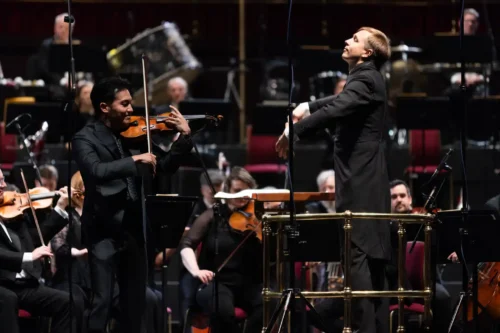
High drama of a technical, come theatrical, nature interrupted the closing Finale: Allegro assai vivace. Mid-phrase, the relentless momentum of the virtuosic staccato theme came to an abrupt halt when Chen suddenly snapped his E-string with an audible crack. Rather than breaking the spell, this moment solidified his grip on the astonished audience. In a display of outlandish orchestral choreography, he instantly handed his 1714 ‘Dolphin’ Stradivarius to the leader of the orchestra Duncan Riddell, swapping it for his instrument to continue playing without losing a single beat.
While Chen maintained his busy, muscular passagework on the leader’s violin — producing an identical, beautifully resonant tone that proved his projection belongs entirely to his fingers rather than the wood — Riddell passed the Stradivarius down to assistant leader Tamás András. Chen pulled a spare string from his jacket pocket, and András performed a lightning-fast pit-change on the stage. The fresh string was fitted with such blinding speed that the soloist was only briefly denied the use of his priceless Cremonese instrument, executing what Chen later called the ‘quickest ever string change’ on a platform.
Once reunited with his own violin in time for the final credits, Chen found a gear even better than before, propelling the movement toward an electric, ecstatic finish, though Petrenko’s handling of the final bars felt rather mannered, lacking the uninhibited, helter-skelter sprint required to completely break free from the movement’s strict structural constraints. Chen’s encore was the Prelude from Ysaÿe’s Violin Sonata No 2, delivered with a zestful zeitgeist of infinite, interplanetary virtuosity that blasted through the rafters of the Royal Albert Hall and left the elevated audience spellbound.
The Trauermarsch of Mahler’s Symphony No.5 in C-sharp minor opened with a technically flawless execution of the solo trumpet fanfare by the RPO’s Principal Trumpet, Matthew Williams, demonstrating an impressively steady and powerful delivery of the opening triplets. The soloist cleanly articulated the initial Auftakt motif with commendable precision, projecting an authoritative presence across the orchestra. Yet, for all its structural stability, this opening statement lacked the necessary sense of apocalyptic terror and aphrodisiac dread; it all felt far too subdued and safe.
Petrenko then allowed the tempo to drop far too drastically during the subsequent quieter, reflective sections. This self-indulgent pacing quickly revealed itself as a bad-habit hallmark of an often pedestrian performance. While the brass managed to cut through the heavy textures with a biting edge, the momentum stalled significantly during these broader, overly static periods. The sudden, violent outbursts of grief from the string section remained sharply articulated, but they struggled to gain traction within a framework that too frequently prioritised micro-management over organic symphonic flow.
Mahler’s second movement, marked Stürmisch bewegt, mit grösster Vehemenz, erupted with the necessary fury. The strings played with a gritty intensity, and the RPO brass section unleashed an exceptionally powerful, blazing wall of sound that initially dominated the texture. However, this sonic weight was structurally undermined by a noticeable deficit in the back row; the percussion section lacked the crucial weight and projection required to anchor the movement’s violent climaxes, leaving the catastrophic orchestral crashes sounding somewhat top-heavy.
Petrenko navigated the chaotic shifts in mood with precision, building up to the premature, blazing brass chorale with a sense of tragic inevitability before letting it dissolve back into darkness. Yet, a familiar lethargy crept into the score during the more intimate passages, most notably at the return of the Trauermarsch tempo. In this exceptionally quiet, elegiac sequence, Petrenko chose a pace far too slow, causing the musical line to sag thus losing crucial structural tension.
In the central Scherzo, the focus shifted to the solo horn, played outstandingly by Principal Horn Ben Hulme. Petrenko embraced the rustic lilt of the Austrian Ländler, though he occasionally micro-managed the phrasing, robbing the dance of its spontaneous, earthy character. Despite this slightly calculated approach, the orchestra executed the complex, contrapuntal web of lines with exceptional clarity and rhythmic drive. Yet this movement was not immune to Petrenko’s mannerist manoeuvres; in the sprawling, shadowy central trio section, during the ghostly pizzicato string passage, he dropped both the volume and the tempo far too drastically. The texture became so overly quiet and slow that the momentum flatlined, and the entire performance nearly fell apart before Hulme’s horn finally dragged the ensemble back into full stride. This near-collapse precipitated a visible wave of departures, with people walking out during the subsequent pause, evidently uninspired by the stop-and-start pacing.
The mawkishly kitsch Adagietto was, paradoxically, the only movement conducted completely straight, entirely devoid of slowing down which marred all the other movements. This was Petrenko’s finest conducting of the evening; by maintaining a firm grip on the structural tension and the linear flow without dragging it out as conductors tend to do to ‘milk’ it dry bringing tears to the eyes and thoughts of when will it all end.
This refreshing reading miraculously removed the swooning syrupy association with Luchino Visconti’s ‘chocolate-box’ film Death in Venice. It is well worth recalling Otto Klemperer’s curt remark to Peter Heyworth that this maudlin movement was mere ‘salon music’. I think that Klemperer was correct of course, and this ‘intermission interlude’ could easily be cut from this gargantuan score, though devout Mahler purists would raise hell at the omission.
On this occasion, the RPO strings and harp delivered a deep, solid, warm string tone without ever sounding saccharine; it was moving without being cloying. Perversely, the lack of syrupy indulgence seemed to disappoint the casual listeners; yet another contingent of patrons walked out before the final rondo began, preferring their Mahler heavily sweetened.
The concluding Rondo-Finale initially brought an injection of genuine drive and panache, with the fugal entries sparkling through the orchestral textures with commendable energy. Yet, as if structurally compelled to over-interpret, Petrenko lapsed back into his familiar slow-motion mannerisms during the movement’s more intimate sequences. The forward momentum flatlined in the quiet, delicate chamber-music dialogue between a small group of strings and woodwinds marked Grazioso, where he slowed down far too much, and it curdled entirely when the strings reintroduced the quiet reminiscence of the Adagietto theme.
I have no rigid objection to the use of tempo changes in Mahler, provided they serve an organic agogic purpose and do not negate the fundamental metric pulse and horizontal phrasing of the score. Here, however, these laboured mannerisms sounded affected and indulgently drawn-out, so sabotaging the organic flow of the music.
Fortunately, the concluding movement ended extremely well with a great gusto that brought the house down at the final thunderous orchestral chord.
Ultimately, however, this evening will be remembered for Ray Chen saving the Korngold without a single hint of flinching let alone sinking; for here the deckchairs on the Titanic were for once well rearranged. And special thanks go to Tamás András who did a deft job to ensure Ray Chen didn’t miss a note!
Alexander Verney-Elliott
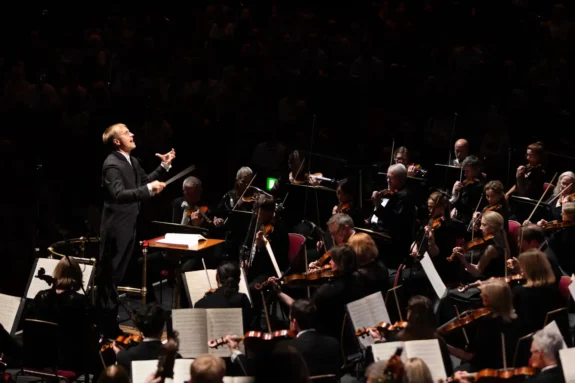
Featured Image: Vasily Petrenko conducts the Royal Philharmonic Orchestra © Frances Marshall
Acoustic Addendum: In my previous review of Petrenko’s Mahler Sixth, I complained about the heavy brass after-echo reverberation near the front side stalls. Yet tonight, sitting further back in the side stalls, I heard no after-echo reverberation from the brass at all. Ultimately, this demonstrates that there are indeed certain areas in the Royal Albert Hall where one does not hear those after-echo reverberations.