
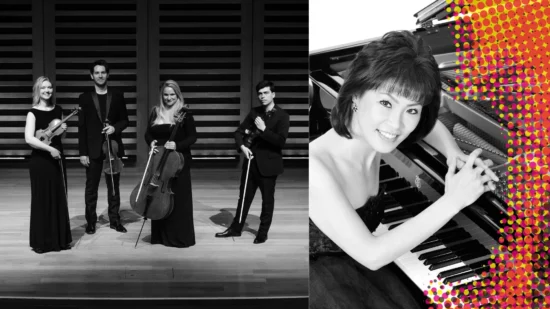
 United Kingdom Mendelssohn, Phibbs, Brahms, Remembrance and Renewal: Noriko Ogawa (piano), Piatti String Quartet (Michael Trainor, Emily Holland [violins], Miguel Sobrinho [viola], and Jessie Ann Richardson [cello]). Hall One, King’s Place, London 13.5.2026. (PC)
Mendelssohn – String Quartet No.2 in A minor, Op.13
Joseph Phibbs – Piano Quintet (world premiere); Elegy for Steven Stucky
Brahms – String Quartet No.1 in C minor, Op.51, No.1
With the first performance of Joseph Phibbs’s Piano Quintet at its core, this recital given by the Piatti Quartet and pianist Noriko Ogawa at London’s King’s Place offered polished and committed interpretations of satisfying and well-chosen repertoire. The event’s title, ‘Remembrance and Renewal’ alludes to the inclusion in the programme of recent commemorative works and also the scheduling of a pair of string quartets by 19th-century German composers that both looked back, due to their indebtedness to Beethoven, and also revitalised the genre in different ways.
Proceedings began impressively with an intensely rapt and refined reading of Felix Mendelssohn’s String Quartet No.2 in A minor (1827). The work’s slow introduction and extended epilogue are both preoccupied with the composer’s love song, Frage, Op.9, No.1, with its three-note questioning motive, ‘Is est wahr?’ and the performance gave due weight to these deeply expressive passages without overshadowing the rest of the piece. Indeed, in the players’ compelling and ideally balanced account, a profoundly eloquent, surprisingly volatile Adagio and an appealing, exquisitely crafted Intermezzo deftly counterpoised the variegated and, at times, vigorously contrapuntal outer movements.
Joseph Phibbs has worked with the Piatti Quartet and pianist Noriko Ogawa on several occasions over the last ten years and his new Piano Quintet (2026) provided an ideal opportunity to bring these musicians together. The piece is written in memory of the composer’s former teacher and friend Steven Stucky (1949-2016) to mark a decade since his untimely death. There was a reflective, contemplative aspect to much of the music with more energetic, acclamatory episodes bringing a palpable sense of appreciation and gratitude. The quintet began with a predominantly hushed Andante movement in which, flowing out of silence, the piano’s fragile, distractedly repeated figurations were juxtaposed with the quartet’s songlike, rising and falling figures. The central Con bio brought pulsing energy and radiance with assured, sometimes forceful keyboard writing holding sway. In his programme note, the composer suggests that the closing Andante might be heard as a ‘vocalise’ and the five players responded instinctively to each other in a solemn interplay of lyrical lines. An incisive, fast coda rounded off the piece with bite and resolve. Noriko Ogawa and the Piattis brought heartfelt commitment and an improvisatory freshness to material tailor-made for their musicianship. It is hard to imagine this rewarding and indispensable addition to the chamber music repertoire being shaped and illuminated by more persuasive or impeccable advocates.
As an apt supplement to this premiere performance, Noriko Ogawa remained on the stage after the hearty and well-deserved applause for the new work to give a beautifully phrased and spontaneous-sounding rendering of the brief piano piece, Elegy for Steven Stucky, written by Phibbs in 2016. This withdrawn, melancholy miniature with its poised reiterations of a heartfelt phrase, chimed beautifully with the more elegiac elements of the composer’s quintet and brought the recital’s first half to a thoughtful and refined close.
After the interval, the Piattis presented a deeply felt and precisely articulated performance of the String Quartet No.1 in C minor by Brahms. There was fervour and warmth as well as power and energy in the outer Allegros, while the Romanze second movement was invested with wistful lyricism and the following intermezzo-like movement had a shadowy allure. The performance of the Brahms work was dedicated by the players to the late Günter Pichler, founder and first violin of the Alban Berg Quartet, who was a mentor to first violin Michael Trainor and cellist Jessie Ann Richardson. It was a fitting tribute, technically secure, musically sensitive and acutely alert to the pathos and stoicism as well as the grandeur of Brahms’s vision.
As a welcome encore, the players chose the Cantilena from Joseph Phibbs’s String Quartet No.4, which was written for them in 2024. This enchanting short movement, with its gently recurring melody rising inexorably from the depths of the cello up to the first violin’s highest register, cast a spell over the audience and set the seal on an evening’s music-making of the highest order.
Paul Conway