
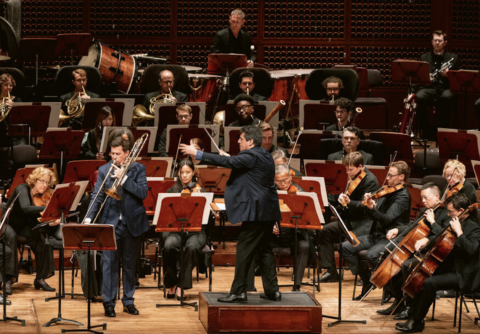
 Various: Timothy Higgins (trombone), San Francisco Symphony / Miguel Harth-Bedoya (conductor). Davies Symphony Hall, San Francisco, 29.5.2026. (HS)
Ginastera – ‘Dances’ from Estancia
Jimmy López – Shift (SF Symphony commission and US premiere)
Turina – Danzas fantásticas
Ravel – Rapsodie espagnole
Jimmy López’s new trombone concerto, a virtuosic dive into the instrument’s possibilities, was the least Spanish work in a rousing concert that celebrated symphonic music inspired by the Spanish-speaking world, but it was the most arresting.
López, born in Lima, Peru, and currently a Californian, is composer-in-residence for the San Diego and Montreal symphony orchestras. His works include the opera Bel Canto (based on the Ann Patchett novel), premiered by Chicago Lyric. Shift, the trombone concerto, premiered in June 2024, with the much-acclaimed Jörgen van Rijen (the concerto’s dedicatee) and Tarmo Peltokoski conducting the Rotterdam Philharmonic.
For the U.S. Premiere of the SF Symphony-commissioned concerto, Timothy Higgins, who has been principal trombone in this orchestra since 2008 and now is the principal trombone of the Chicago Symphony, was tabbed as the soloist. From the first a cappella phrases, he grabbed onto López’s music and ran with it thrillingly.
The title Shift reflects López’s inspiration for the concerto: the Doppler effect. We experience it most often when an emergency vehicle’s siren seems to reach toward a higher pitch as it approaches and lowers as it moves away. The effect applies to waves other than audio, including water and light. López’s music reflects water by adjusting tempo (think of ocean waves) and light by painting the solo lines and orchestration with shifting colors. Though the music is not terribly obvious about it, I could hear these aspects as melodies rose and fell and paces sped up and slowed. Harmonies brightened and darkened, and the textures of the solo lines thickened and faded.
Higgins was up to the technical challenges too. At one phrase, he made an astonishing jump from a fortissimo at the bottom of the instrument’s range and, without a breath, conjured a pianissimo note well above the instrument’s normal range. And then, seconds later, repeated that. He spun out rapid triple-tonguing in those opening a cappella statements and multiple versions of the phrases throughout the piece.
A composer himself – a performance last year of his eight-minute tone poem ‘Market Street 1920’ outshone Brahms and Tchaikovsky on a program here – Higgins lent a natural understanding to what López had fashioned musically. He executed the soft-textured lyrical second and third movements gracefully and the finale, which recalled elements from the first three in an endlessly fascinating kaleidoscope, was even better.
And, of course, there were glissandos – it wouldn’t be a trombone piece without them. They were neither specific impressions of Doppler-effect sirens nor introduced for comedy, as often happens in orchestral music. They were more like a singer’s tastefully applied portamento.
All this added up to a dazzling 25 minutes which, despite its decidedly un-Latin style, fit nicely with the rest of the program’s Spanish-accented music. Argentinian composer Alberto Ginastera’s Estancia, Cátalan composer Joaquin Turina’s Danzas fantásticas and Maurice Ravel’s Rapsodie espagnole (a French composer’s ode to Spain) made for a lively evening of drama and high-octane rhythms.
There may have been a sense of sameness to the construction of all of these suites. Each opened and closed with broad, energetic dance music around briefer middle movements or sections of sensuous slower music. Conductor Miguel Harth-Bedoya, who like López was born and raised in Peru, certainly had a feeling for the rhythms and outsized melodic gestures, even if he missed enough layering of dynamics in the suites.
Though played with enviable precision and enthusiasm, Ginastera’s 1941 Estancia had the roughest edges. It is all about intensity, especially the breakaway-speed ‘Malambo’ finale. The wildness of the music came through clearly although the thump-thump gestures delineating each chorus were a bit soft.
The sexiness of Turina’s 1919 Danzas fantásticas shone nicely, living up to the movement titles Exaltación, Ensueño and Orgia. The middle movement was especially tender, one of the few sensitive moments in the suites.
Ravel’s 1908 Rapsodie, probably the best-known piece on the program, emerged with density and definition, the sort of music that grabs an audience by its lapels and doesn’t let go. It made for a heart-thumping finish.
Harvey Steiman