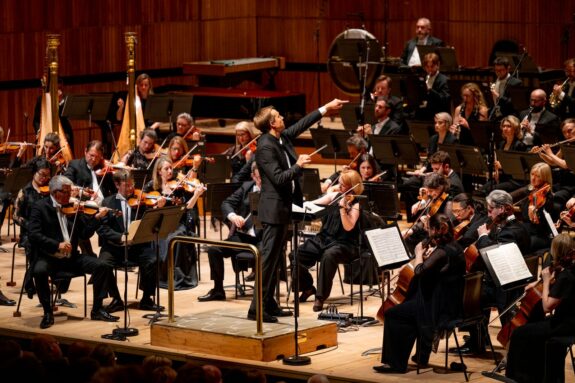
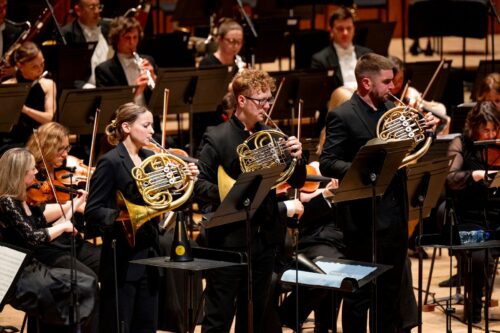
 United Kingdom Rachmaninov, Hisaishi, Scriabin: Alexander Edmundson, Ben Hulme, Katy Woolley (horns), Royal Philharmonic Orchestra / Vasily Petrenko (conductor). Bristol Beacon, 4.6.2026. (CK)
Rachmaninov – Isle of the Dead
Joe Hisaishi – The Border (Concerto for Three Horns and Orchestra)
Scriabin – Symphony No.3, ‘The Divine Poem’
In this magnificent concert from Vasily Petrenko and the Royal Philharmonic Orchestra two seldom-played Russian masterpieces framed the UK premiere of a work by Joe Hisaishi, a composer whose work crosses geographical and cultural frontiers with ease: a prolific film composer – he has been called Japan’s John Williams – his work for the concert hall forms a relatively small part of his output. Asked to write a horn concerto, as an avowed minimalist (following Terry Reilly, Philip Glass et al) he needed something for the soloist to play patterns against, to go gradually in and out of phase with; it was hearing Robert Schumann’s Konzertstück for four horns that showed him the answer. Turn the solo horn into a trio.
As a piece of concert music – three movements, 25 minutes – did it work? I didn’t think so. In the first movement, Crossing Lines, the three (excellent) soloists played endless fast rising figures, sounding as though they were having an urgent, muttered conversation amongst themselves, whilst the orchestra played chirpy rhythmic patterns of their own. The second movement – The Scaling – was more interesting: the horns at the bottom of their compass, accompanied only by the timpani; the horns open and stopped; Ben Hulme playing an evocative solo, the other two blowing through their mouthpieces. Again, an insistent four-note rising figure.
The third movement – The Circles – had bright, John Adams-like energy, with tricky open and stopped rhythms for the horns. I just wanted them to be allowed to let fly! There was some attractive music for them towards the end, including a slow, reflective cadenza-like passage; but the performance has, for me, left little or nothing behind. My failure to appreciate what Hisaishi was up to, perhaps. I have nothing but praise for Alexander Edmundson, Ben Hulme and Katy Woolley’s performance of what sounded like technically very challenging music. Perhaps it felt a little lightweight after the intensity of the Rachmaninov that had preceded it.
Arnold Böcklin’s The Isle of the Dead is one of 19th-century art’s indelible images; unsettling and macabre, it retains its ability to trouble one’s dreams. I was not familiar with Rachmaninov’s response to it for large orchestra: Petrenko was superb at sustaining the slow, inexorable pull from its mysterious opening on harp, low strings and timpani to its darkly majestic climax, the strings passionate, the brass glowering, the timpani tremendous. As so often in Rachmaninov’s music the Dies Irae materialises, at first insistently on the clarinets: as the music seems to sink back into the dark water it is still there, on the bassoons. The last sound is a plangent minor chord on the oboes.
I mustn’t harp on about the synergy between Vasily Petrenko and the RPO, but every time I hear them something wonderful happens. Or, as here, two things. Scriabin is nothing if not excessive, some might say self-indulgent: how conductor and orchestra were able to perform his Third Symphony, ‘The Divine Poem’ – a 50-minute wallow – so cogently, its musical line and its perfumed intensity never slackening, is beyond my comprehension. The orchestra is enormous – quadruple woodwind, twenty brass – yet we were able to hear everything: it never descended into mush. There are some clear and memorable motifs – including a powerful seven-note motto theme – that emerge from a Wagnerian wash of sound; saturated, harp-spangled textures, gorgeous strings, a mighty gong… Petrenko drew out strands and streamers of sound from the crowded platform in front of him, driving the faster sections, clearly demarcating the contrasts of tempo and texture. A fanfare on first trumpet; a lovely passage for the leader; an aviary of flutes; an exquisite pastoral scene… and this being Scriabin, an earth-shattering conclusion; in the timpanist’s final extended drumroll the arc of his sticks was up to his ears. It is a magic carpet of a piece; in this performance it was superbly disciplined, never dragging, and alive in every bar.
Since Petrenko was on the platform at Temple Meads, waiting for the same train as me, I congratulated him on the performance. He was most affable; he thought Bristol Beacon too small an acoustic envelope for the piece – when his namesake Kirill Petrenko and the Berlin Philharmonic perform it at the BBC Proms in September there will be more space for it to expand into. That may well be the case; but it merely underlines the fact that the clarity of this performance bordered on the miraculous. I may or may not get to that concert in the Royal Albert Hall: but if I do, I don’t think it will erase the impact of this performance from my memory.
Chris Kettle
Featured Image: Vasily Petrenko conducting the RPO (at the Royal Festival Hall) © Sarah Louise Bennett/RPO