 United States ‘Echoes of Ireland’ – Turlough O’Carolan and others: Apollo’s Fire / Alan Choo (conductor). Bath Church, Akron, Ohio, 17.6.2026. (MSJ)
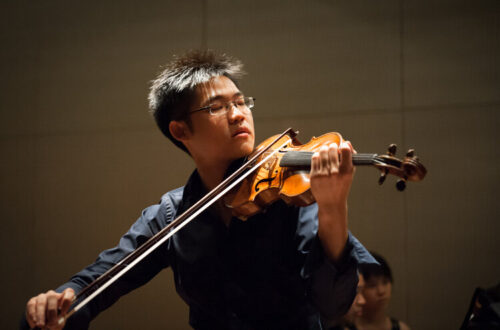
Performers: Alan Choo (fiddle), Sam Kreidenweis (baritone), Anna O’Connell (harp and vocals), Brian Bigley (Uilleann pipes, Irish flute, whistle, bodhrán, dance), Luke Conklin (recorder, flute, oboe, whistle, harp), Caitlin Hedge (fiddle & vocals), William Simms (lutes & guitar), René Schiffer (cello)
In a program five years ago (revew here), Apollo’s Fire presented a wide-ranging list of works that included a song by the man considered the last great bard of Ireland, Turlough O’Carolan (1670-1738). In ‘Echoes of Ireland’, that seed blossomed into an entire program built around O’Carolan’s life and music, a rewarding journey that ranged from deep melancholy to boisterous dance.
O’Carolan was a blind harper who created songs as he traveled around Ireland performing. However, he did not write those songs down in the manner of a composer, although he was aware of contemporary classical music in Europe and even reflected it in some songs. His songs were written down by others years later, typically surviving as melodies without accompaniment, which requires today’s performers to work extensively to adapt the tunes for ensembles. Much of that arranging was done for this concert by Alan Choo and René Schiffer, the associate artistic director and principal cello of Apollo’s Fire. The O’Carolan songs were interwoven with similarly arranged British folk songs and a few classical works of the period.
Choo and guest fiddler Caitlin Hedge drove the folk dances with high energy and a wonderful contrast in the tones of their instruments: Choo sounded bold and bright while Hedge’s playing was more veiled and mysterious. Characteristically for this group, when a suite of dance numbers was played they didn’t just give us a highlights medley, they played full realizations of each dance with solos from various players, as it should be.
Anna O’Connell headed the harp numbers, central to the music of O’Carolan, and was deftly supported by harpist Luke Conklin who also played flute, whistle and a gloriously tart oboe. O’Connell sang in several numbers, demonstrating where her pliant harp phrasing has its origins in lilting vocal lines, and Hedges joined in the vocals in numerous places, harmonizing to perfection. The cornerstone of the vocal pieces, though, was baritone Sam Kreidenweis, whose glowing, resonant voice carried both energy and emotion, whether singing a mischievous folk song like ‘The Cutpurse’ (borrowing Apollo’s Fire music director Jeannette Sorrell’s arrangement) or one of O’Carolan’s longing airs of unrequited love to a woman named Bridget Cruise. Kreidenweis is magnetic.
O’Carolan’s encounter with Italian composer Francesco Geminiani is said to have ended in Geminiani declaring O’Carolan a true genius. This encounter was highlighted in the pairing of Geminiani’s ‘An Irish Tune’ with ‘O’Carolan’s Concerto’, an instrumental number showing the bard’s awareness of the continental baroque style. Stirring performances of songs from John Dowland and Henry Purcell fleshed out the classical angle of the program.
Busy and highly accomplished throughout the concert was Brian Bigley, who had started the evening by leading the ensemble in from offstage playing ‘Brian Boru’s March’ on the Uilleann pipes (which, according to his website, he makes as well as plays). After that, he was active on almost every song, playing the pipes, whistle and Irish flute or drumming with a bodhrán. And near the end of each act, he took center stage and had his feet flying in some tremendous Irish dancing.
William Simms and Schiffer had vigorous solo moments as well as powering the ensemble from beneath as a spring-wound continuo. Choo balanced vigor and grace as he led the ensemble, yet he knew when to put the emphasis on others. Choo also wrote and designed the informative program book which wrapped up the 2025/2026 season impressively.
The only possible complaint this critic could have is that with all these delightful songs, selected from O’Carolan’s catalogue of 214 surviving airs (or 226, if you count the dozen disputed attributions), Apollo’s Fire managed to miss my personal favorite, the ‘Lament for Charles McCabe’, as arching and aching a melody as I have ever heard. (Investigate the performance by Andrew Lawrence-King and The Harp Consort for a powerful realization on YouTube.) If this program is revisited in the future, perhaps that addition could find its way into the set. Hint, hint.
Mark Sebastian Jordan