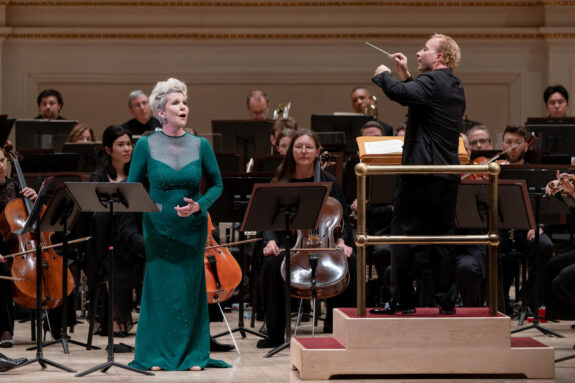
 United States Saariaho, Mahler: Joyce DiDonato (mezzo-soprano), The Met Orchestra / Yannick Nézet-Séguin (conductor). Stern Auditorium, Carnegie Hall, New York, 18.6.2026. (ES-S)
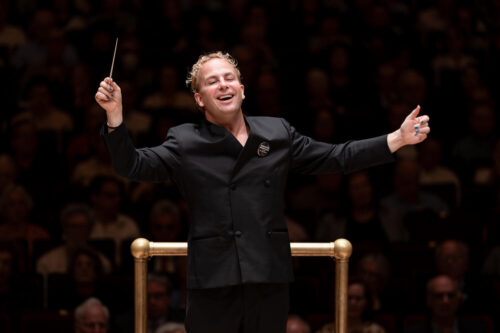
Saariaho – Lumière et pesanteur
Mahler – Rückert-Lieder; Symphony No.4 in G major
For Carnegie Hall’s final orchestral performance of the regular season, Yannick Nézet-Séguin and The Met Orchestra offered a program poised between the claims of earthly existence and the promise of spiritual release. With Saariaho’s Lumière et pesanteur opening onto Mahler’s Rückert-Lieder and Fourth Symphony, the evening suggested a journey toward radiance – but not one easily attained. It had to pass through renunciation, solitude, memory and dream.
Saariaho’s brief Lumière et pesanteur served as more than an introduction. Its title is almost a description of Saariaho’s soundscape: timbre appears weightless yet continually gathers density. Drawn from the world of La Passion de Simone, her meditation on Simone Weil, the piece carried into purely orchestral terms the philosopher’s opposition between gravity and light. Nézet-Séguin shaped the score with patience and restraint, letting its sonorities gather, hover and dissolve rather than pressing them toward a conventional climax. The strings generated a fine-grained luminosity while wind and brass sonorities emerged as if through shifting layers of mist, the music’s surface beauty touched by a trace of eeriness. The orchestra’s coloristic resources – so often hidden in the opera pit – were on impressive display.
Joyce DiDonato approached Mahler’s Rückert-Lieder as an inward drama rather than a display of vocal amplitude. Mahler’s five songs rarely fit a single voice type comfortably, moving from lyrical lightness to nocturnal weight and almost disembodied withdrawal. The mezzo-soprano kept the phrasing focused and the emotion inward, most persuasively in the quietest passages where her voice took on a confidential intensity and drew the listener into the private space of Rückert’s poems. At other points, especially in the higher register when set against a more voluminous ensemble sound, the voice acquired a degree of hardness. ‘Blicke mir nicht in die Lieder’ carried a quicksilver, furtive charm, while ‘Ich atmet’ einen linden Duft’ floated on lightly suspended phrasing. ‘Liebst du um Schönheit’ brought a warmer, more direct tenderness, and ‘Um Mitternacht’ darkened into spiritual reckoning. Nézet-Séguin again proved a sensitive accompanist, keeping textures transparent and giving each song its specific color without any hint of operatic excess. ‘Ich bin der Welt abhanden gekommen’ was the natural culmination: the orchestral fabric receding around the voice until the song seemed suspended in stillness.
After intermission, Mahler’s Fourth Symphony carried the program into a more ambiguous realm where innocence and unease are not easily separated. Nézet-Séguin drew out the delicacy and transparency of Mahler’s writing, its voices hovering with remarkable grace. Strings and woodwinds responded vividly and accurately to the conductor’s demands, giving the music clarity, color and nervous life. The brass were less consistently secure, with occasional rhythmic and intonational blemishes disturbing the symphony’s otherwise finely calibrated poise. In the first movement, the tempo felt too brisk for Mahler’s ‘without hurrying’ marking and some of the music’s deeper undercurrents passed by too quickly. Still, the pastoral surfaces were animated by quick shifts of color and by sly changes of perspective through which Mahler unsettles his own charm.
A buoyant Scherzo with grotesque edges sharpened that unease, though not as incisively as it might have. Concertmaster Benjamin Bowman’s scordatura violin had a suggestive, unsettled quality but never quite acquired the sardonic edge and mischievous charm of a ‘Freund Hein’ fiddler leading the village dance toward the precipice. The trios relaxed the tension without dispelling it, their apparent ease only making the solo violin sound stranger on its returns.
In the third movement, Nézet-Séguin again seemed to brush aside Mahler’s qualifier: his Poco adagio was slow enough to all but ignore the ‘somewhat’. There were moments of real eloquence: the opening drew a warm, homogeneous sonority from the lower strings; woodwind lines emerged with touching clarity; the climactic outburst had breadth and force; and the return to tranquility was shaped with genuine tenderness. Nevertheless, the movement’s long arc felt insufficiently sustained, more beautiful in episodes than inexorable as a whole.
Placed at the back of the orchestra for the ‘Das himmlische Leben’ finale, DiDonato offered a beautifully controlled performance. This was not quite heaven seen through a child’s innocent eyes but a vision refracted through an adult consciousness, bringing the text’s unsettling references to Herod and sacrificed lambs into relief. Nézet-Séguin kept the orchestral textures light, letting the final pages fade without insisting on their serenity.
Next Carnegie Hall season, Nézet-Séguin is scheduled to undertake a complete Mahler cycle with the Met and Philadelphia orchestras. One should look forward to the endeavor – not least because this performance revealed both his sensitivity to Mahler’s color and volatility and a still-evolving conception of the composer’s expressive logic.
Edward Sava-Segal
Featured Image: Mezzo-soprano Joyce DiDonato, conductor Yannick Nézet-Séguin and The Met Orchestra © Jennifer Taylor