
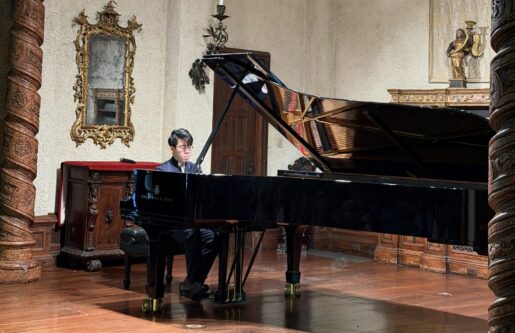
 United States Caramoor Festival [2] – Various: Aristo Sham (piano). Music Room of the Rosen House, Caramoor Center for Music and the Arts, Katonah, 11.7.2026. (ES-S)
Brahms – Capriccio No.1 in F-sharp minor, Op.76; Capriccio No.2 in B minor, Op.76; Capriccio No.3 in G minor, Op.116; Intermezzo No.3 in C major, Op.119; Intermezzo No.2 in A major, Op.118; Capriccio No.8 in C major, Op.76; Six Chorale Preludes Op.122 (arr. Busoni)
J.S. Bach – Chaconne from Partita No.2 for Solo Violin in D minor, BWV1004 (arr. Busoni)
Busoni – Variations on a Prelude by Chopin, BV 213a (after Chopin’s Prelude No.20 in C minor, Op.28)
Encore: Chopin – Nocturne No.2 in E-flat major, Op.9
At the most recent Van Cliburn International Piano Competition, Aristo Sham won both the gold medal and the audience award. His name may not yet be familiar to many New York concertgoers, but the full Music Room at Caramoor suggested that his Fort Worth victory, following earlier top prizes, had not gone unnoticed.
More revealing than the prizes themselves was the self-possession Sham displayed from the outset. Though still early in his international career, he played with the artistic assurance of a musician who knew precisely what he wanted to achieve. His interpretations were intense and powerful yet never seemed calculated merely for effect; each was grounded in a clearly defined conception and carried through with unwavering conviction.
The intermission-less program was unusually ambitious. Rather than assemble a sequence of familiar, immediately pleasing pieces, Sham placed Ferruccio Busoni at the center of a dialogue with Brahms, Bach and Chopin. A pianist-composer in the Lisztian tradition, Busoni treated transcription as a creative act in its own right. The three Busoni works revealed distinct facets of his art: the transcriber who expanded Bach’s violin writing into the monumental sonorities of the modern piano; the arranger who recast Brahms’s late organ chorales in a more intimate pianistic language; and the composer who used a Chopin prelude as the point of departure for his own invention. Sham explained this design lucidly from the stage. An excellent and engaging speaker, he clarified the connections underlying the program without turning the recital into a lecture.
The opening group of six Brahms miniatures, drawn from Opp.76, 116, 118 and 119 – some well-known, others seldom heard – was fashioned into what sounded like a carefully assembled suite, allowing echoes and contrasts to emerge among the pieces. Sham set the restless, sometimes explosive energy of the Capriccios against the greater inwardness of the Intermezzos. The celebrated A-major Intermezzo retained its place within the whole rather than emerging as an isolated moment of lyrical repose. The Schumannesque C-major Capriccio recalled both the somewhat awkward, good-humored dance gestures of Op.76, No.2 and the broad melodic sweep of No.1, before carrying the group into a brief final upward surge.
With Busoni’s transcription of Bach’s Chaconne, the scale of the recital expanded dramatically. Sham embraced the work’s grand dimensions, drawing an almost orchestral weight from the piano while preserving the sense of a single, continuously unfolding structure. In the central D-major section, he brought Bach’s harmonic shifts into especially sharp relief. The tension mounted through a succession of climaxes but, even at the height of the maelstrom, the performance never dissolved into a mere display of virtuosity.
Busoni’s arrangements of six of the eleven chorale preludes from Brahms’s Op.122, ranging between contrapuntal and homophonic textures, offered a contemplative counterweight to the Chaconne. Sham resisted treating them uniformly as somber or valedictory. Across these successive layers of reinterpretation – Brahms’s transformation of the chorale melodies, Busoni’s transfer from organ to piano and Sham’s own reading of the transcriptions – the contrasts among the six pieces remained clear. ‘Herzlich tut mich erfreuen’, a hymn anticipating the pleasures of summer, retained its brightness and gentle animation, while the concluding ‘O Welt, ich muss dich lassen’ was rendered with serenity rather than anguish. Sham’s control of tone gave the music gravity without imposing heaviness.
The recital concluded with Busoni’s Variations on a Prelude by Chopin, based on the familiar Prelude No.20 in C minor. Busoni first treated the theme in 1884 in an expansive set of eighteen variations and a fugue, returning to it almost four decades later to condense and lighten it radically: some of the original variations were discarded, others substantially reworked and several new ones added. Elements of the original fugue were recast in the fugue-like Scherzo finale, marked Vivace misurato – evidence that Busoni was rethinking not only Chopin but also his own youthful work. In the later form heard here, the theme becomes less an object of homage than material for continual reinvention, at times disappearing almost completely. Sham clarified its rapidly changing guises, from the bell-like sonorities of ‘En carillon’ through passages with almost jazzy inflections to the waltz rhythms of the ‘Hommage à Chopin’, before propelling the Scherzo’s return with tremendous energy. The result was unmistakably Busonian – and a fitting culmination to a recital devoted to the creative possibilities of transformation.
A Chopin Nocturne made a fitting encore: after Busoni’s continual reinvention of his music, the composer was heard in his own voice.
Edward Sava-Segal