 United Kingdom Wagner, Tristan und Isolde: Soloists, London Symphony Chorus (director: Mariana Rosas), London Symphony Orchestra / Sir Antonio Pappano (conductor). Barbican Hall, London, 12.7.2026. (JPr)
When Wagner was composing Act III of Tristan und Isolde he wrote to his muse Mathilda Wesendonck: ‘I fear the opera will be banned – unless the whole thing is parodied in a bad performance – only mediocre performances can save me! Perfectly good ones will be bound to drive people mad – I cannot imagine it otherwise’. Well, a good one – well excellent one actually – in the Barbican Hall brought most of the audience to their feet when the music stopped after five hours (including intervals of course). Soloists, the London Symphony Chorus and Orchestra had returned to the Barbican having performed the opera first on 1 July and then subsequently at Baden-Baden.
The LSO’s chief conductor Sir Antonio Pappano (The Royal Opera’s first-ever conductor laureate) is not particularly remembered for conducting Tristan at Covent Garden – as we associate him more with Ring cycles past and present – though there was a very well-received recording with Plácido Domingo, Nina Stemme and his Royal Opera House orchestra in 2005. Returning to Tristan now, Pappano never allowed the pace to slacken and whilst there was often scrupulous attention to detail he occasionally tended to gloss over the more reflective episodes – in Isolde’s Act I narrative, the love duet in an unaccountably cut (for 2026) Act II, and Tristan’s third-act delirium – whilst prepared to give the moments of supreme drama everything he and the orchestra could offer. This was also true for Sara Jakubiak’s concluding ‘Verklärung’: she was making her role debut as Isolde and clearly this was the first part of the role she had studied – and it showed – and whilst undoubtedly compelling and sung with commendable radiance it did not have the emotional depth of this ‘transfiguration through love’ I have heard from others singing the role.
Also, Pappano sometimes let his musicians have their own way too much and so a shift in dynamics towards the singers would have been appreciated as they were sometimes challenged by the sheer volume of exquisitely burnished tone (especially from the strings) coming from the massed ranks behind them. This would not happen of course at the Bayreuth Festspielhaus which has given me – for good or ill – my abiding musical memories of Tristans under Christian Theilemann. Some individuals in the orchestra made significant solo contributions throughout the evening particularly from amongst the woodwinds.
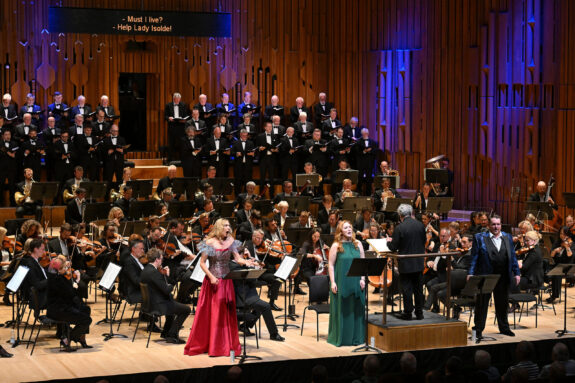
Over the years there have been tirades from me against concert performances of operas with music stands and no interaction between artists. This has developed over recent years, but more often than not, these are often hybrid occasions with some singers secure with their parts, others singing ‘on the book’. Here devoid of costumes and props – and in an odd mix of semi-formal outfits the sold-out Barbican Hall only intermittently experienced the true drama of the Tristan story. In 2000, I saw René Kollo’s final Tristan at the Deutsche Oper Berlin (again conducted by Thielemann), his portrayal was the most dramatically convincing I had experienced – until now! Kollo had pushed his voice to the very edge of what was physically possible during the crazed, feverish outpourings in Act III.
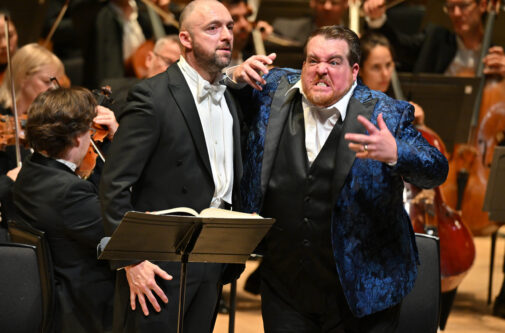
Clay Hilley – confined by a concert performance – gave an equally visceral performance in my opinion and one I will long remember. Hilley is not a heroic tenor (thankfully) in the mould of Andreas Schager (often heard shouting on pitch); Hilley is considerably more lyrical and in the mould of the much-missed Alberto Remedios whose open-faced onstage persona Hilley also shared many qualities with. Hilley conjured up a most effecting ‘Isolde!’ before expiring or rather retiring back down to his chair from which he had earlier risen to perform this mammoth role from memory and commanding our attention all the better for it. Though Hilley (in a silvery tuxedo jacket) was keen on acting his role, the others often did not (apart from vocally); in Act I Hilley mimed drinking his death potion and proffered it to Isolde who did not react; in Act II he showed Tristan prepared for Melot’s sword while Gyula Orendt’s Melot did not react either; and in Act III he was ‘slumbering’ on his chair until roused, and that was reflected in the audience by one of the country’s senior music critics who was spotted catching up with his sleep.
Dressed in green Sara Jakubiak looked that she was born to be Wagner’s flame-haired ‘wild Irish maid’ and most of the time she sounded it too. Jakubiak could often sustain a beautiful vocal line whilst tracing her character’s physiological arc from vengeful fury to ecstatic transcendence. Her soprano had suitable – as appropriate – cutting edge top notes, flexibility, weightlessness or feeling and her interpretation can only go from strength to strength.
Whilst I was happy Marina Prudenskaya’s Brangäne was – almost for once these days – totally distinct vocally from Jakubiak’s Isolde I was left rather ambivalent about her dark, resonant sound and scooping up to the note. For me Brangäne didn’t seem a natural fit for her even though there was a ‘fitting’ haunting quality to her offstage ‘Einsam Wachend’ in Act II.
There was a very solid ‘supporting cast’, with Gyula Orendt as a mellifluous Kurwenal, perhaps too mellifluous when he approached some of his Act III singing as if it was Lieder. Orendt’s Kurwenal was clearly loyal to his master but had little of the old retainer about him. The sonorous Franz-Josef Selig was the personification of a noble, dignified, deeply hurt, ultimately regretful King Marke and the expressivity and clarity of diction of his singing was immense. Making the most of the vignettes Wagner allots them were Neal Cooper’s Melot, Michael Gibson Sailor/Shepherd and James Emerson’s Steersman. Finally, for me, the contribution of an over-manned selection of tenors and basses from the London Symphony Chorus was more stentorian than atmospheric as the Wagner’s Act I sailors, knights and squires.
Jim Pritchard
Featured Image: Marina Prudenskaya (Brangäne), Sara Jakubiak (Isolde) and Clay Hilley (Tristan), London Symphony Chorus and Orchestra and conductor Sir Antonio Pappano (1 July performance) © Mark Allan
Cast:
Clay Hilley – Tristan
Sara Jakubiak – Isolde
Marina Prudenskaya – Brangäne
Franz-Josef Selig – King Marke
Gyula Orendt – Kurwenal
Neal Cooper – Melot
Michael Gibson – Sailor / Shepherd
James Emerson – Steersman