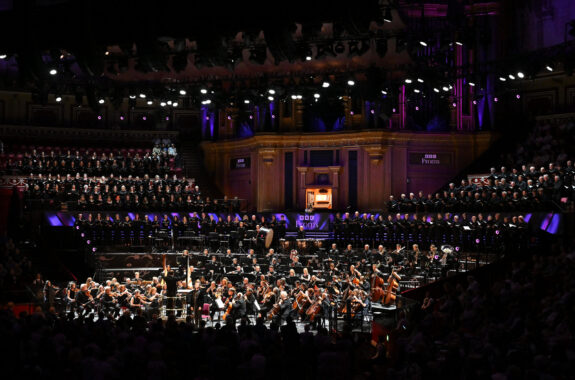
 United Kingdom BBC Proms 2026 [4]- Various: Mari Eriksmoen (soprano), Paula Murrihy (mezzo-soprano), James Way (tenor), Szymon Mechliński (baritone), London Philharmonic Choir, BBC National Chorus of Wales, BBC National Orchestra of Wales / Ryan Bancroft (conductor). Royal Albert Hall, London, 23.7.2026. (AV-E)
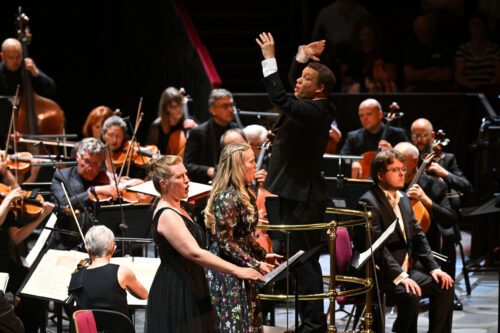
Lili Boulanger – Vieille prière bouddhique
Szymanowski – Stabat Mater
Messiaen – L’Ascension
Richard Strauss – Death and Transfiguration
This concert was titled Afterlife: Visions of the Beyond, and Ryan Bancroft invoked and inhabited that vision, leading the BBC National Orchestra of Wales through an evocative exploration of transcendence in 20th-century music. Across Boulanger, Messiaen, Szymanowski and Richard Strauss, he revealed a rare ability to illuminate the spaces between mystery and revelation, mortality and eternity, drawing performances that opened portals between the earthly and the eternal.
I am ashamed to admit that I had never previously heard Lili Boulanger’s Vieille prière bouddhique, a nine-minute masterpiece of orchestration whose colossal expansiveness made it feel as long as Verdi’s Requiem, a reminder that music can overturn our ‘commonsense’ assumptions about time itself, transporting us beyond ordinary clock time into an ontological experience of duration. Music can never be measured by the clock because music takes its own time, taking time out of clock time.
The acutely attuned Bancroft shaped the performance with exceptional sensitivity, allowing Boulanger’s intricate soundworld to unfold with tranquil delicacy and natural inevitability. The BBC NOW responded with playing of extraordinary refinement, revealing the composer’s miraculous orchestral palette with total transparency and complete commitment. James Way’s tenor contribution emerged with radiant purity and expressive restraint, blending seamlessly into the orchestral texture while adding a human warmth to the work’s spiritual atmosphere. It was a performance of rare concentration and beauty, with Bancroft and the orchestra revealing the timeless mystery and overwhelming expressive power contained within Boulanger’s massive ‘miniature’.
Immediate juxtapositions can be cruel. Following the extraordinary orchestral imagination of Vieille prière bouddhique, Karol Szymanowski’s Stabat Mater was academic, pedestrian and conservative, unimaginative in its orchestral conception. The contrast was stark: where Boulanger created a world of luminous colour, mystery and transcendence, Szymanowski’s orchestration was dull and dreary, lacking the same sense of invention, individuality and expressive imagination. Indeed, despite Lili Boulanger’s tragically short life, Vieille prière bouddhique alone provides overwhelming evidence of a composer of exceptional originality and genius, possessing an orchestral imagination far greater than that revealed in Szymanowski’s Stabat Mater which is even more tedious and tiresome than Fauré’s Requiem.
Thankfully, the performance itself was of the highest calibre. The BBC National Chorus of Wales and London Philharmonic Choir were absolutely magnificent, bringing extraordinary richness, warmth and emotional conviction to Szymanowski’s setting. Their combined sonority possessed a powerful spiritual intensity, with every vocal line delivered with remarkable precision and commitment. The soloists — Mari Eriksmoen, Paula Murrihy, James Way and Szymon Mechliński — contributed with great distinction, shaping their individual lines with sensitivity and expressive focus. Bancroft conducted with complete confidence, eliciting eloquence and exquisiteness from all forces involved and ensuring that, despite my reservations about the orchestral language, the work’s dramatic and devotional qualities were fully realised.
Olivier Messiaen’s L’Ascension was the work I had most eagerly anticipated in this Prom, a masterpiece of twentieth-century music that is still far too rarely encountered in the concert hall. Composed in 1932–33, it represents one of Messiaen’s earliest great statements of faith, already revealing his extraordinary ability to transform orchestral sound into a language of spiritual transcendence. Across its four movements, L’Ascension explores not narrative drama but states of contemplation, ecstasy and revelation, with a soundworld in which brass, woodwind, strings and percussion are fused into something both earthly and otherworldly. Bancroft and the BBC NOW entered fully into this extraordinary universe, revealing the work’s immense architectural scale, mystical atmosphere and astonishing originality of colour.
The opening movement, Majesté du Christ demandant sa gloire à son Père, immediately established Messiaen’s extraordinary ability to transform orchestral sound into a vision of the sacred. The opening brass chorales were played with a burnished, resplendent intensity, combining a blazing sonority of luminous brilliance and numinous mystery with an austere, otherworldly purity that suspended the music between earthly power and celestial radiance. The monumental, processional unfolding of the movement created a sense of vastness and spiritual gravity, with the immense brass sonorities suggesting an immaterial grandeur rather than conventional triumph. The spacious acoustic of the Royal Albert Hall worked wonderfully in Messiaen’s favour, allowing the brass resonance to expand naturally through the hall while retaining remarkable definition and clarity. In a drier acoustic such as the Barbican Hall, these densely layered brass sonorities risk sounding harsh and hard-edged, while in the Royal Festival Hall their projection would sound woolly and diffuse. Bancroft understood exactly how to balance grandeur with transparency, allowing the harmonic richness of the movement to bloom naturally and giving it a sense of timeless invocation — a prayer rising into an atmosphere of celestial splendour.
The second movement, Les eaux de la Grâce, offered a striking contrast: more fluid, intimate, and mysterious. Here Messiaen’s textures seemed to shimmer and breathe, with delicate instrumental colours evoking the movement and translucence of water. The music possessed a dreamlike serenity, its gentle waves of sound carrying an almost Eastern-perfumed sensuality, where the sacred and the elemental seemed to merge. The conductor drew out the subtle interplay of colour and resonance, allowing the movement’s quiet radiance to unfold with remarkable patience and poise.
The third movement, Alléluia sur la trompette, alléluia sur la cymbale, unfolded with an almost ceremonial inevitability. Messiaen’s writing here is a study in accumulating brilliance: the trumpet’s proclamations, the shimmering cymbal colours, and the increasingly ecstatic orchestral layers create the sensation of a sacred procession gathering momentum. The music does not simply grow louder; it intensifies through repetition, colour, and rhythmic insistence, as though drawing the listener towards an inevitable moment of revelation. The brilliance of the orchestration lies in the tension between splendour and restraint — the sense that something immense is approaching but has not yet been revealed.
Messiaen’s so-called ‘Exoticosm’ was vividly present in the percussion writing, with the tambourine’s sensuous, shimmering pulse evoking ritualistic musical traditions far beyond the Western canon. Messiaen’s rhythmic and melodic language was profoundly influenced by Hindu music, particularly the deçî-tâlas and Hindu rāga. Messiaen was also fascinated by Japanese Gagaku, its instruments and distinctive relationship between harmony and melody, while Balinese and Javanese music exerted an important influence on his conception of timbre. It is important to acknowledge the cultural appropriation evident here; and yet the result was musically compelling and commanding, a celebratory unification of cultural difference into a universal soundworld. Composers must respect borders. Music transcends borders.
The fourth movement, Prière du Christ montant vers son Père, brought L’Ascension to its final state of contemplation. Marked by its slow-moving harmonic progression and austere orchestral textures, the movement unfolded with an extraordinary sense of suspended time. The serene strings played with exceptional concentration, sustaining Messiaen’s long, arching phrases with remarkable patience and control, while the sparse orchestral writing allowed each sonority to emerge with immense significance. Bancroft’s mastery was evident throughout, his conducting balancing the stillness of the score with an acute awareness of its underlying tension and spiritual direction. The movement’s gradual ascent unfolded with complete inevitability, the orchestra rising towards its final affirmation before the closing sonority arrived with absolute precision: a perfectly judged conclusion that avoided sentimentality and allowed Messiaen’s vision to dissolve naturally into silence.
The closing work, Richard Strauss’s Tod und Verklärung (Death and Transfiguration), revealed Bancroft as a consummate Strauss conductor, with complete command of this scorching score’s immense demands. Arguably among the most difficult of all Strauss scores to conduct, it requires not only technical mastery but an innate understanding of pace, proportion, colour, and dramatic tension. Bancroft’s handling of the score’s intricate transitions was remarkable, each shift of atmosphere precisely judged and seamlessly connected. The climaxes were shaped with exceptional sensitivity — powerful without excess, inevitable rather than imposed — and the orchestra responded with playing of striking character, concentration, and emotional depth. What made the performance especially memorable was the complete partnership between conductor and orchestra: Bancroft’s assured authority of Strauss was matched by an ensemble response of extraordinary discipline and expressive intensity. The result was a reading that combined ferocity with refinement, and technical assurance with spiritual depth.
That such an outstanding concert played to a hall only two-thirds full was a considerable disappointment, as it deserved a far wider audience. Those present, however, were spellbound throughout, transported by an evening of mystical evocation, visionary imagination and transcendent beauty. The BBC Radio 3 broadcast ensured that this extraordinary journey beyond ordinary musical experience reached listeners far beyond the enigmatic spaces of the otherworldly Royal Albert Hall.
Alexander Verney-Elliott
Featured Image: Ryan Bancroft conducts the Afterlife: Visions of the Beyond Prom at the Royal Albert Hall © BBC/Mark Allan
Thank you for your detailed and encouraging review!
V perceptive and detailed review. I think you really captured the enigmatic essence of the Boulanger.