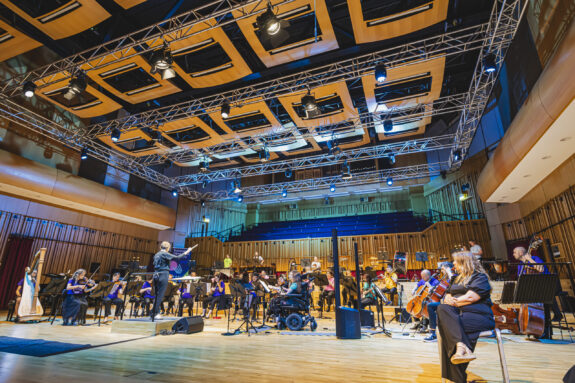
 United Kingdom Various: Members of the National Open Youth Orchestra and BBC National Orchestra of Wales / Alice Farnham (conductor). Hoddinott Hall, Cardiff, 30.7.2026. (LJ)
Charlotte Harding – The Orchestra: A Young Person’s Guide (2026)
Vivaldi – Excerpts from The Four Seasons (1723), ‘Spring’ (arr. Rhian Davies); ‘Autumn’ and ‘Winter’ (arr. Ellen O’Brien)
Oliver Cross – Barriers (2019, arr. Liam Taylor-West)
Florence Price – Juba Dance from Symphony No. 1 in E minor (1932, arr. Rhian Davies)
Michael Betteridge – Soaring Through Sparks (2023, arr. Julia Koelmans)
Accessibility was at the heart of this concert. At Cardiff’s Hoddinott Hall, eighteen disabled and non-disabled young musicians from the National Open Youth Orchestra (NOYO) joined thirteen guest players from the BBC National Orchestra of Wales for a relaxed performance lasting one hour. Ten brightly coloured beanbags at the front of the auditorium and undimmed lighting created a more informal atmosphere. This inviting ambiance enabled both the performers and their audience to settle into the story of the music. As violist Cass Alabaster narrated, this concert was about ‘how music tells stories and how we work together to make it sound amazing.’ NOYO’s story had a clear message: disability is no longer a barrier; it is a voice to be heard and celebrated.
The music itself afforded a compelling vision of what a contemporary orchestra can be, with values of inclusivity and accessibility prioritised alongside innovation and originality. The programme combined reimagined classics and new commissions with sections from Vivaldi’s ‘Spring’, ‘Autumn’, and ‘Winter’ sitting alongside works like Florence Price’s Juba Dance (from the third movement of Symphony No.1 [1932]) and Oliver Cross’s Barriers (2019). Throughout, different members of NOYO introduced each piece by giving a succinct description of its key features (with BSL interpretation by Julie Doyle).
Charlotte Harding’s The Orchestra: A Young Person’s Guide (co-commissioned by the BBC and NOYO this year) was the centrepiece of the afternoon. Harding described working with NOYO as ‘a privilege’ and referred to her piece as ‘an all-out celebration of the 21st-century orchestra; its rich past, present energy, and the infinite sonic possibility it holds for the future.’ It is a reimagining of Benjamin Britten’s orchestral work from 1945, in which Britten quotes Purcell’s famous theme (the Rondeau from Abdelazer), originally composed in 1695. With five movements titled ‘Particles’, ‘Individuals’, ‘Sections’, ‘Palettes’, and ‘Tutti’, Harding’s work showcases the textures and shape of an orchestra. It also combines traditional instruments with synthesisers, electronics, and the clarion which is an accessible digital instrument (performed using a touchscreen by Evie Read and via a Quha Zono headmouse by Alessandro Vazzana). The piece included audience participation in the form of clapping and repeating ‘this is our orchestra’ during the final movement. In their impassioned performance, NOYO demonstrated that an orchestra can be more than the sum of its parts.
This orchestral warmth could be felt in several of the pieces that NOYO performed, most notably Ellen O’Brien’s arrangement of Vivaldi’s ‘Autumn’. NOYO were also able to express their genuine enthusiasm for music-making. This could be heard in Florence Price’s exuberant Juba Dance (arranged by Rhian Davies), which draws on African American dance traditions with its vivacious syncopation and orchestration.
One of the standout moments was the orchestra’s performance of Oliver Cross’s Barriers. Cross, a former member of NOYO, wrote the piece as a reflection on obstacles faced by disabled musicians. He suggests that these barriers can be removed ‘by working together’. NOYO’s performance was compelling, with harpist Holli Pandit leap-frogging any barriers thanks to her considerable talent, good sense of timing, and infectious love of music.
If Cross’s piece broke down barriers, Michael Bettridge’s Soaring Through Sparks (2023, arranged by Julia Koelmans) defied the sheer existence of barriers in the first place. Bettridge originally composed this piece as the first concerto for clarion. Here, new technology did not stifle, but enabled creativity with soloist Alessandro Vazzana performing his electronic instrument with small, almost imperceptible head movements. Being able to see the notes that Vazzana played on the screen directly in front of him added a sense of synaesthetic wonder.
Indeed, this concert showed the audience how inclusivity and innovation can inspire creativity in each of us. The works performed demonstrated that the orchestra is a living, breathing organism that needs to evolve and grow so that it embraces who we are. NOYO’s performance was evidence that technology, adaptive instruments, and diversity do not mean that tradition will be replaced, but that it can be expanded. In this way, an orchestra can generate even more textures, sounds, and feelings.
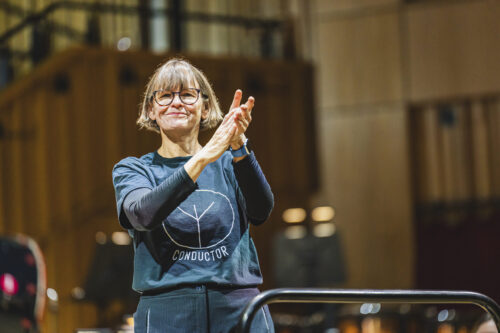
By conducting NOYO, Alice Farnham is once again leading the charge for fairer representation within the music industry. Her innate musicality and nurturing approach to her orchestra made this recital a joy to be a part of. To quote from the title of Farnham’s brilliant book on conducting, NOYO (and the audience) were ‘in good hands’.
In their wholeheartedly inclusive approach to music-making, NOYO, under Farnham’s baton, imbued in everyone at the Hoddinott Hall a feeling of belonging. The orchestra itself launched in 2018 as the world’s first disabled-led national youth ensemble with 75% of its musicians identifying as disabled or neurodivergent. Indeed, NOYO is not just an orchestra with a difference; it is making a difference. As Niamh Moriarty beautifully narrated during NOYO’s performance of Harding’s piece: ‘in this orchestra, everyone fits’.
Lucy Jeffery
Featured Image: Alice Farnham conducts the National Open Youth Orchestra with members of the BBC National Orchestra of Wales © Kirsten McTernan
Brilliant performance in Cardiff last week Amazing musicians