
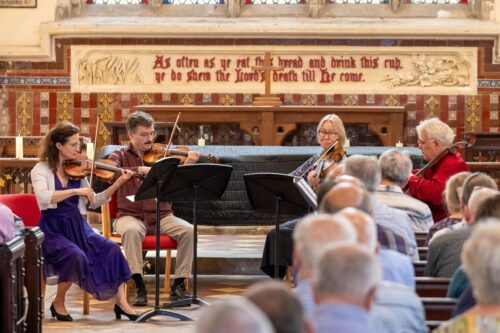
 United Kingdom Three Choirs Festival 2026 [10] – Howells, Wood: London Chamber Ensemble String Quartet (Madeleine Mitchell, Godon Mackay [violins], Bridget Carey [viola], Joseph Spooner [cello]). St Nicholas’ Church, Gloucester, 31.7.2026. (JQ)
In Town and Country
Herbert Howells – ‘Chosen’ Tune and Luchinushka from Three Pieces for Violin and Piano, Op.28 (arr. Madeleine Mitchell); String Quartet No.3 ‘In Gloucestershire’ (earlier version, 1920)
Charles Wood – ‘Highgate’ String Quartet (1893)
This recital, given in the pleasing acoustic of St Nicholas’ Church gave the opportunity to hear some unfairly neglected music by Howells and Wood; the Three Choirs Festival is marking the centenary of the death of the latter composer. Under the leadership of Madeleine Mitchell, the London Chamber Ensemble String Quartet (LCE) has embarked on a recorded survey of all of Wood’s string quartets for SOMM Recordings; two instalments have already been issued and the final release is due in January 2027. Jonathan Woolf for MusicWeb International gave a warm welcome to the first disc in the series (review here) and subsequently I covered its successor for MusicWeb (review here).
Fittingly, today’s concert was dedicated to the memory of Anthony Boden (1938-2025). Boden’s name will always be associated with the Three Choirs Festival. He gave a great deal of voluntary service, including acting as Administrator of the Gloucester festivals (1989-1999). But, surely, his greatest achievement was to write the definitive, indispensable history of the Three Choirs Festival (review here). Introducing the concert, David Francis, the Three Choirs CEO, paid tribute to Boden and mentioned that he was buried on Chosen Hill, just outside Gloucester. That is a local landmark which was well known to musicians such as Howells and Ivor Gurney, so it was highly appropriate that the first item on the programme should be Howells’ ‘Chosen Tune’. (As an aside, the dedication of Howells’ Piano Quartet in A minor (1916) is ‘To the hill at Chosen and Ivor Gurney, who knows it’.)
We heard the two pieces from Howells’s Three Pieces for Violin and Piano in string quartet arrangements by Madeleine Mitchell. I thought these worked very well. ‘Chosen’ Tune is quite short; the melody is suffused with English pastoralism. Luchinushka is rather longer. It is quite a haunting piece and the harmonies are adventurous.
Wood’s ‘Highgate’ String Quartet (1893) is his second composition in the genre. He named it in acknowledgement of his frequent visits to his older brother who was music master at Highgate Grammar School until his premature death in 1895. In the notes which accompanied the CD release, Wood’s biographer, Jeremy Dibble stated that at the time critics detected a ‘stylistic deference to Brahms’. I can understand where that judgement came from, especially in relation to the first and third movements of the work. The quartet is cast in four movements. The first, Allegro con moto, is most attractive and, it seems to me, well argued. The LCE’s performance had admirable vitality. The second movement, Molto moderato, is quite genial but has a more serious central section. The third movement, Adagio ma non troppo, is a serious creation. The music is, for the most part, pensive and I think this is the deepest part of the whole work. Wood concludes with a finale marked Molto animato. This is a forthright, cheerful movement and the LCE did it very well. This performance of the ‘Highgate’ Quartet was excellent and full of conviction. I wonder how many of us in the audience will ever get the chance to experience another quartet by Charles Wood in live performance. I suspect the answer is ‘not many’; based on what I heard today and have heard on the LCE’s two CDs, that is a great pity. Today’s performance made a very strong case for Charles Wood.
The history of Herbert Howells’s String Quartet ‘In Gloucestershire’ is quite complicated. In his review of the LCE’s recording, my colleague Jonathan Woolf summarised the background and I hope he won’t mind if I quote him. ‘Howells wrote a quartet in 1916 which was then almost immediately lost in a train. He rewrote it in 1920 with new material. After private performances, this version too disappeared. Before it disappeared, though, Howells replaced three of the movements, with only the Scherzo remaining largely intact. This is the version that’s usually played. However, in the 1980s a set of parts from 1920 was discovered and therefore it’s this “earlier” version, newly reconstructed, that is recorded here. It’s been edited by Jonathan Clinch and Joseph Spooner, the cellist of the London Chamber Ensemble Quartet.’
This 1920 version is in four movements. The first is Allegro non troppo. The music features lovely flowing melodies; as well as the tunes, I admired the richness of texture and harmony. As the movement unfolded there were several instances of romantic ardour in the writing; I also very much liked the fragile beauty of the end. It is a fine movement which was persuasively performed here. Next came Allego ma sempre ritmico. Here, the music seemed elusive and shadowy at times; it was well articulated by the musicians. The slow movement is marked Andante assai espressivo. I loved the yearning opening, despite the brief disruption of a mobile phone ringing; the music had grave beauty. This episode led into an extended passage which was more intense in nature, after which Howells reverted to the veiled, hushed beauty with which the movement began. This gem of a movement was played with eloquence. Howells rounded things off with a movement marked Presto scherzando. This is, essentially, a merry dance which was delivered with a fine degree of energy.
Madeleine Mitchell and her colleagues have done a notable service in bringing Howells’s lost quartet back to life. Notwithstanding the pleasures of the first half of their programme, I think this was the finest piece they played.
As an encore at the end of this fine recital the LCE treated us to the lively, entertaining Scherzo from Charles Wood’s ‘Harrogate’ String Quartet, No.4 in E-flat (1912).
I enjoyed this morning concert very much, as did the rest of the audience. It was especially pleasing that, as Madeleine Mitchell put it, she and her colleagues had brought the original version of Howells’s quartet back to Gloucestershire
John Quinn