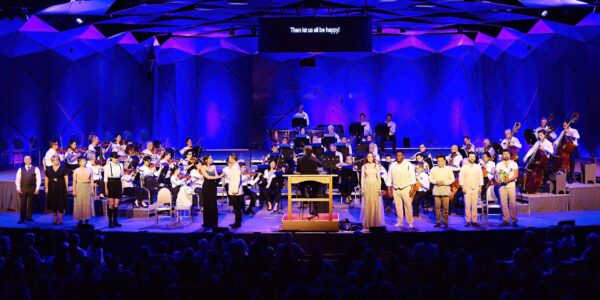
 United States Tanglewood 2026 [3] – Mozart, The Marriage of Figaro: Soloists, Tanglewood Music Center Vocal Fellows, Boston Symphony Orchestra / Andris Nelsons (conductor). Tanglewood, Massachusetts, 1.8.2026. (CSa)
On a balmy evening at the beginning of August, a sizable audience in the Koussevitsky Shed and a crowd of 2000 or so picnickers on the well-tended grounds beyond, gathered expectantly to hear first full concert performance ever given by the Boston Symphony Orchestra under its Director of Music Andris Nelsons of Mozart’s The Marriage of Figaro. The choice of opera, which coincided with the United States 250th anniversary, was particularly apt. The revolutionary ideals celebrated in the Declaration of Independence in 1776 are mirrored in Mozart’s Enlightenment masterpiece. The work premiered in Vienna only ten years later in 1786 and its subtly subversive message advanced the same concepts enshrined in the US Constitution: liberty, social justice and the rights of ordinary people over aristocratic authority and inherited privilege.
In short, the opera, based on Beaumarchais’s comedy of the same name, tells the story of Figaro and Susannah, two servants in the employ of Count Almaviva, who are engaged to be married. The lascivious Count attempts to exercise his droit de seigneur (the feudal ‘right of the lord’) to sleep with Susannah on the eve of her wedding. Susannah, joined by Figaro, the long-suffering Countess and others, combines wily intelligence and dignity to resist her master’s abuse of power. In a finely balanced reading of Mozart’s score, Nelsons overcame the acoustic challenges of the open-sided concert space and some unnecessary directorial distractions to elicit a flawless performance from his authentically scaled-down ensemble. His baton technique imposed strict classical precision while simultaneously unlocking vibrant swathes of orchestral colour and splendid singing from a sensational international cast and members of the Tanglewood Music Centre Chorus.
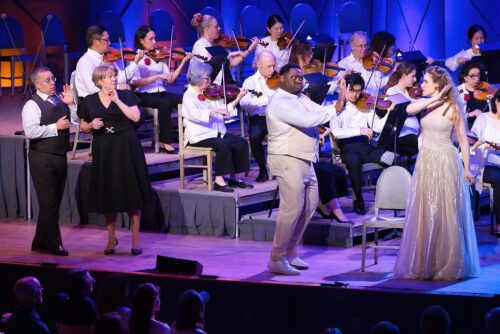
American bass-baritone Michael Sumuel, in lustrous voice, gave us a cunningly defiant Figaro while German-born Nikola Hillebrand, relatively fresh from her acclaimed debut performance as Sophie in Richard Strauss’s Der Rosenkavalier at the Vienna State Opera, beguiled as the arch and artful Susannah. In their nicely contrasted Act I duets ‘Cinque…dieci…venti’ in which she and Figaro sing of their imminent wedding and ‘Se a caso madama la notte ti chiama’, where they discuss the dangers of the Count’s predatory advances, their voices blended seamlessly. Canadian mezzo-soprano Emily d’Angelo made her debut as Cherubino at the Spoleto Festival some ten years ago and has repeated the role many times since. Her vocal strength accomplished acting skills and sharp humour have made this famous trouser (in this production culottes) role very much her own. Another great Canadian Singer, mellifluous baritone Joshua Hopkins perfectly captured Count Almaviva’s arrogance and anger making his ultimate plea for forgiveness a memorably dramatic moment, even in a concert performance. His Countess was sung with glass-like purity and superb breath control by Hanna-Elizabeth Mūller. Her velvet soprano penetrated the emotional heart of the drama, and she delivered her great arias ‘Porgi amor, qualche ristoro’ and ‘Dove sono I bei momenti’ with the utmost poignancy. Excellent performances too from bass-baritone Patrick Carfizzi as the vengeful, blustering lawyer Bartolo, and Elizabeth Bishop (Marcellina) as his scheming housekeeper whose infatuation and later bitterness towards Figaro melts into fierce maternal affection once she discovers he is her lost son.
That Nelsons and his players were able to deliver such an outstanding performance was remarkable given the bitter and now well-publicised institutional turf war which rumbled under the surface of Tanglewood’s manicured lawns. Some five months ago, the orchestra’s relatively new leaders CEO Chad Smith and the Chair of the Board of Trustees, Barbara Hostetter, unexpectedly announced that Nelson’s contract had been terminated and that that he would be leaving after the summer 2027 Tanglewood season. The official announcement claimed somewhat delphically that the orchestra and Nelsons were not ‘aligned on their future vision.’ In truth, the musicians, had been blindsided. They had not been consulted about the decision to sack their internationally esteemed Director of Music and had no idea what was meant by their ‘future vision.’
In a gesture reminiscent of the Soviet-led invasion of Czechoslovakia in 1968, when citizens protested by placing flowers into the gun barrels of Russian tanks and the buttonholes of the occupying troops, orchestra members and audiences demanding the reinstatement of Nelsons, donned red roses in a show of support for the dismissed conductor. Over the last few months, volunteers have handed out thousands of red flowers. Earlier this season in an Orwellian act of authoritarianism BSO officials and security instructed staff to challenge and expel anyone seen distributing them in the Tanglewood grounds.
Chad Smith was recently asked by a Boston based news station what he and the Board meant by ‘future vision’ and the need for ‘alignment’. His response was vague: ‘We landed at a place where we felt that the organisation …that the orchestra must serve Boston, must serve our communities more expansively and inclusively’ he said before adding ‘We were seeing significant declines across a number of areas at the BSO, and the only way for us to move forward was to think differently about what it is that we put on our stages, whose voices get to be heard, whose stories get to be told …how we can do that in a way which can continue to centre and anchor the great canon of classical music.’
None of this begins to explain why it was thought necessary to terminate Nelsons’s contract, the true reasons for which remain obscure. Neither Smith nor the board have criticised his artistic standards, performances or achievements. Nor could they reasonably do so. Although a handful of Nelsons’s concerts during his twelve-year tenure with the BSO have drawn negative reviews – well, even Homer nods – such criticism is hardly the prevailing verdict. During his time with the BSO, Nelsons has won five Grammys, two of them as recently as last year. His musicianship is revered by some of the world’s greatest orchestras, several of whom have now added their voices to the protest. They include the Chicago Symphony, the Berlin Philharmonic, the Gewandhausorchester Leipzig where he serves as Kapellmeister. Only this year, the Vienna Philharmonic awarded him honorary membership in recognition of their deep and long-standing partnership. Some speculate that the unstated reason for Nelsons’s dismissal was that his international commitments spread him too thin, taking valuable time away from the orchestra. This, however, was not the case. On the contrary, Nelsons used his leadership roles in Boston and Leipzig to foster a fruitful transatlantic alliance, facilitating shared performances in both cities, co-commissions and valuable musician exchange initiatives.
One of the principal justifications for Nelsons’s dismissal is said to have been the BSO’s financial situation. Management has contended on various occasions that that audience attendance has fallen over the last 20 years by 40%, and that the orchestra – one of the world’s richest – is facing imminent fiscal failure which only radical change can reverse. However, Thomas Dinsmore, who is a retired corporate executive, a Wharton trained accountant, and a music-loving classical violinist entirely unconnected to the BSO, has conducted a detailed analysis of the orchestra’s audited accounts and tax returns filed after the dismissal decision. He contends that the records properly understood have been misinterpreted, and like reports of Mark Twain’s death, news of the orchestra’s impending demise has been greatly exaggerated.
The evidence increasingly suggests that the real reasons for this astonishing decision are about strategy and philosophy. The new BSO leadership appears to want a different kind of orchestra institutionally and artistically; one which primarily focuses on equity, inclusion, social outcomes and relevance. These objectives are reflected in the mission statement of the Barr Foundation, one of the largest private grant-making organisations for the arts in New England which Barbara Hosstetter co-founded with her husband and chaired for three decades. Barr actively calls for major changes in the way its recipients operate, and insists on ‘cultural evolution, civic leadership, community engagement and new cultural models.’ The intellectual framework of Barr’s arts philanthropy substantially overlap with the views of Thomas Morris, a former CEO of the Boston Symphony and the author of Always the Music. He argues against ‘calcified’ programmes which are too dependent on the works of 19th century composers and emphasises a broader and more diversified mix of musical genres, and ‘fewer and more varied concerts’ which ‘engender community relevance’. In one critical passage, he writes: ‘Orchestras must convince their communities that they matter. Given the perpetual request for audiences and donors, the community must have authentic ownership of the institution.’ The book has been warmly endorsed by Smith. Although Smith and the Board talk airily of maintaining excellence, the implementation of a policy that envisages mixed-genre programming and demands community outcomes have led many to doubt whether excellence is achievable or even a genuine priority.
Nelsons’s musical world is broad but deeply rooted in the great European orchestral tradition. But he does not regard his role to be that of a guardian of a musical museum. He and his players see themselves as both custodians of the great classical canon and champions of the new. There has been a veritable explosion of new commissions from contemporary composers under Nelsons’s leadership. Neither he nor the orchestra resist change. On the contrary, they believe that innovation should take place alongside, but not at the expense of exceptional standards of musicianship and artistic excellence which have historically defined the BSO.
Nelsons is, in the truest sense, a musician’s conductor for whom musical excellence and integrity are paramount, and whose responsibility is to shape the repertoire and develop the players. He not an institutional executive tasked with fund-raising, or meeting sociological utility and other worthy but diffuse social policy objectives on behalf of the Board or its funders
It is here that the dispute between board and orchestra become clear and poses a deeper but fundamentally simple question: who in the end controls an orchestra, and who decides what it is for?
This question is not unique to the future of the BSO. Unhappily, it has dogged debates about arts funding throughout Europe and the United Kingdom, where critics argue that programming decisions are increasingly driven by issues of perceived elitism, social identity and easy listening rather than musical merit. It is instructive to consider the activities of the Arts Council of England ‘ACE’, a government-funded public body established after the Second World War to promote and support the arts across England, Scotland and Wales.
For years ACE has been criticised for turning public funding into something of a box ticking exercise. Alongside artistic ambition and quality, organisations have been expected to demonstrate diversity, access, community engagement, geographical reach and other social outcomes. The objection is not to the aims themselves, but to the perception that demonstrating compliance can become more important than making the strongest artistic case. Wigmore Hall famously decided to become independent of ACE, giving it greater freedom to determine its own artistic priorities and programming. The hall’s director, John Gilhooly, argued that an institution devoted to musical excellence should not have its artistic decisions constrained by externally imposed policy criteria.
In late 2024, the UK Government appointed Baroness Margaret Hodge to conduct an independent review of ACE. It reaffirmed the importance of the arms-length principle: governments (or the board in the context of the BSO) may establish broad policy directives, but artistic decisions should remain insulated from political direction. Significantly, the Review also recorded widespread concern that the Arts Council’s emphasis on equality and inclusion had in practice, become a ‘straight-jacket capable of stifling innovation’
The debate over ACE priorities is directly relevant to the BSO Board since it raises the same fundamental question: should its Board and executives determine not merely how the institution survives but what kinds of art it should champion and what social outcomes it should pursue? Here, the ghost of Lord Reith, first Director-general of the BBC haunts the debate. He fashioned British public service broadcasting in the 1930’s and 40’s and believed that radio should elevate public taste and moral standards rather than chase commercial ratings or popularity. His famous injunction to ‘inform, educate and entertain was founded on the rather unfashionable belief that a cultural institution should not merely give audiences what they already want, or in modern parlance ‘dumb down’ and confuse accessibility with simplification. Rather it should raise its sights and bring the best to the widest possible audience. The challenge for the BSO is surely not to choose between excellence and inclusion but to pursue inclusion without lowering the artistic bar; to bring people to great music rather than to bring people in by making the music less great.
Mozart’s The Marriage of Figaro offers an unintended but irresistible metaphor for the present impasse: the musicians, cast as Mozart’s servants, are expected to submit while the lordly powers of Board and Management exercise their own corporate version of droit du seigneur. No wonder the players feel sore.
At the time of writing, negotiations between the interested parties had dragged on; strike action was authorised for the first time in the orchestra’s 145 year-old history and loomed threateningly on the horizon. It was to be hoped, that in the opera’s spirit of forgiveness and reconciliation trust could be restored, that the orchestra’s artistic voice would be heard, and this troubled marriage between players and management would enjoy a long and happy future. In the end a new three-year pay deal was accepted though it still failed to keep Nelsons in his post beyond next summer. However, we have now learned that the new deal has secured the players a far greater and more vital role in future artistic planning and decision-making. This is a huge victory for them and an important precedent for orchestras worldwide
Chris Sallon
Featured Image: Members of the cast of The Marriage of Figaro with the BSO conducted by Andris Nelsons at Tanglewood © Hilary Scott
Cast:
The Countess – Hanna-Elizabeth Müller
Susanna – Nikola Hillebrand
Cherubino – Emily D’Angelo
Marcellina – Elizabeth Bishop
Count Almaviva – Joshua Hopkins
Figaro – Michael Sumuel
Doctor Bartolo – Patrick Carfizzi
Barbarina – Eden Bartholomew
Don Curzio – Joshua Saunders
Don Basilio – Rodell Rosel
Antonio – Dean Murphy
I am skeptical of just how much say the musicians actually won contractually in artistic direction without securing Nelson’s position as Conductor I have not seen the language. Had they threatened a walkout prior to the end of the Tanglewood season I think they would have had more clout.
I’m speaking as a senior patron who handed out hundreds of roses and was threatened by a big guy named Jason for speaking with someone about the🌹. I’m also a lifelong union member and union activist who was on the picket lines. I’ve also been at Tanglewood since I was a child. Over the last couple of years, ticket prices under Chad Smith and Barbara Hostetter have gone way up along with food and drink prices. Additionally they have added extra high price pop concerts during time that was not previously used that way … It is time to fire Chad Smith and remove Hostetter from the head of the Board of Trustees. Also remove their newly appointed trustees and advisors. All but one appear to have no musical background but appear to be corporate tech bros and other big money folks who could likely care less about classical music. Seems to be par for the course during these Trump years. Hopefully that too shall pass …sooner than later, so hopefully we can save the integrity of some important institutions. In this case let’s protect the BSO, the musicians and its musical excellence. Keep Andris Nelsons. Fire Chad! Remove Hostetter!
[Original has been slightly edited.]