 United Kingdom Edinburgh International Festival 2026 [5] – Richard Strauss, Elektra: Soloists, Chorus, BBC Scottish Symphony Orchestra / Karina Canellakis (conductor). Usher Hall, Edinburgh, 23.8.2026. (GT)
Of the operas programmed in the 2026 Edinburgh International Festival, it was this performance of Elektra that stood out most of all, and surely one of the highlights of the whole festival this year. Richard Strauss’s second opera based on Sophocles has held audiences spellbound ever since its premiere at Dresden in 1909 and was the first collaboration with Hugo von Hofmannsthal. Few operas quite succeed in portraying the societal turmoil of the early 20th century with its murky themes of violence, patricide, and repressed sexuality.
At the centre of Strauss’s stage work are the qualities that draw audiences: its brutality, passion and the dysfunctional family tragedy. The one-act work astonishes for its modernism and its striking orchestral climaxes and often cacophonous outbursts, contrasted by rare moments of lyrical beauty. At the core is the bitonal Elektra chord in E major and C major, exhibiting advanced dissonance and harmonic parallels in technique.
This performance is part of the Anderson Opera Series supporting opera in concert at the Usher Hall. Opera in concert at the Edinburgh International Festival has proved popular, most memorable being the Wagner Ring cycle over three years involving three different orchestras and starring some of the finest Wagnerian singers. Opera in concert at the Usher Hall has mostly comprised Mozart in recent years, and this most challenging operas by Strauss offered a fresh opportunity for Festival audiences.
Based on Hofmannsthal’s play, Elektra is uniquely suited for concert performances through its intense drama and single-act structure. Of course, the absence of staging removes one of the controversial aspects of opera today, as productions often become the focus of criticism rather than the musical performance as it has proved in stagings of the Ring at Bayreuth recently.
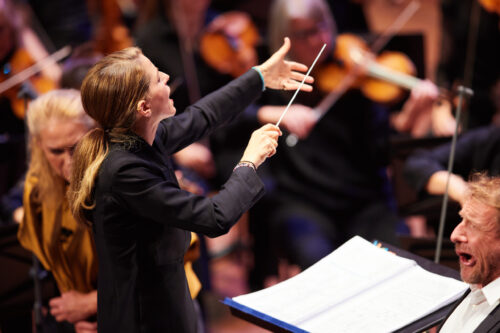
The BBC Scottish Symphony Orchestra has become a highly gifted ensemble in opera, most notably last season in Bartók’s Bluebeard’s Castle under Elim Chan. On this evening, the conducting of Karina Canellakis was excellent in finding the precise structural shifts in the score while ably evincing all the intensity of the drama, and the softer lyrical sections of the opera. She masterminded the often-daunting climaxes, emphasising the brutality of the score, matched with the excitement of the unfolding drama.
Of the singers, the Elektra of Ingela Brimberg (making her UK debut) was magnificent in her evincing all the shades in the personality of this darkly tragic character, portraying it with both poise and solid determination in her obsessed grief, in an amazing characterisation of magnificent stamina. Her performance was matched by Karen Cargill as Klytamnestra, and which was equally astonishing because of her late replacement for Nina Stemme. Her portrayal was magnificent, vocally and in acting. It was amazing that this was her first performance in this role.
The Chrysothemis of Vida Miknevičiuté (also in her UK debut) was another star of the evening, contrasting vocally with her higher voice to the Elektra of Brimberg, and most of all, characterising the ambitions of a woman dreaming of a happy life with her lover, and performed as if she had been singing this role for years. Of the male voices, John Daszak’s Aegisth was masterly and in fine voice, while the Orest of Günther Groissböck was excellent in his darkly magisterial baritone and subtly mannered movements.
In the early passages, the five maids and other cast members performed from the front of the stage, but in the closing scene, the chorus of servants sang from the rear of the orchestra, ‘Stimmen hinter der Scene’ announcing Orest’s arrival.
This performance was often spellbinding both in the magnificent singing and the terrific orchestral backing by Canellakis and her huge orchestra, with great solo passages from the woodwinds and the strings. The brass also made a solid contribution, bringing out all the terrific excitement and drama of this tragic opera. This was surely one of the great highlights of the 2026 Edinburgh International Festival and certainly will be remembered for long by all those who were in the audience. The performance was recorded for future broadcast on BBC Radio Three.
Gregor Tassie
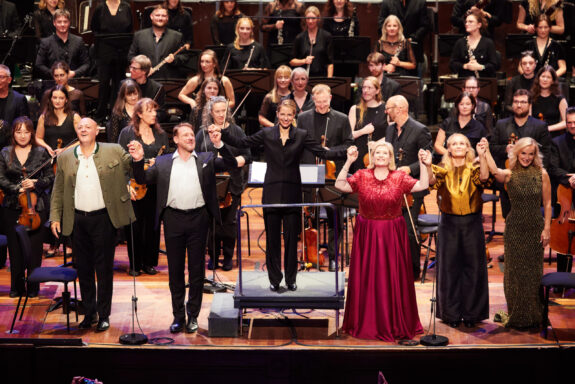
Featured Image: The principal cast of Strauss’s Elektra at the Edinburgh International Festival © Andrew Perry
Cast:
Elektra – Ingela Brimberg
Chrysothemis – Vida Miknevičiuté
Klytamnestra – Karen Cargill
Orest – Günther Groissböck
Aegisth – John Daszak
Orest’s tutor – Barnaby Rea
Young servant – Lucas van Lierop
Old servant – Martin Schnell
Overseer – Lee Bisset
First Maid – Claudia Huckle
Second maid – Maria Schnellenberg
Third maid – Lea Shaw
Fourth maid – Eleanor Dennis
Fifth maid – Emma Morwood
How did the balances of the orchestra with the voices seem to you? With Strauss’s massive orchestra for this opera, it would seem all too easy for a conductor’s enthusiasm to run away with him/her at more than one moment. When this concert appears on BBC Radio 3, then the sound engineering will address that for home listeners, of course. In any case, it’s great to read that this concert opera presentation evidently went very well.
I was in the centre stalls midway, and throughout I thought the balance was good. In general, Canellakis’s handling of the orchestral sound and the voices was good; at no time did I sense the singers being drowned out by the orchestra.