
 United States Various: Rainer Eudeikis (cello), Alonzo King LINES Ballet, San Francisco Symphony / James Gaffigan (conductor). Davies Symphony Hall, San Francisco, 19.11.2026. (HS)
Prokofiev – Sinfonia concertante in E minor
Debussy – Prélude à L’Aprés-midi d’un faune
Copland – Suite from Appalachian Spring
During the COVID lockdown, San Francisco Symphony and the Alonzo King LINES Ballet struck up a fruitful collaboration, producing two small video projects to get things going until audiences could return. Thursday evening yielded two breathtaking premieres with King’s brand-new choreography to Debussy’s Prélude à L’Aprés-midi d’un faune and Copland’s Appalachian Spring.
The troupe of 11 dancers distinguished themselves with superbly athletic, modern takes that sinuously melded with the familiar music in ways that elevated the experience of listening to the timeless compositions. James Gaffigan, an assistant conductor to Michael Tilson Thomas early in his career and now a regular guest with this orchestra, looked like he was enjoying the synergy between what he was getting from the orchestra and the distinctly musical dance expressions.
Admittedly, I lack the background to comment with any inside knowledge of dance, but every gesture, every twist of the body, every pas de deux and ensemble glowed with feelings and colors identical to the music. In my experience, that is a signature attribute of King’s: he has been responsible for creating several memorable dances with this orchestra. Aside from the videos – Arvo Pärt’s Spiegel im Spiegel in 2021 and Stravinsky’s The Soldier’s Tale in 2022 – Ginastera’s Estancia Suite was first on the stage in 2021’s gala concert and Ravel’s Ma mère l’Oye in 2024, with Esa-Pekka Salonen conducting all.
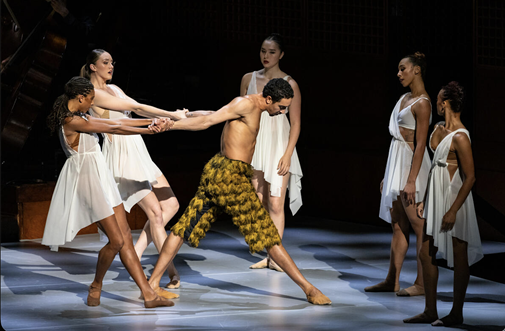
From a musical perspective, Gaffigan showed special sensitivity to timing and orchestral color. The Debussy eased gently and sensuously into the famous opening flute solo, played languidly by principal Yubeen Kim. The orchestra draped itself delicately around it. The pulses in the music had the dancers – especially Schwab Elhassan as the titular faune – wriggling and writhing as if lifted by the music, and they dazzled with their moves.
In both this ballet and the Copland, executed on a stage-wide thrust to allow space in front of the orchestra, King’s choreography focused on responding to cues in the music rather than spelling out a story. The character of the faune, which scares off the lovely nymphs in Vaslav Nijinsky’s original dance, never even looked at the women in King’s. They intentionally stand their ground and even scare off their pursuer. In Appalachian Spring, aside from a tableau with two men who mime sipping water from a spring during the halting opening measures, the dance was all about fast-moving pairings, solo moments and matching bodies to the force of the music.
That last was what was so striking about King’s approach. Although both pieces derived from poems, the differences are critical. Nijinsky’s original 1912 dance to Debussy’s 1894 Faune follows the meditative form of Stéphane Mallarmé’s poem. Except for a sexually active animal and a few nymphs eyeing and dodging each other, he followed no real narrative. There is a narrative to Martha Graham’s Appalachian Spring (although Copland just called it ‘Ballet for Martha’), inspired by an excerpt from Cart Crane’s poem ‘The Bridge’ about a spring (not the season). The Graham scenario, about a pioneer couple finding their way, was added later.
In King’s dance for Copland, what matters seems totally inspired by the tempos, rhythms and musical gestures. For me, watching the dance progress was like seeing the sounds come to life before our eyes. Using the symphonic suite from 1945 rather than the eight-minutes-longer original score dismisses much of the connective music associated with the narrative and allows for quick changes in tone and style. It was exhilarating.
The various episodes spun into place seamlessly. The soft, slowly-opening music allowed for gliding dance as the stage populated gradually. The intensifying rhythms matched with bouncier choreography, and the buildup to the ‘Simple Gifts’ variations – starting with a solo dancer to match with the clarinet solo statement of the tune – gradually built to a magnificent climax, with all 11 dancers forming up and mixing spectacularly.
In Faune, Elhassan portrayed the wakening beast as a bundle of energy, swooping and stretching suggestively. The nymphs responded with more than a little lust but he seemed immune to their gestures, or at least unwilling to connect. The tension made every moment even more exquisite.
The first part of the program featured principal cellist Rainer Eudeikis in Prokofiev’s Sinfonia concertante in E minor, a three-movement cello concerto in all but name. The soloist seldom rests over its 35 minutes and must handle some of the most difficult cello music extant. It was written for Mstislav Rostropovich who debuted it in 1951 as Prokofiev’s Second Piano Concerto. His revision (which debuted, retitled, in 1954 after his death) was the one heard here.
Eudeikis applied as much deftness and attention to the simpler legato sections as to the ones that demanded double-stops, flamboyant arpeggios and fast work at the top of the cello’s range. All the while, the orchestra cruised through its own work with Prokofiev’s signature mix of marches, Romantic idylls and oodles of complex development.
All hands contributed to a definitive performance, impressive for its intensity and flair. With the orchestra ‘dancing’ the music and the dancers moving musically in the second half, this emerged as particularly admirable concert.
Harvey Steiman