 France Wagner, Siegfried: Soloists, Orchestre de l’Opéra national de Paris / Pablo Heras-Casado (conductor). Opéra Bastille, Paris, 10.11.2026 performance (directed by Jérémie Cuvillier) livestreamed on 19.11.2026. (JPr)
Those online did better than ticket-holders for the Siegfried performance on 19th November at the Opéra Bastille who only got a concert performance because some members of the Paris Opera supported a national strike. Generally, when an opera or ballet is broadcast an earlier performance is also recorded in case something goes wrong with the live feed, so online the Ring cycle could continue with Siegfried from nine days earlier.
Is a solution to Calixto Bieito’s Konzept any nearer, I am not too sure. After the threat of AI hovered over Das Rheingold (review here), Die Walküre (review here) didn’t seem to take this anywhere in particular. We left Brünnhilde in a white plastic-lined room and Wotan conjuring up an orangey-red fog. A little research suggests that for Bieito this was chemical poison and, as we will soon see in Act III, Brünnhilde is entombed in ice (neither is clear from how Walküre ends). Now in the post-apocalypse, post-nuclear world of Siegfried, while the building from Walküre is already suggested initially in the distance, nature is out-of-control and a dark, dense, lush forest with a grassy floor is taking over, even if it is topsy-turvy with fir treetops coming in from the sides or down from above. It is often all shown flickering and expanding and with an extensive root system. A few faceless figures roam – often staggering or writhing as if sick – through the scenes who are either mutant androids or mutant humans from a nuclear catastrophe.
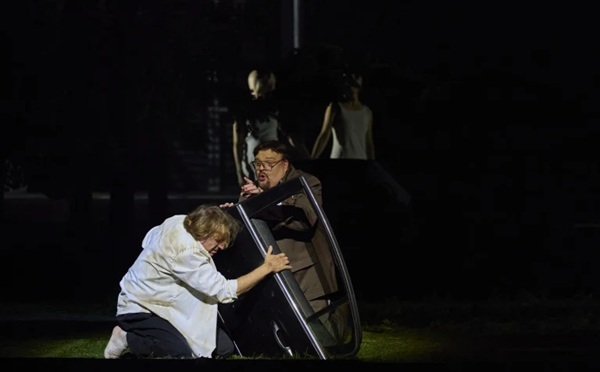
There is no forging of course and neither is Mime the character he was in Rheingold, he now has hair, red nail polish, glasses and a brown suit with a medal. His life is in a metal suitcase; with blood pressure monitor and the drugs he is dependent on and attempts to force on Siegfried who spits them out. Siegfried (in white shirt, dirty vest and dark slacks) doesn’t bring in a bear, only a battered car door that he proceeds to play with. As the story unfolds we will see how he seems to want to sniff everything! Mime’s supposed sword he has worked on is just a bit of piping. When Siegfried learns of his birth he tries on Sieglinde’s dress and it will be with him throughout the opera. Finally, Mime shows Siegfried the two pieces of Nothung.
The Wanderer/Wotan arrives covered by a blanket and with an axe in a greatcoat with a wolf (!) pelt as its collar and he wields an axe. He is back from a military conflict with his backpack (the oxygen he needs is in it) and dog tag round his neck. His trembling hands maybe PTSD but all of this is underdeveloped. The Wanderer spends most of his time using duct tape to join all the bits of his broken spear together. Siegfried returns to make Nothung new again but there is no bellows, no fire, and no anvil. Siegfried just rubs the two pieces of the sword together, bangs the car door, then a bucket and his bandaged head. Meanwhile Mime concocts something with a syringe and some powdered drugs. Deleted from my Walküre review was how Siegmund’s wound appeared as significant as that of Tristan or Amfortas and indeed Siegfried now pulls Nothung out from himself and uses it to cut off the tip of a fir tree.
At the opening on Act II a bloodied and bruised Alberich (isn’t everyone bloodied and bruised in this Ring?) arrives in a green sou’wester pulling a cart. He kidnaps a zombie-like android who is clearly pregnant. As he confronts Wotan he uses forceps – under the cover of a blanket – to deliver baby Hagen and uses a knife to cut the extravagant umbilical cord. We are made aware who ultimately may inherit the ring. Wotan imitates the dragon when – together with Alberich – they attempt to warn him about Siegfried and on leaving hecovers the now dead android. On arrival Siegfried smears mud on himself for some reason and engages in some contemporary dance as he responds to the Woodbird (there is no reed and no horn).
The dragon – surrounded by more orange-red smoke – is a giant version of the mask seen in Rheingold attached to an aerial ladder (or similar) and with light shining through its eyes. Fafner himself is seen in scaly black-and-white with a panda’s (?) head and rows of huge pearls around his neck. Siegfried withdraws the huge ring and a cape-like Tarnhelm from the face’s mouth and gets covered in blood and will be until the end of the opera. From then on Siegfried never seems to know what to do with the ring or Tarnhelm that he might or might not have, or perhaps comes into the action without either. After dispatching Mime, Siegfried as a character (and singer?) looks totally spent while the crimson-haired Woodbird with sunglasses and in yellow puts in a brief appearance ‘flying’ in on high.
After we see even more branches hanging down at the start of the final act Wotan summons Erda to what looks like supper at a table in the woods. Erda is wearing a black negligee and brings in a large pan of soup, but their cosy meal does not go well, and Wotan ends up threatening her. As a now-bloodier-than-ever Siegfried squares up to Wotan, Erda watches on covered by a tablecloth sometimes laughing, sometimes grimacing. Siegfried hides under the table, plays around with it, and throw a chair over, with Wotan getting the saucepan on his head before now powerless he crawls away twitching on the floor. The spear is not broken again, and Siegfried has it until it is just cast aside.
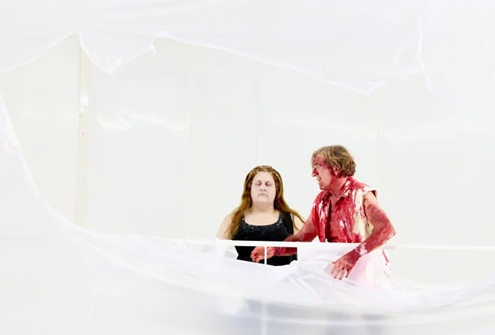
Perhaps anticipating the stagehands’ strike Siegfried starts clearing the stage including some of the fake grass and briefly resists the pull of the ring. We soon realise Brünnhilde (in black as in Walküre) has been cryogenically frozen above and Siegfried symbolically hacks at a block of ice for the ‘Das ist kein Mann!’ moment. He ascends the stairs to the frosted Brünnhilde before awkwardly ripping down some polythene covering the opening at the front and cuddles her to warm her up for ‘Heil dir, Sonne! Heil dir, Licht!’ Of course, there has been no shield, helmet or breastplate. Eventually down below Siegfried wrestles Brünnhilde to the ground before in an act of joint submission Brünnhilde removes her leather wristbands and Siegfried some bandages on his wrists. Siegfried used his bloody shirt to help warm Brünnhilde and now it binds his wrists until cut by Nothung. The final duet has them at either end of the sword before finally they embrace and walk away.
I am getting tired of seeing and hearing Andreas Schager as Siegfried, is there no one else worth giving a chance to? To his credit he is a wholehearted performer who clearly embraces Bieito’s Personenregie uncomplainingly. His is a very angry, unlikable Siegfried with few redeeming features. As for his singing it was very effortful (and painful to the ear) during the most demanding moments of Act I which he seems to want to get over as quickly as possible. That he can singing more quietly and lyrically was heard during the Forest Murmurs in Act II and it was some of the best singing I have heard from him in quite a while. However, in Act III he was vocally ‘running on fumes’ and ended the duet with the lowest note I can remember from a Siegfried. I think he gets applauded for all his Duracell bunny hyperactivity on the stage and the fact audiences have forgotten how the role should be sung.
This Ring has proved a triumph for Christopher Maltman as Wotan and marked by detailed acting (and reacting) that charts a clear trajectory of declining authority. Maltman allies his sonorous baritone to Lieder-like phrasing in a similar way to the great Michael Volle whose successor he seems to be as this generation’s leading Wotan. The veteran Gerhard Siegel is a consummate character actor and Mime was neurotic, drug-addled and duplicitous; whilst at times, oddly, more pleasant to listen to than Schager. Brian Mulligan portrayed a very anxious, scheming, and spiteful Alberich with a voice perhaps more suited to Wotan (which he also sings) than the malicious black dwarf.
There is drowsiness, defiance and resignation from Erda’s involvement in Siegfried which we did not particularly get from Marie-Nicole Lemieux who has a much lighter sound than some of her predecessors in the role. Mika Kares had the ideal booming cavernousness bass for Fafner, either on or off the stage, and Ilanah Lobel-Torres was a sweetly chirruping Woodbird.
Finally, I began to realise that Tamara Wilson might prove an absolute revelation as Brünnhilde in this Ring if not for her acting but for the ease, subtlety and radiance of her sound; even though her timbre is not particularly youthful.
Pablo Heras-Casado – supported by an orchestra playing with compete fluency – conducted a suitably scherzo-like Siegfried with consummate pacing and a dramatic arc to meld all its shifting moods — Mime’s scheming, forging of Nothung, Fafner’s lair, Forest Murmurs and a final awakening of Brünnhilde — to not make it sound too episodic.
Will Götterdämmerung tie up Bieito’s myriad loose ends or will we be left wondering – rather like Parsifal – what it was we had seen.
Jim Pritchard
Featured Image: Andreas Schager (Siegfried) and Gerhard Siegel (Mime) © Herwig Prammer/OnP
Creatives:
Staging – Calixto Bieito
Sets – Rebecca Ringst
Costumes – Ingo Krügler
Designer – Maurice Mbikayi (masks of Heterotopia/Fafner’s costume)
Visual Artist – Zikun Zhu (Woodbird’s costume)
Lighting – Michael Bauer
Video – Sarah Derendinger
Dramaturgy – Bettina Auer
Cast:
Siegfried – Andreas Schager
Mime – Gerhard Siegel
The Wanderer – Christopher Maltman
Alberich – Brian Mulligan
Fafner – Mika Kares
Erda – Marie-Nicole Lemieux
Brünnhilde – Tamara Wilson
Voice of the Wood bird – Ilanah Lobel-Torres