 Austria Wagner, Tannhäuser: Soloists, Chorus and Orchestra of Vienna State Opera / Philippe Jordan (conductor). Broadcast live (directed by Dominic Kepczynski) from the Vienna State Opera, 25.5.2025. (JPr)
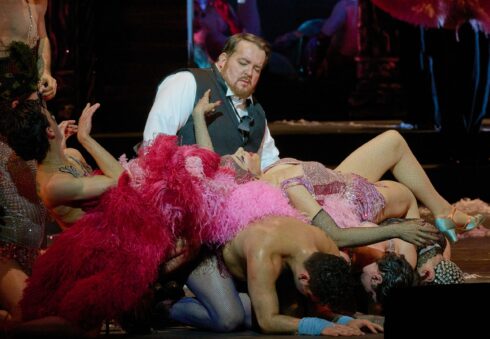
Perhaps I have not seen Tannhäuser as much as some other Wagner operas over 50 years and more operagoing, but this one stands out for the first time I have seen and heard Wolfram’s ‘O du mein holder Abendstern’ – an introspective aria supposedly mourning the death of his unrequited beloved – sung showing how his true feelings may lay elsewhere. While we hear Martin Gantner’s unpoetic yet heartfelt rendition we see him imagine Tannhauser’s return from seeking absolution in Rome and getting embraced and kissed by him.
Whenever I see a new production of Tannhäuser my mind goes back to the Covent Garden fiasco in 1977 when legendary tenor Jon Vickers belatedly withdrew from The Royal Opera’s new production which had been mounted especially for him and despite plans for the performances having begun in 1974. Vickers announced he now considered the role to be ‘blasphemous’ and refused to sing it. Plans for further performances at the Met were also cancelled and this conflict of personal religious conviction with contractual professional obligations created a considerable furore at the time. The role of Tannhäuser was considered, even then, to be one of the most difficult in the repertory, and his cancellation was dismissed by many as an admittance that he was – at best – unable to connect with it, or at worst, was unable to sing it. However, Vickers was adamant that his withdrawal was due to his Christian beliefs, the story of the opera and its words.
At the end of his life, Wagner still felt he owed the world a Tannhäuser and tinkered with the score – which was always one of his most popular – leaving us with the 1875 Vienna version where the original 1845 Dresden music has accreted revisions from ill-fated performances in Paris in 1861 (including the Venusberg ballet) and a number of subsequent post-Tristan refinements. Appropriately this is the Tannhäuser version we now hear in Vienna; even though it remains an uneasy mix of German Romantic opera and Franco–Italian opera; two distinctly opposing traditions.
Tannhäuser, is supposedly a medieval thirteenth-century knight, with conflicting sensual and spiritual sides to his character. He desires both Venus and Elisabeth though cannot have either and only finds redemption in death. Wagner ‘plots’ this out in a typically sophisticated way and it can be seen best in Tannhäuser’s Act I ‘Hymn to Venus’. In a series of dialogues with Venus, the tenor sings in D-flat, then D, and finally E-flat. By moving the music up half a tone each time Wagner demands more and more from the tenor’s voice such that the physical strain caused by the music mirrors the knight’s dilemma over the choice he must make between the erotic and religious realms. He praises the goddess with his lips, his eyes and his heart, whilst part of his heart, still lies elsewhere. This ‘elsewhere’ is revealed when Tannhäuser sings a third time and it is not in Venus’s key (E major) but the key of Elisabeth (E-flat). Then in Act II as Tannhäuser passionately reprises the hymn again during the song contest to win Elisabeth’s hand, it is now in E major and so Tannhäuser is singing for Elisabeth but in the key of Venus. This role is far from an ‘easy sing’ and, as in everything in Wagner’s oeuvre; a complex character is illuminated by his music.
Vickers said in 1986, ‘I’m a committed Christian. Tannhäuser is, I think, an attempt to strike at the very root of the Christian faith’. Whether it is Christian or anti-Christian can the theology of this opera be ignored? Possibly not, for the medieval story is something of a Christian morality play; it includes Marian theology, as well as several mentions of faith and the redeemer. Tannhäuser goes to Rome hoping the Pope will pardon him, but he refuses his plea and Tannhäuser is eventually redeemed when Elisabeth sacrifices herself for him on earth and then intervenes with God on his behalf in heaven. Despite this Tannhäuser dies anyway and although it is the love of a good woman that finally sets him free, all the Christian references must mean something and certainly did to Jon Vickers in the 1970s.
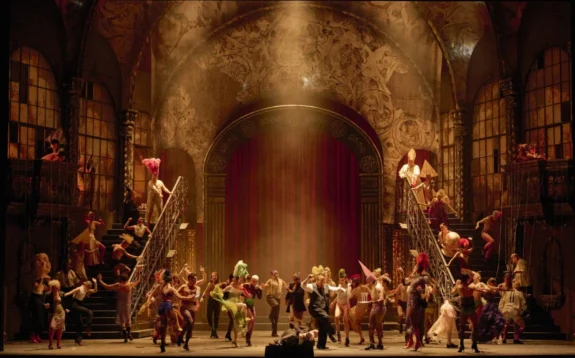
In the first Tannhäuser performances in Vienna for over ten years, American-born director Lydia Steier now cleanses it entirely of Christianity. This leaves somewhat of a gaping hole at the centre of the struggle between all the bacchanalia, sensuality, irreligious behaviour and devout spirituality: she fills this void with an allegory (sets by Momme Hinrichs and in Alfred Mayerhofer’s costumes) of cultural hedonism in the early-twentieth century. In Act I there is a lavish 1920s Weimar Cabaret setting – it reminded me of something I saw once on TV about a legendary Berlin venue of that time called Moka Efti – and the clientele present and their couplings had all the gender and sexual fluidity of the laissez-faire, carefree interwar years. There is also a suggestion of Paris’s Moulin Rouge – and even Las Vegas – in Venus as a sparkly and pink ostrich-feathered showgirl with her similar-looking chorus line including four high up on trapeze. (The Venusburg ballet at times looked like the Venice Carnival after everyone had eaten too much Magic Mushroom risotto.) At the end of the first act the Young Shepherd (plaintively sung by Ilia Staple) appears on high as a baroque fantasy while a Ronald MacDonald-like clown plays the cor anglais on the stage. The Landgrave’s Bavarian hunting party soon arrives.
The 1930s in Germany was a time of increasing social and political instability, eventually leading to the rise of Nazism. It is another cabaret setting but it is now a much more formal occasion of society’s great and good dressed in their finery – much hopefully faux fur – and men wearing regalia (Freemasons?). For the song contest about the nature of love, it is as if they have come to watch a celebration of their (Aryan?) heritage as the Minnesingers all have blond wigs and wear medieval garb. As tensions rise between the knights and Tannhäuser’s thoughts turn to Venus, then the lighting turns pink and she lowers on a glittery crescent moon and her troupe appear too, though only visible to him.
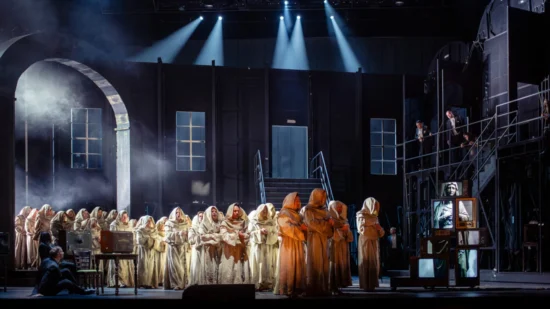
We seem to have moved forward several decades by Act III, though generally set in the milieu from before, now it is a dark, possibly war-blighted world. Men sit silently watching old-style TV sets and an image of the Virgin Mary is displayed on a jumble of TVs and what look like microwaves, and it is to this that Elisabeth prays. Earlier the Pilgrims (wearing shabby robes) returned but Tannhäuser who went with them is not among them, and a distraught Elisabeth dies. Venus again reappears on her moon and in force – including several of the Act I revellers and the aerial artists – and attempts to lure Tannhäuser back to her before Elisabeth’s funeral procession means he has been redeemed by her sacrifice. We now see Elisabeth as a vision in white and she is reunited with Tannhäuser under a huge heavenly bower.
Of course, everything I heard was through (good) speakers and may have sounded different in the opera house. Clay Hilley’s Tannhäuser brought back memories of the late Johan Botha who I saw in the role however he is not (yet?) as good as he was. Whilst he trumpeted some solid high notes and every word was clearly sung, I thought his phrasing was choppy and there was just too much – aforementioned physical – strain at the top of his voice at times. His Act III ‘Inbrunst im Herzen’ was the highlight of his performance as he convincingly abandoned himself to Tannhäuser’s repentance and suffering. However, Hilley is not (yet?) a great singing actor and who this Tannhäuser was I wasn’t sure. Smoking and drinking from a hip flask he seemed more of an outsider than usual throughout the opera. I just wonder if he was little more than a star performer because when he waved a white handkerchief and sang at the end of the first act, I got distinct Pavarotti vibes.
Malin Byström made an impressive role debut as an intense Elisabeth, she portrayed her as pining for true love, somewhat scared mentally by being initially deserted by Tannhäuser and finally incapable of coping with his betrayal. Byström’s expressive soprano voice had some interesting mezzo-ish colours, and her Act III ‘Allmächt’ge Jungfrau’ was the heartrending prayer it should be. Ekaterina Gubanova’s alluring-looking Venus was well-characterised even though her dusky mezzo-soprano did not sound as seductive as some I have heard in the role. Günther Groissböck was an aristocratic Landgrave (the lodge’s Grand Master?) and though his voice is nearly as commanding of previous years, his lowest bass notes sounded a little thin. The Minnesingers were well cast and made a strong contribution throughout; if I had to choose, I would say that Simon Neal’s fey Biterolf stood out.
To be truthful it all ended with more profundity and spirituality than I expected after Act I and that, and the success of the evening elsewhere, was mostly due to Philippe Jordan – bidding farewell as music director in Vienna – who has developed into a fine Wagner conductor. Jordan’s excellent Tannhäuser had the foundations of the virtuosic musicianship of the Vienna State Opera Orchestra and his interpretation had authority, a strong grip of overall structure, persuasive grandeur, seamless flow, and exquisite attention to detail. He was supported by Thomas Lang’s outstanding chorus which made a collective sound almost the equal of that I once regularly heard at Bayreuth.
Jim Pritchard
Featured Image: Vienna State Opera’s Tannhäuser Act I © Michael Poehn/Wiener Staatsoper
Creatives:
Production – Lydia Steier
Sets and Video – Momme Hinrichs
Costume – Alfred Mayerhofer
Choreography – Tabatha McFadyen
Light – Elana Siberski
Chorus master – Thomas Lang
Cast:
Landgraf Hermann – Günther Groissböck
Tannhäuser – Clay Hilley
Wolfram von Eschenbach – Martin Gantner
Walther von der Vogelweide – Daniel Jenz
Biterolf – Simon Neal
Heinrich der Schreiber – Lukas Schmidt
Reinmar von Zweter – Marcus Pelz
Elisabeth – Malin Byström
Venus – Ekaterina Gubanova
A Young Shepherd – Ilia Staple
Jim, I also saw the stream there were two clever references to other Tannhäuser productions The piper shepherd in clown outfit was a reference to the current Bayreuth Tannhäuser even down to the van he sat on, plus in the second act the set the trumpeter played from was a reference to the old but current Met opera set for Act 2.