
 Germany Wagner, Lohengrin: Soloists and Chorus of Hannover State Opera. Niedersächsisches Staatsorchester Hannover / Stephan Zilias (conductor). Hannover State Opera, 12.10.2025. (DM-D)
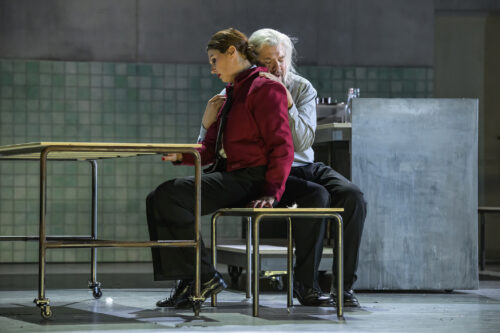
Much of the new production of Lohengrin in Hannover was disappointing for me. The revolving set consisted of white interior walls engulfing a cramped open space, or white exterior walls with different sets of staircases leading to doors or even less precisely defined spaces. Lighting was mainly dim, and when it brightened up, the angle was such that it lit up the tops of the performers’ heads, or indeed the space behind them – their faces remained in the shadows for much of the time. Elsa was brought onto the stage in a metal cage and the King appeared shocked when he saw this – a good albeit brief moment of character direction. The battle between Lohengrin and Telramund was boring.
The Bridal Chorus accompanied the men and women of Brabant, including Elsa, enlisting in the King’s army and some receiving their token burgundy-coloured jacket – others were wearing one already. The venue for this was a canteen and this environment replaced the bridal chamber. Elsa scooped some food out of a random pot for them to eat from what looked like army-style metal plates. The table on which Telramund was placed after Lohengrin killed him conveniently had wheels, allowing his men to wheel him before the King. During Lohengrin’s Grail Narration in the final act we saw Ortrud killing Gottfried, as Lohengrin declared Elsa the new protector of Brabant. Ortrud stabbed Lohengrin to death, and here the opera ended. These elements, and many more, did not add up to any kind of consistent story.
The singing had its share of problems as well. Shavleg Armasi was wobbly as the King, at times out of sync with the orchestra. Viktorija Kaminskaite often sounded shrill in the higher register, and the quieter moments of Elsa’s music were simply that, quieter without the usual concomitant beauty. Maximilian Schmitt’s voice sounded strained throughout, with occasional cracks at the beginning. There were only a few individual moments when the voice was even and sounded beautiful. Grga Peroš, Ewa Vesin and Peter Schöne saved the day in terms of singing. Peroš was a rare example of a baritone who brought considerable melodic beauty to Telramund, rather than seeking to express that character’s assumed roughness through rough singing. Vesin was outstanding as Ortrud, in full vocal command of her role. Schöne could easily have sung Telramund as well, giving the Herald’s lines a level of nobility and importance it rarely gains elsewhere.
Stephan Zilias conducted the orchestra in a rather random manner, with some very beautiful moments, some that were routine, and some rather rough and tumble passages.
Daniel Meyer-Dinkgräfe
Featured Image: Lohengrin Act I – The Brabantians see first signs of Lohengrin’s imminent appearance (feathers falling from the sky) © Bettina Stöss
Production:
Directors – Richard Brunel, Catherine Ailloud-Nicolas
Set designer – Anouk Dell’Aiera
Costume designer – Nathalie Pallandre
Lighting designer – Laurent Castaingt, Andreas Schmidt
Dramaturgy – Ann-Christine Mecke
Chorus director – Lorenzo da Rio
Cast:
Heinrich der Vogler – Shavleg Armasi
Lohengrin – Maximilian Schmitt
Elsa von Brabant – Viktorija Kaminskaite
Friedrich von Telramund – Grga Peroš
Ortrud – Ewa Vesin
The King’s Herald – Peter Schöne
Four Brabantine Noblemen – Constantin Bauer, Chanhee Cho, Bowen Ding, Dongryeol Kim
Bridesmaids – Daniela Butina, Barbara Carta, Hye Jin Eun, Sandra Firrincieli, Soa Park,
Diana Piticas, Clarissa Reif, Eunjeong Song