
 Germany Puccini, Madama Butterfly: Soloists, Chorus and Extra Chorus of Bremen Theatre, Bremen Philharmonic / Sasha Yankevych (conductor). Bremen Theatre, 11.10.2025. (DM-D)
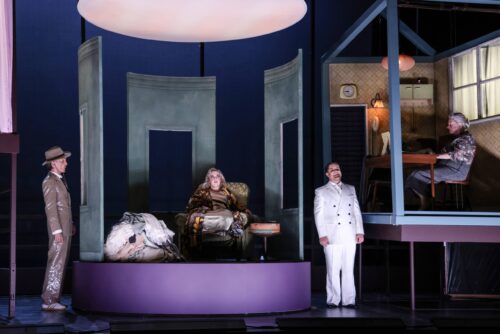
The set for this intriguing production, designed by Rebekka Dornhege Reyes, consisted of three interior spaces, side by side but at different levels in relation to the stage floor and not interconnected. Each was inhabited by a different Cio-Cio-San. To the left, we had a teenage girl’s bedroom in pink, suggestive of Japanese cherry blossoms, with Angela Jiyoung Shin as Cio-Cio-San I. At the end of the opera, she hung banners in a Southeast Asian language and English over the railings of her space to suggest that she was in fact of Korean and not Japanese descent. In the middle space we saw middle-aged Cio-Cio-San II, Sarah-Jane Brandon, occupying a bulky armchair, with a pile of clothes to her side. The third space, on the right-hand side, was the highest of the three, with an old Cio-Cio-San III, Brigitte Hahn. It was a kitchen space, old-fashioned and simple, suggesting poverty, but kept very neat and tidy. The appearance of the woman matched the environment, with simple, well-worn clothes but tidy, and well-kept hair.
The three Cio-Cio-Sans were on the stage throughout the duration of the performance, engaging in some kind of activity according to the nature of their space. They took turns singing Cio-Cio-San’s lines, with Brandon singing the majority, the other characters interacting with one of the three in no apparent order and seemingly for no particular reason, either. At the end of the opera, Cio-Cio-San I left her room through the roof hatch, Cio-Cio-San II remained motionless, while Cio-Cio-San III drank and presumably died from a concoction of cleaning liquids from her kitchen cupboard. For me, this form of suicide triggered an association with the young woman’s suicide in J. B. Priestley’s An Inspector Calls.
There was not much space on this part of the set for the chorus, who sang from the area between this front part of the stage and the back wall, predominantly only vaguely visible or indeed invisible to the audience. Unfortunately, a line of lamps were shining from the back of the stage into the auditorium for much of the performance, literally painfully bright for much of the time, forcing me to close my eyes frequently – other spectators in different seats or with less sensitive eyes may have seen more of what possibly went on between the lamps and the demarcations of the three spaces for the three Cio-Cio-Sans. The costumes displayed a combination of ‘western’ and ‘Asian/Japanese’ references and were mainly unassuming.
Angela Jiyoung Shin was given the most lyrical, light material of Cio-Cio-San’s lines. She displayed a bright, shining soprano, quite a luxury for a member of the resident opera chorus. Brigitte Hahn was the old Cio-Cio-San. A long-time company member of Niedersächsische Staatsoper in Hannover (2006-19), her repertoire there focused on dramatic roles, including Isolde and Brünnhilde. For the first time as a guest performer on the Bremen stage, Hahn impressed with a well-focused, even voice, with particularly beautiful long arcs sung with obvious relish and ease. Sarah-Jane Brandon sang her central Cio-Cio-San with much attention to melodic detail, with particular consideration for accurate differentiation of volume. Her voice soared in the broad strokes of the lines she had been given to sing, rising to beautiful bloom.
Natalie Mittelbach portrayed Suzuki as a caring companion (in love with Brandon’s Cio-Cio-San, culminating in a one-off but prolonged kiss on the mouth, which Cio-Cio-San did not resist and which left her pleasantly stunned). She sang with considerable commitment, her voice particularly mellow and warm, emphasising the melodious lines. Oliver Sewell added Pinkerton to his Italian repertoire. He was convincing both as the care-free, careless, reckless youngster and the slightly more morally mature family man with a conscience. His singing was accordingly ardent and compassionate, respectively, with clear vocal focus and secure, ringing top notes. Michal Partyka presented Sharpless as a man who immediately realised he should intervene on Cio-Cio-San’s behalf and that supporting Pinkerton as a fellow American was morally wrong. His remorse was thus all the more palpable and believable at the end. Partyka was able to express such complex emotions very well vocally, bringing a level of depth to the role not often seen. His voice was lean, elegant and warm in tone. Company soloists and chorus members did full justice to the smaller parts. The chorus, nearly invisible or cramped into comparatively small spaces, sang well.
Sasha Yankevych led the orchestra in a rich rendering of Puccini’s music, elegantly combining unsentimental drive and emotional flow as appropriate. Ulrike Schwab’s production was original and intriguing, consistent within its chosen frame. There were questions it raised but did not resolve, which is not necessarily a bad thing, but some of the set design and lighting decisions were at least potentially problematic or not readily linkable to the directorial concept.
Daniel Meyer-Dinkgräfe
Featured Image: [l-r] Angela Jiyoung Shin (Cio-Cio-San I), Sarah-Jane Brandon (Cio-Cio-San II) and Brigitte Hahn (Cio-Cio-San III) © Jörg Landsberg
Production:
Director – Ulrike Schwab
Set designer – Rebekka Dornhege Reyes
Costume designers – Martha Lange, Lena Schmid
Lighting design – Norman Plathe-Narr
Chorus and Children’s Chorus director – Karl Bernewitz
Dramaturgy – Frederike Krüger, Caroline Scheidegge
Cast:
Cio-Cio-San I – Angela Jiyoung Shin
Cio-Cio-San II – Sarah-Jane Brandon
Cio-Cio-San III – Brigitte Hahn
Suzuki – Nathalie Mittelbach
Pinkerton – Oliver Sewell
Sharpless – Michal Partyka
Goro – Fabian Düberg
Bonze – Jasin Rammal-Rykala
Prince Yamadori – Sunwoong Park
Yakusidé – Paul J. Ham
Imperial Commissioner – Daniel Ratchev
Registrar – Yosuke Kodama
Butterfly’s mother – Krassena Velkova
Aunt – Zlatina Genova-Wolf
Cousin – Andrezza Reis
Child – Leon Mache
Kate Pinkerton – Imogen Weidinger