
 United Kingdom Scriabin, Benjamin, Stravinsky, Ravel: London Philharmonic Orchestra / George Benjamin (conductor). Royal Festival Hall, London, 11.2.2026. (AV-E)
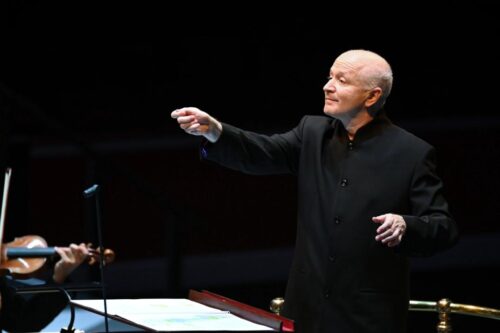
Scriabin – The Poem of Ecstasy
George Benjamin – Palimpsests
Stravinsky – Symphonies of Wind Instruments
Ravel – Mother Goose (complete ballet)
What attracted me to this concert was the rare chance to hear the complete score of Ravel’s Mother Goose ballet which included the interludes not heard in the suites; and also hearing one of my favourite works, Scriabin’s The Poem of Ecstasy. But I had never heard of the LPO’s composer-in-residence, George Benjamin, as a conductor before and as things unfolded throughout the concert, I unfortunately concluded how Benjamin had not succeeded either as composer or conductor.
The London Philharmonic Orchestra played The Poem of Ecstasy with precision and polish but without passion and potency, being ‘held back’ (that is, ‘tamed’ and ‘restrained’) by Benjamin, who seemingly censored the score of its perfumed sexuality, ecstatic sensuality and volcanic voluptuousness. For it all sounded far too tame, polite, subdued and manicured.
I can still vividly recall Lorin Maazel’s mesmerising Poem of Ecstasy with the Philharmonia Orchestra in December 2012 which was a paradigm performance of how it should be played and conducted. Tim Ashley reviewed it in The Guardian: ‘The closing work, Scriabin’s Poem of Ecstasy, was exceptionally fine – a beautifully controlled arc of sound rising steadily to its climax, with pitch-perfect playing and wonderfully sensual sonorities.’
Disappointingly, Benjamin did not observe the all-important ‘Grand Pause’ in the closing passages and thus completely missed the essence of the work.
With Benjamin and Boulez (1995), the ‘Grand Pause’ silence is silenced. Censored of its silence – as a sort of ‘mind-the-gap’ – the extreme tension and intensity of being held-hostage to silence in nothingness is negated: resulting in a lost silence of being in the silence of nothingness. For Scriabin, silence represents nothing. Whilst Maazel (2012) and Mravinsky (1958) accurately observed the six seconds of ‘transcendental silence’ in the ‘Grand Pause’ and created an incredibly intense sensation of one being suspended in nothingness just before the concluding ecstatic explosion of sound representing the self-affirmation of spirit: ‘I am’.
In the programme notes, George Benjamin writes: ‘Palimpsest: a manuscript on which two or more texts have been written successively the original surviving only in fragments.’ Or, in our contemporary parlance: a ‘cut-and-paste’ job. Listening to Benjamin’s pallid Palimpsests (2000-2002), I felt a sense of déjà vu – for I had heard it all before: a meandering mishmash of a mishap misarray. Palimpsests secreted a sense of selflessness: a voiceless voidness of non-identity; for there was no sense of human presence. The eminent critic, Rob Pennock wrote to me concerning Palimpsests: ‘I listened to it and it is nondescript and as with so much music of its kind it is too long. For me the strength of the material doesn’t support the length of the pieces.’
Suffice to say that the audience gave it applause more out of politefulness than delightfulness.
Igor Stravinsky’s Symphonies of Wind Instruments was by far the highlight of the evening with the LPO winds playing with characterful charisma and could have easily performed this short piece without a conductor (though, I suppose, in hindsight, they did).
How Benjamin could make Ravel’s enchanting Mother Goose ballet sound so bland and boring is a feat in itself since it never ignited. For, despite some deliciously evocative woodwind playing, the conductor failed to capture the magic and the mystery. It lacked the shimmering translucency and ethereal glow heard in Erich Kleiber’s 1946 NBC SO concert of the suite. Le jardin féerique is the most wonderful piece of incandescent music ever written yet here it was never illuminated and went for nothing. How deeply depressing.
Alexander Verney-Elliott