 United States Shostakovich: Chamber Music Society of Lincoln Center: Andriana Chuchman (soprano), Sitkovetsky Trio (Wu Qian [piano], Alexander Sitkovetsky [violin], Isang Enders [cello]); Inon Barnatan (piano/celesta), Paul Huang (violin), Jonathan Swensen (cello), Victor Caccese, Ayano Kataoka, Ian Rosenbaum (percussion). Alice Tully Hall, New York, 1.2.2026. (ES-S)
Shostakovich – Trio No.1 in C minor for Piano, Violin and Cello, Op.8; Seven Romances of Poems of Alexander Blok for Soprano, Violin, Cello and Piano, Op.127; Symphony No.15 in A major for Ensemble, Op.141 (arranged by Viktor Derevianko)
The Chamber Music Society of Lincoln Center continues to demonstrate its commitment to thoughtful, artistically ambitious programming, and this all-Shostakovich Sunday afternoon concert offered a compelling example of how historical insight and musical excellence can reinforce one another. By juxtaposing an early chamber work with a late song cycle and the composer’s final symphony, the program traced Shostakovich’s lifelong negotiation between private expression and public expectation under the Soviet state, allowing the music’s irony, restraint and emotional ambiguity to emerge with particular clarity.
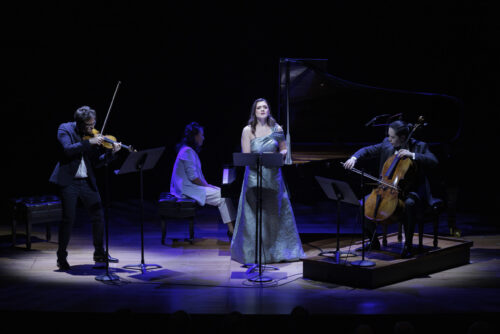
The performance of Seven Romances on Poems of Alexander Blok emerged as the program’s expressive core. Composed in 1967 for Mstislav Rostropovich and his wife, Galina Vishnevskaya, the cycle belongs to a moment of intense artistic introspection late in Shostakovich’s life in the aftermath of serious illness. Setting poems by the Symbolist poet Blok, whose work was viewed uneasily by Soviet authorities, Shostakovich fashioned a sequence of stark nocturnal visions, bleak prophecies and inward laments.
The composer responds to Blok’s texts through radical restraint. Each song is defined by a single instrumental presence, with voice and accompaniment kept deliberately exposed. The cello’s solitary line in ‘Ophelia’s Song’ establishes an atmosphere of isolation, while the piano’s stark outbursts in ‘Gamayun’ introduce menace. In ‘We were together’, the violin’s fragile lyricism briefly suggests intimacy before receding into austerity. Silences carry as much weight as sound, and the delayed appearance of the full ensemble heightens the sense of physical vulnerability embedded in the music’s structure. When voice and trio finally converge in ‘Music’, the effect remains tentative, reinforcing the work’s inward focus and avoidance of resolution.
Soprano Andriana Chuchman delivered a powerful and unvarnished performance, her clear, incisive Russian lending authority to Blok’s charged imagery. From the hushed inwardness of ‘Ophelia’s Song’ to the final ‘Music’, she fashioned the cycle as an intimate psychological narrative. Throughout, she was supported by instrumental playing of concentration, balance and expressive discipline from the members of the Sitkovetsky Trio, allowing the music’s tensions to register naturally.
The same ensemble had opened the program with Trio No.1, written in 1923 when Shostakovich was just seventeen. Cast in a single movement and described by the composer as a ‘poem’, the work reveals a lyrical, openly romantic voice, offering little hint of the irony and bitterness that would later mark his music. Two contrasting thematic ideas, one chromatically inflected and laden with pathos, the other more diatonic and songful, are set in continual opposition, lending the piece a rhapsodic, almost improvisatory character.
The trio embraced the music’s combination of melancholy and youthful ardor rather than tempering it, allowing long-breathed string lines to unfold freely while the piano’s animated figurations propelled the music forward. Given the cello’s prominent role in the work, Isang Enders shaped its expansive melodies with focus and tonal depth, providing the emotional anchor of the performance. Alexander Sitkovetsky brought suppleness and warmth to the violin line, complementing the cello’s lyricism without excess. At the piano, Wu Qian balanced clarity and momentum, driving the music forward while maintaining a sensitively chamber-scaled presence. The unguarded energy of the closing pages, delivered without apology, underscored the ensemble’s belief in the work’s sincerity and directness.
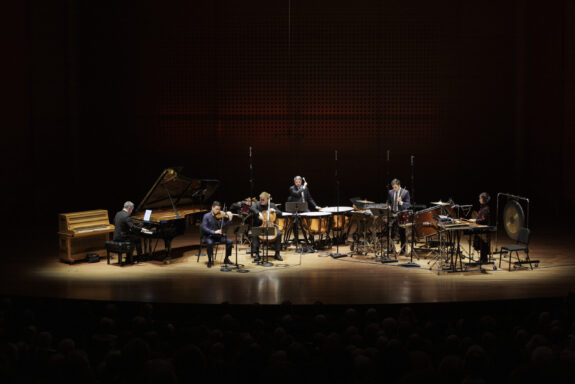
The program concluded with Symphony No.15, Shostakovich’s enigmatic final symphony, heard in the 1972 reduction by Viktor Derevianko. The symphony’s spare, episodic writing meant the reduction read less like a makeover than a sharpening of focus, even as certain losses were unavoidable and regrettable. Most keenly felt was the absence of brass weight. Passages that in the orchestral version depend on massed sonority, particularly the Wagner allusions in the finale and the central climaxes of the slow movement, could not summon the same sense of pressure or inevitability.
Shostakovich’s familiar quotations, from Rossini’s William Tell to motifs from Wagner’s Ring and Tristan, are stubbornly resistant to interpretation, functioning less as coded messages than as intrusive memories whose meanings remain elusive. Alongside these borrowed fragments are Shostakovich’s own self-quotations, which surface without explanation, further blurring the boundary between memory and irony. In this reduced scoring, all these abrupt appearances sounded especially exposed.
At the same time, the apparent imbalance of the ensemble, with a piano trio set against a prominently featured percussion group, laid bare the symphony’s inner workings. The second movement rested heavily on Jonathan Swensen’s cello, whose extended lament unfolded in near isolation, sharpening the music’s gravity. At the piano, Inon Barnatan played with notable modesty, doubling as celesta where required and letting the brittle sonorities speak for themselves. Paul Huang’s violin, often confined to the upper register, contributed a strained, glassy color well suited to the music’s unsettled character.
The percussion, central to the symphony in any guise, proved especially effective, articulating both the toyshop grotesquerie of the opening movement and the skeletal ticking of the coda with precision rather than display. What the performance could not provide in sheer orchestral mass, it compensated for in clarity and exposure. In this reduced form, Symphony No.15 emerged less as a farewell statement than as an unresolved meditation, its final pages receding in detachment.
Edward Sava-Segal
Featured Image: [l-r] Inon Barnatan, Paul Huang, Jonathan Swensen, Victor Caccese, Ayano Kataoka, Ian Rosenbaum © Tristan Cook/CMS