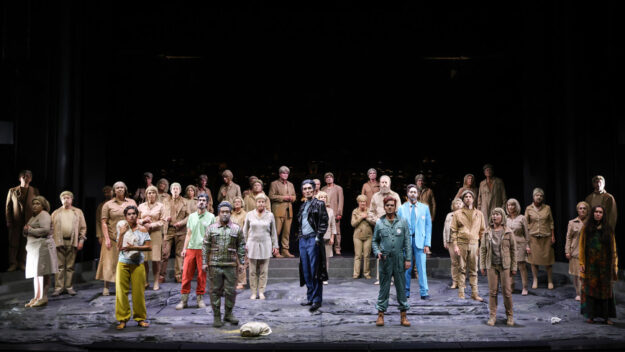
 Germany John Adams, Doctor Atomic: Soloists and Chorus of Bremen Theatre, Bremer Philharmoniker / Stefan Klingele (conductor). Bremen Theatre, 1.2.2026. (DM-D)
Some phenomena of life, here or elsewhere, are so huge that they remain almost beyond comprehension. Scientific discoveries, and what people do with them feature prominently among such phenomena, and the impact of the atomic bomb dropped on Hiroshima and Nagasaki is at the top of the list. John Adams’s opera Doctor Atomic, with a libretto by Peter Sellars, was premiered in 2005. Bremen premiered it on 16th September 2023, kicking off the 2023/24 season. The production became a critical success and proved so popular with the audience that it was revived in 2024/25 and again in 2025/26, accumulating a total of 16 performances. This is rare for contemporary opera in Germany.
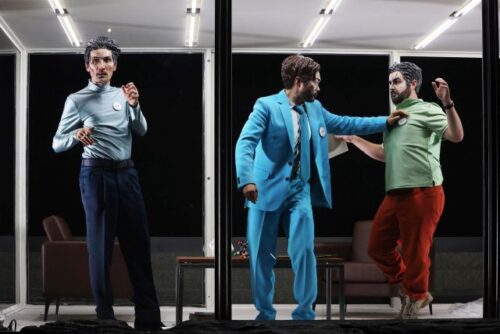
Theater Bremen’s head of opera, Frank Hilbrich, chose stylisation as the major directorial approach – it proved suitable to convey the absurdity of the context and contents: scientists, led by J. Robert Oppenheimer, isolated in a research facility in the desert, engaged in a race with scientists in Nazi Germany to design and build a weapon of unprecedented power. The endeavour was known as the Manhattan Project. Volker Thiele’s set consisted of a landscape where the ground looked like solidified lava. Out of that landscape a rectangular cabin with plexiglass walls, the abode of the scientists, was raised for the relevant scenes, and lowered to the ground level again for others. In line with the composer’s wishes, the singers’ voices were amplified, as was the orchestra placed behind the acting area of the stage, sometimes visible to the audience through a gauze curtain, sometimes not. The singers, both inside and outside the indoor cubicle, moved in slow motion throughout, adding to the non-realistic, surreal nature of events and characters. The scientists wore suits in bold, shiny colours, which gave an impression of some kind of futuristic uniform, reminiscent of Star Trek. Gabriele Rupprecht underlined the surreal nature of those costumes strikingly in line with the characters’ facial makeup or masks and hairstyles, which were made to look artificial and rigid.
Stefan Klingele drew maximum tension from the orchestra and singers, guiding the Bremer Philharmonic through the complex score with apparent ease and full confidence. Music and plot line came across as congruous. Michal Partyka sang Oppenheimer with an exquisitely beautiful, lyrical and sonorous baritone. The character’s vocal line added a further level of complexity to the opera, juxtaposing the horror of the bomb he is developing, and the beauty of life that comes under massive threat. Nadine Lehner sang Oppenheimer’s wife, Kitty. Her character provided the major feminine counterbalance to the male group of scientists and military personnel. Her relationship with her husband was on an equal footing, her musings providing him with appropriate context and, perhaps surprisingly given some of her very adamant comments, he derived support from her company. Lehner started out as a mezzo-soprano and has retained that particular ease in the lower register of her voice, which features prominently in Adams’s music for Kitty. Maria Koshiishi sang Pasqualita, the indigenous nanny reflecting on life and nature. The soprano originally cast for the role, Constanze Jader, had to withdraw due to illness on the day I saw the performance and Koshiishi stepped in at very short notice (she arrived at the theatre from Amsterdam at 4pm for the 7pm start), settling into the production admirably well and singing with a very gently and poetically flowing, rich voice, for which the score puts an emphasis on the lower register, making it borderline alto.
General Leslie Groves oversaw the Manhattan Project, which involved a total of some 150,000 people. Elias Gyunseok Han imbued his character with the necessary aura of authority and power, moving the scientists as needed on his giant chess board. The other scientists depicted in the opera, as selected by Oppenheimer and approved by Groves, included Edward Teller, Oppenheimer’s personal rival, and later in life the main instigator of rumours that Oppenheimer was in fact spying for the Russians. Hidenori Inoue sang Teller with a particularly dark colour of his sonorous bass. Robert R. Wilson was a leading physicist in Oppenheimer’s immediate group. Also a sculptor and an architect, he was one of very few scientists who voiced concern about the need to continue developing the atomic bomb after Nazi Germany had surrendered. Adams wrote this part for a tenor, and Oliver Sewell explored the nature of the role very well with his lyrical voice. Christoph Heinrich brought out the extreme pressure on his character, meteorologist Jack Hubbard. Bremen Theatre chorus member Wolfgang von Borries successfully added the role of Captain James Nolan to his slate of solo roles.
While the atomic bomb was and continues to be a massive threat, some have argued that artificial intelligence might pose a similar threat to humankind which is as yet underestimated, just as the radiation impact of a nuclear explosion was not sufficiently considered in the initial stages of the bomb’s development. The haunting video material created for the Bremen production using AI demonstrated an awareness of such potential parallels.
Daniel Meyer-Dinkgräfe
Featured Image: Bremen Theatre’s Doctor Atomic © Jörg Landsberg
Production:
Director – Frank Hilbrich
Stage design – Volker Thiele
Costume design – Gabriele Rupprecht
Video – Ruth Stofer
Sound design – Mathias Kluge
Lighting design – Christian Kemmetmüller
Chorus director – Noori Cho and Alice Meregaglia
Dramaturgy – Frederike Krüger
Cast:
J. Robert Oppenheimer – Michal Partyka
Kitty – Nadine Lehner
Edward Teller – Hidenori Inoue
Robert R. Wilson – Oliver Sewell
Pasqualita – Maria Koshiishi
General Leslie Groves – Elias Gyunseok Han
Jack Hubbard – Christoph Heinrich
Captain James Nolan – Wolfgang von Borries