
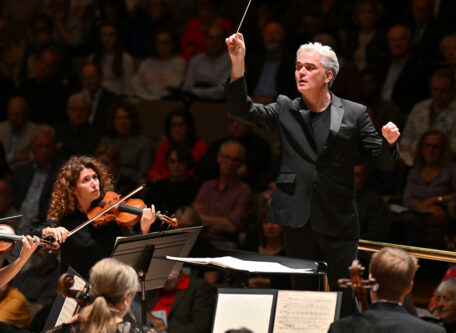
 United Kingdom Bacewicz, Martinů, Lutoslawski, Janáček: Josef Špaček (violin), London Philharmonic Orchestra / Edward Gardner (conductor). Royal Festival Hall, London, 4.2.2026. (CK)
Bacewicz – Overture
Martinů – Violin Concerto No.2
Lutoslawski – Symphony No.4
Janáček – Taras Bulba
The London Philharmonic Orchestra are on a roll. Hot on the heels of their memorable pair of concerts under their erstwhile Principal Conductor Vladimir Jurowski come another pair under their current Principal Conductor Edward Gardner; Saturday’s concert is yet to come, but on the evidence of this outing I have no doubt that it will be equally stimulating, exciting and peerlessly performed.
Polish music and Czech music – two works each – were satisfyingly interlaced in the programme. Having been very impressed by Grażyna Bacewicz’s Second Symphony (performed by Sakari Oramo and the BBC Symphony Orchestra in November 2024), I was eager to hear her Overture: Gardner and the LPO delivered it with irresistible zing, its martial elements trumped by its clean, bright energy, its instrumental details sharply focused. As with the symphony, the music has a faint but perceptible Nordic flavour – specifically, Nielsen – and exudes the same kind of health. What better way to begin a concert, especially in a performance as deft and brilliant as this?
Josef Špaček – looking much too young to be a former concertmaster of the Czech Philharmonic – was the soloist in Martinů’s Second Violin Concerto, and a marvellously eloquent one, both in airy lyricism and in thrilling virtuosity, meeting the work’s formidable demands with crystal clarity and an unfailingly light touch.
The first movement introduces a variation of the old Romantic opposition of soloist and orchestra. The latter opens the work with music of discord, almost of pain, and the soloist resists, trying to soften the orchestra’s attempts to straitjacket him with grim gestures: Orpheus-like, buffeted by extended orchestral episodes, he plainly wants to make love, not war.
The Andante moderato brought lovely sounds from woodwind and horns against gently plucked double basses, and lyrical flights – both tender and brilliant – from the soloist; later, a mysterious, faintly ecclesiastical chant in the orchestra. The soloist’s virtuosity is very much to the fore in the exciting finale. If the concerto represented something of a standoff between violin and orchestra, Špaček’s encore made touching amends: a Dvořák Humoresque, for which he was joined by Leader Pieter Schoeman, Principal Viola and Principal Cello.
If anyone thinks that atonal music cannot be beautiful, they should listen to the opening of Lutoslawski’s Fourth Symphony, his last: the clarinet, trying out a melody, emerging from a golden, quietly pulsing haze on harp and lower strings. Very different from the Beethovenian clenched fist with which the Third Symphony begins.
The orchestra for the Fourth is large and colourful, including a colony of percussion, two harps, piano and celeste: it produces sounds both sharp and shimmering, woodwind bubbling up and spiralling down, brass and percussion sending out streamers and splinters, strings rich mahogany with violins low in their register.
The symphony – like its two predecessors – is in two movements (according to Norman Lebrecht, the fastidious composer wrote symphonies in two sections because listening to three or four movements always left him feeling exhausted). The first movement appears to chart a gradual expansion, a long crescendo, in which there are many singing voices: all this was masterfully controlled by Gardner and spine-tinglingly played by the LPO. The second movement – there is no break between the two – builds to an apparent apotheosis: but this dissipates, leaving the symphony to drift towards a bleak conclusion. But then a great burst of energy blows in from nowhere, leaving us simultaneously uplifted and uncertain where we are.
If Gardner and the LPO excelled in this rarely played symphony, they outdid themselves in Janáček’s Taras Bulba. Janáček’s music is visceral: violin strokes cut like knives, percussion cracks like breaking glass, brass hits us in the solar plexus. When Simon Rattle and his Bavarians prefaced Bruckner with this work in the Barbican Hall last November they played it beautifully, but there was no edge, and no sense of heroic expansion, no thrilling widescreen vision in Taras’s prophecy as he burns (a rather feeble organ didn’t help). Gardner and the LPO gave us all this, in spades: the roar of the organ, the clangour of the bells, the thundercracks of Simon Carrington’s timpani – the sheer, semi-barbaric magnificence of it all. No, I am not saying the louder and coarser, the better: but it is the music’s vernacular that is so moving, its honesty and directness (as in the Sinfonietta; as, perhaps, in every note that Janáček wrote).
An extraordinary, exhilarating concert; an opportunity to hear three works I had never heard in the concert hall, crowned by a performance of a 20th-century masterwork that did it full and unforgettable justice. As I said, the London Philharmonic Orchestra are on a roll.
Chris Kettle