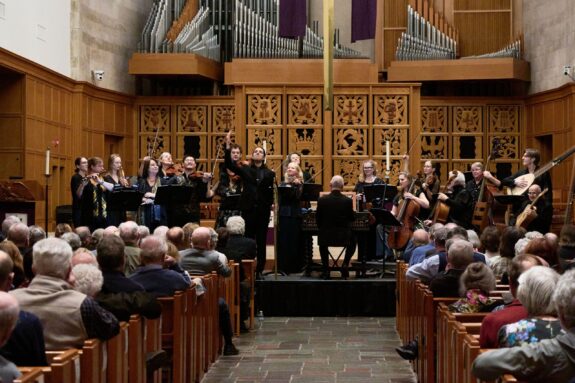
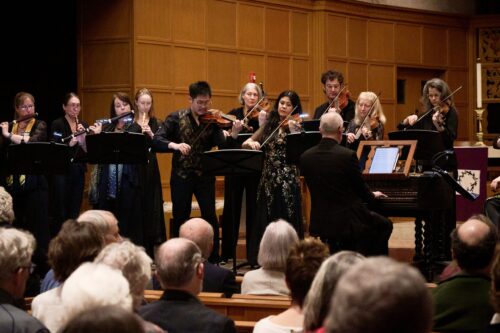
 United States ‘Palace of Versailles’: Apollo’s Fire / Alan Choo (director, violin). St. Paul’s Episcopal Church, Cleveland Heights, 7.3.2026. (MSJ)
Lully – ‘Marche pour la cérémonie des Turcs’ and ‘Canarie’ from Le Bourgeois gentilhomme; ‘Passacaille’ from Armide
De Lalande – Les Fontaines de Versailles
Leclair – Violin Concerto No.5 in A minor, Op.7
Charpentier – Concert pour 4 parties de violes, H.545
Rameau – ‘Suite’ from Les Indes galantes
Rebel – ‘Les Caractères de la danse’
This concert unfolded the poised elegance of the French Baroque, allowing listeners to hear six masters side-by-side which pointed out some interesting elements. The first and foremost is that Jean-Philippe Rameau was the giant of the age. Lully had hauteur, De Lalande elegance and so forth, but the ‘Suite’ from the opera Les Indes galantes demonstrated that Rameau could hardly put pen to paper without creating a vivid sketch of character, emotion or movement. Whether in the dainty dance of the ‘First Rondeau for the Flowers’, the jittery ‘Storm’ (complete with period thunder sheet), the limpidly poised flutes of ‘The Adoration of the Sun’, the breezy piccolo of the ‘First Air for Zephyr’ (played with buoyancy by Kathie Stewart), the tragically intertwining lines of ‘The Savages’ or the feisty ‘Tambourins’ (played here with tambourine support, not the actual tall drum of the title), the music leaps from the page, and the ensemble savored every turn under Alan Choo’s direction.
Not far behind Rameau is Jean-Baptiste Lully, who was Italian-born but made his career etching out what was to become the quintessential French style: dance-based, poised and focused on color and elegance over drama. The performance opened with a march led by percussionist Anthony Taddeo who embodied Lully, leading from the front with a wooden staff. This is exactly how Lully led performances, banging out the beat with a staff on the wooden floor until he infamously stabbed himself in the foot with that pointed staff in 1687. In those days before antibiotics, gangrene set in but, according to legend, Lully refused to have his toe amputated because it would impair his ability to dance. The infection spread and he died. It is rare to hear a performance that includes the staff, and I wouldn’t have minded hearing it on all three Lully selections. But with or without the staff, the performances caught the haughty, almost arrogant feel of the composer’s music, which included a recorder solo delivered with flair by Kathryn Montoya.
The following portrait of the fountains of King Louis’s Palace of Versailles by the king’s chapel composer Michel-Richard de Lalande basically sounds like Lully, emphasizing elegance and without the sneer, though the composer tends to fall back on stock gestures. The outstanding movement was ‘Plaintes, regrets’ which featured the soft glow of the Baroque oboes. The latest composer of the six featured was Jean-Marie Leclair whose Violin Concerto in A minor infused French elegance with a touch of Vivaldian brio. Alan Choo did double duty as fiery soloist in the piece, maintaining his focus despite an unusual number of distracting noises from the side gallery of the audience. Like De Lalande, Leclair liked to incorporate formulaic sequences, but Choo zeroed in on those passages as being ones that needed extra motivation to keep the work going, to brilliant effect.
The Charpentier chamber work for four viols was deployed on instruments of the violin family (Alan Choo and Susanna Perry Gilmore on violins, Nicole Divall on viola and René Schiffer on cello, supported by William Simms and Brandon Acker on plucked instruments), brightening its mellow contemplations. The passing dissonances in the closing passacaglia were exquisite and quite daring for their day.
One drawback here: the generally drab acoustics of the venue which absorbed high frequencies and failed to resonate low frequencies, emphasizing the mid-range which can get a little wooly in some of the pieces that focus on the middle frequencies. That, combined with the, frankly, ugly mid-century Brutalism of the room’s architecture made it a less-than-ideal venue. Additionally, the shape of the room kept the ensemble’s sound in the distance, easily covered by audience noise which, unfortunately, was plentiful.
The evening closed with a whirlwind tour of the dance styles of the day from Jean-Féry Rebel which served as a built-in encore for the program. The audience response was enthusiastic.
Mark Sebastian Jordan
Featured Image: Percussionist Anthony Taddeo personifies Lully and marks time with a wooden staff © Malcolm Henoch/AF