 United Kingdom Mozart, Le nozze di Figaro: Soloists, Chorus and Orchestra of Opera North / Valentina Peleggi (conductor). Lyric Theatre, The Lowry, Salford, 12.3.2026. (MC)
One of Mozart’s most admired operas Le nozze di Figaro (The Marriage of Figaro) has stood the test of time. It is 240 years since the opera received its premiere in 1786 at Vienna’s Burgtheater with Mozart conducting this commedia per musica (comedy through music) from the keyboard. Mozart’s librettist was Lorenzo Da Ponte who choose to set a text based on the Pierre-Augustin Beaumarchais comedy La Folle Journée, ou le Mariage de Figaro. Thanks to the collaboration between two of the greatest minds in opera, I never tire of this enduring masterpiece. For my money Figaro is the oldest of the opera warhorses performed regularly today.
An enduring comedy favourite, Figaro is a madcap excursion during a hectic twenty-four hours at the Almaviva mansion, a feudal estate. In the scenario there are lots of intriguing goings-on including infatuation, secrets, infidelity, betrayal, disguise, concealment etc. It is a clever libretto from Da Ponte where the men tend to act as buffoons whilst the women are by far the smarter of the sexes. It was William Shakespeare who wrote in his play A Midsummer Night’s Dream how ‘The course of true love never did run smooth’. This is certainly the case here on the wedding day of Figaro and Susanna both servants to the Count and Countess of Almaviva. The plot is based around Figaro and fiancée Susanna, conspiring with the Countess, to help beat off the Count’s amorous advances toward his bride-to-be.
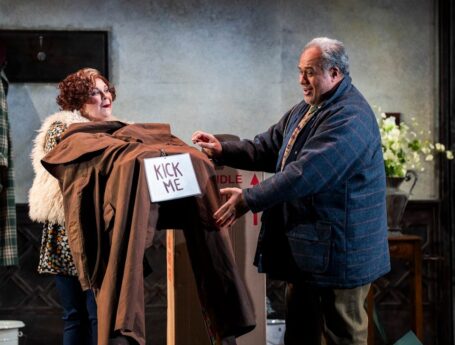
The original setting is Count Almaviva’s palace close to Seville in Spain. This new production by Opera North directed by Louisa Muller brought the action forward to the present day, set in a rundown English country mansion. Madeleine Boyd had given plenty of reminders of the era such as the boot room decked out with items like the Hunter wellingtons, walking boots, cricket pads and bats, wicker picnic baskets and Barbour coats. I was impressed how depth was added to the set by the magnificent wooden staircase that could be seen through the large paned window on the back wall. Given the contemporary nature of Boyd’s sets, it did seem puzzling why the company chose to take the plunge and use for its first time the original Italian libretto.
The success of Muller’s production was helped by assembling strong principal protagonists. Casually dressed in purple jumper and blue denim jeans Liam James Karai, was a crafty and affable enough Figaro, often looking anxious as the Count’s philandering came too close to home. A highlight was Karai singing Figaro’s famous aria Non più andrai (You shall go no more) as he escorted Cherubino away to his expeditiously awarded military commission. Singing and acting well, Karai provided clear and firm projection nevertheless at times I wanted more passion generated in the role. In 2022 at Manchester, I came across Karai also as Figaro in a Royal Northern College of Music production of Figaro and it has been pleasing to see his progress. (Furthermore, I recall Ruggero Raimondi’s remarkable performance of the Figaro aria in Jean-Pierre Ponnelle’s production in 1985 at the Metropolitan Opera on DVD.)
Dressed casually in a green jumper and brown trousers Claire Lees as Susanna, Figaro’s fiancée, seemed comfortable with what is one of operas longest roles. In Act IV at night Susanna is singing her love song Deh vieni non tardar (Oh come, don’t delay) from inside a stable with Figaro hiding just inches away from her on the other side of the wooden panel. As intended Figaro mistakenly thinks she is singing about the Count. A creamy and clear-toned soprano Lees’s rendition of the aria was entrancing however for my taste I imagine Susanna as a more spirited bride-to-be.
Philandering Count Almaviva is the master of the house and baritone James Newby was clearly relishing the role. I was surprised the Count didn’t underline his status by dressing in tweeds or suits rather than looking too similar to his staff members. Whilst playing snooker Almaviva commences his third-act recitative and aria Hai già vinta la causa!… Vedrò, mentr’io sospiro (We are sure of our case now… Must I forget my pleasure!). This bitter statement by the Count about his hurt feelings and how his servants laugh at him was strikingly sung by Newby. Generally, I prefer an overtly angry Count and Newby wasn’t that, yet I did enjoy his performance.
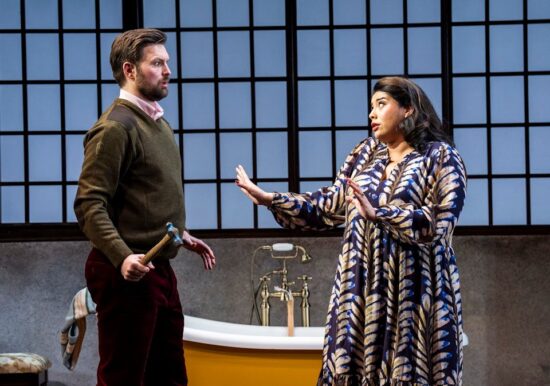
Mozart gave the role of Countess Rosina Almaviva, sung by soprano Gabriella Reyes, two marvellous arias. In the meltingly beautiful and challenging Act II cavatina Porgi, amor, qualche ristoro (God of love, I now implore thee) the Countess has one of the most acclaimed of all Mozart arias. This is an impassioned plea to the god of love to cease her husband’s infidelity and return him to her or let her die. Looking for some emotional peace the tearful Countess retreats to the bathroom and sits on a chaise longue in front of the freestanding bath. At this point dressed in her silky blue and white dressing gown Reyes gave an outstanding performance of the cavatina. She captured the distress of the Countess with unerring sincerity and revealed her attractive creamy tone together with such telling projection. In her captivating performance Reyes was no less compelling with her recitative and aria Dove sono i bei momenti (I remember days long departed) in Act III. Tearfully Reyes imparted persuasively the heartbreak of losing the love of her husband. Not only has Reyes a first-class voice and a telling stage presence she looked elegant wearing the Countess’s glamorous gowns. I am delighted to have seen Reyes in performance and am already looking forward to the next time.
Hongni Wu had the trouser role of Cherubino, the count’s pageboy, dressed in denim jacket with brown trousers and later a blue soldier’s uniform. Wu made an enthusiastic, youthful and frisky Cherubino and in the act one aria Non so più (I no longer know) he described his emerging infatuation with women, especially for the Countess. From Act II the celebrated aria Voi che sapete che cosa è amor (You who know what love is) is the song Cherubino has written, for the Countess, to draw attention to himself. Infusing Cherubino with reserves of energy Hu was in prime form and demonstrated splendid affinity for the role displaying her quite small yet clear and focused voice.
Formidable bass Jonathan Lemalu took the role of Doctor Bartolo, the Countess’s former guardian. Wanting to get his own back on Figaro, and for Marcellina too, he sings his first-act aria La vendetta, oh, la vendetta! (Revenge, oh, sweet revenge!). Dressed in a blue check woollen country jacket Lemalu displaying his rich and secure voice was in redoubtable form.
Taking the remaining roles were Katherine Broderick as Marcellina, Daniel Norman as Basilio, Kamil Bień as Curzio, Jamie Woollard as Antonio and Charlotte Bowden as Barbarina. All seemed fully invested in the production and gave valuable support. This comedy score is bursting with arias, duets, trios and ensemble pieces, many amongst the best known in opera. Aside from the solo arias most notable was the exquisite soprano Act III duet between Susanna and the Countess Sull’aria… che soave zeffiretto (On the breeze … What a gentle little Zephyr). This was quite glorious singing by Lees and Reyes as the Countess dictated a letter to Susanna giving an enchanting description of the impending tryst with the Count. Susanna responded in song by repeating each of her mistress’s lines. Adding to the success of this production was the first-rate contribution of both the Opera North orchestra under Valentina Peleggi and chorus coached by Anthony Kraus.
Directed by Louisa Muller her new Opera North production blew the cobwebs off Le nozze di Figaro with the excellent performers doing full justice to Mozart’s masterpiece.
Michael Cookson
Featured Image: James Newby (Count Almaviva) and Gabriella Reyes (Countess Almaviva) © Tristram Kenton
Creatives:
Direction – Louisa Muller
Set and Costume design – Madeleine Boyd
Lighting design – Malcolm Rippeth
Choreography – Rebecca Howell
Chorus master – Anthony Kraus
Cast:
Figaro – Liam James Karai
Susanna – Claire Lees
Count Almaviva – James Newby
Countess Rosina Almaviva – Gabriella Reyes
Cherubino – Hongni Wu
Doctor Bartolo – Jonathan Lemalu
Marcellina – Katherine Broderick
Don Basilio – Daniel Norman
Don Curzio – Kamil Bień
Antonio – Jamie Woollard
Barbarina – Charlotte Bowden