
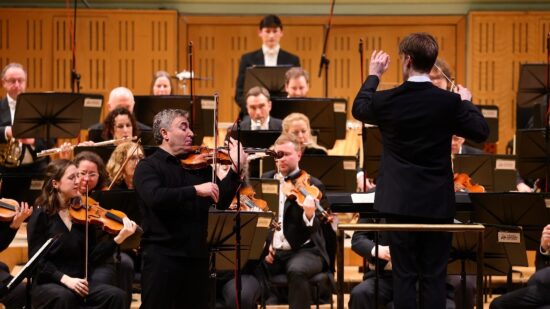
 Ireland Sibelius, Bartók, Tchaikovsky: Maxim Vengerov (violin), National Symphony Orchestra Ireland / Kristian Sallinen (conductor). National Concert Hall, Dublin, 27.2.2026. (RB)
Sibelius – En Saga Op.9
Bartók – Divertimento for Strings Sz 113
Tchaikovsky – Violin Concerto in D major Op.35
The presence of the inimitable Maxim Vengerov ensured that the National Concert Hall was packed out for this event. Vengerov was originally scheduled to play the Mendelssohn Violin Concerto but opted to replace it with the Tchaikovsky. The National Symphony Orchestra Ireland were joined by the young Finnish conductor, Kristian Sallinen.
The programme opened with Sibelius’s tone poem En Saga which received its premiere in Helsinki in 1893. The work does not have a programme or literary source although in the 1930’s Sibelius conceded that the work owed its inspiration to Iceland’s Eddas. A decade later the composer described the work instead as ‘the expression of a certain state of mind’, one with an unspecified ‘painful’ biographical component.
There was much to admire in this performance by Sallinen and NSOI. The string textures which opened the work conjured up the cold unforgiving Nordic landscape. Sallinen struck the right balance between the reflective atmospheric elements and the explosive rhythmic energy in the score. Alex Koustas on viola and Matthew Billing on clarinet played their respective solos beautifully and helped underline the melancholy painful feelings which the composer described. Sallinen coaxed a wide range of dynamics from the NSOI and some of the sotto voce playing from the strings was particularly impressive. He did a fine job steering his orchestral partners through the piece, although I wondered if there was scope for him to use his hands and arms in more expressive ways to convey the character of the music.
Bartók’s Divertimento for Strings was composed over a period of 15 days immediately before the outbreak of the Second World War. It is a neo-Classical work which makes use of the Baroque concerto grosso style where a small group of solo string players are set against the fuller body of strings. In this work, Bartók fuses central European folk music with his driving rhythmic style, and he makes inventive use of fugal and imitative writing.
I had rather mixed feelings about the performance from Sallinen and the NSOI. The first movement opened well, and I liked the earthy approach the string players took to the folk elements in the score. Some of the witty neo-Classical pastiche sections were very well executed. For the most part, the interplay between the soloists and the rest of the orchestra was well coordinated. The performance lost momentum in the development section of the first movement where I would have welcomed a more pugnacious visceral approach to Bartók’s driving rhythms, dissonances and biting accents. Sallinen and the NSOI’s strings did a good job conjuring up Bartók’s ghostly night scene in the slow movement but it would have liked to hear a greater sense of dread in the music. Some of the extreme dynamic contrasts were not as jarring as they needed to be. The finale was the most successful of the three movements. The opening was bright and exuberant and there was excellent interplay between the soloists and the main body of strings. The voicing of the fugal section was admirably clear and the orchestra’s leader, Elaine Clark, treated the audience to an impressive virtuoso display.
Tchaikovsky’s Violin Concerto was written in the aftermath of the break-up of the composer’s disastrous marriage to Antonina Milukova. Tchaikovsky was whisked away to Switzerland by his brother to recuperate. He was visited there by the young violinist, Iosif Kotek, who was a former pupil and lover. Kotek had brought some recently published scores from Berlin, including Lalo’s Symphonie espagnole, and these inspired the composer to write his own violin concerto.
Maxim Vengerov is one of the greatest living exponents of this concerto and his 1995 recording of the work with Claudio Abbado is often cited as a definitive account. He certainly did not disappoint in this performance with Sallinen and the NSOI. His glorious rich, vibrant tone was very much in evidence, and he did a wonderful job projecting Tchaikovsky’s gorgeous melodies around the hall. The playing was very free with Vengerov making judicious use of rubato to underline the expressive qualities of the music. In some ways the playing was a little indulgent although it was impossible not to be captivated with every phrase and nuance. As one would expect, Vengerov negotiated the rapid-fire passagework and double stopping with virtuoso aplomb although even here I was struck by how well he integrated this material into the musical narrative. He captured perfectly the free improvisatory quality of the cadenza while negotiating the considerable technical difficulties with consummate ease. Sallinen and the NSOI provided a sensitive and flexible accompaniment while the big orchestral tutti passage was glorious.
The NSOI’s woodwind ushered in the second movement Canzonetta with a soulful chorale. Vengerov’s playing in this movement had a disarming simplicity and directness. His colouring of the opening theme reflected the soulful Russian melancholy of the music while the subsequent major key section had a beguiling intimacy. The finale was taken at a blistering pace and provided an opportunity for Vengerov to unleash his full technical arsenal. The Cossack dance section was a blistering virtuoso tour de force although even more impressive was Vengerov’s astonishing control of the material and perfect intonation. The coda provided one final adrenaline filled rush as conductor, orchestra and soloist joined forces to drive the work to a thrilling conclusion.
The performance was greeted with rapturous applause and a standing ovation from the audience. Vengerov, Sallinen and the NSOI performed the slow movement from Wieniawski’s Second Violin Concerto as an encore. Vengerov played the lush Romantic melody with immense beauty of tone leaving his Dublin audience spellbound. Fabulous playing.
Robert Beattie