
 United Kingdom Dvořák: Orchestra, Craig Lawton, Paul Ingram (conductors). Turner Sims Concert Hall, Southampton, 1.3.2026. (CK)
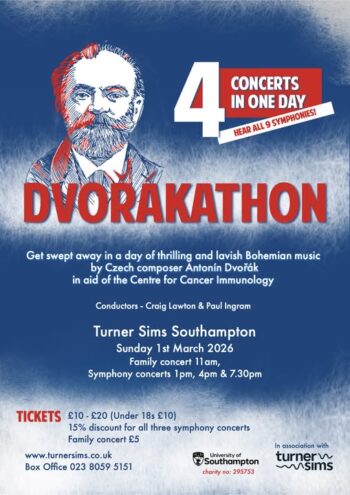
Dvořák – Symphonies 1-9
What better way to salute the arrival of meteorological spring than with the music of that most vernal of composers, Antonín Dvořák? A symphony, perhaps: or how about all of them?
This Dvořákathon was the sixth musical marathon mounted by doughty Hampshire conductors and percussionists Craig Lawton and Paul Ingram, and the third in successive years, following a Tchaikathon (2024) and a Shostakovathon (2025). Neither of those events attempted all the symphonies of the featured composer in a single day: but here we had the full Antonín. As with all previous years, the event was a fundraiser for the critical, cutting-edge work of Southampton University’s Centre for Cancer Immunology.
As before, Craig and Paul had assembled an orchestra of over 60, crowding the Turner Sims stage (designed for much smaller bands). The music began at 11am and ended at 9.30pm: during that time players came and went and came back again, and swapped places within their sections. There were full wind and brass (up to six horns), a forest of violins, a small knot of violas and a splendid bedrock of eight cellos and five double basses.
We began with a well-attended family concert, conducted by Craig and ebulliently compered by Keelan Carew, which presented a considerably abbreviated version of Dvořák’s First Symphony, The Bells of Zlonice (wisely: the symphony lasts almost an hour). This was an inspired choice: the first movement is full of buoyancy and bells (my favourite musical imitation of bells – along with Mahler’s ‘Bimm-bamms’). Great fun and all done in forty minutes.
The 1pm concert drew the sparsest audience, understandably: Symphonies 2-4, none of them well-known, some of them long (especially No.2): a concert of over two and a half hours, a marathon in itself. Paul Ingram was on baton duty for Nos.2 and 3 (he and Craig alternated as timpanist and conductor), drawing some glowing sounds and exciting brass playing – there was a clear sense of the orchestra getting into its stride after some loose ends and frayed edges in the family concert.
No.3 had some fine sounds too, with its lovely, aspiring theme, so mellifluously tuneful, and chiming horns; its second movement less impressive, but nicely played, with burnished brass sounds and a flowing, Rheingold-like ending; and a finale that went with an infectious swing. Craig was back on the podium for No.4: a vigorous, purposeful opening movement, the second stalked again by Wagner (Tannhäuser this time), the third surprising (and amusing) us with – of all things – a Turkish march. More marching in the finale, offset by a warm second theme on the strings.
In the interests of brevity, I shall report simply that the climactic evening concert, in which the best-known symphonies (8 and 9) were performed, was splendid, and enjoyed by a large and enthusiastic audience: which leaves me a little space for the 4pm concert – another two-and-a-half-hour marathon – featuring Symphonies 5, 6 and 7: the heart of the day’s music-making, as far as I was concerned.
As I walked in to take my seat the piccolo was practising her brief but sublime moment of free flight in the Scherzo of No.6: it put a smile on my face which remained there throughout Nos. 5 and 6. These symphonies, full of lovely themes and felicities of scoring, deserve to be better known; and these players responded splendidly, with a lilt in the melodies and a lift in the rhythm of the dances, delicate or rumbustious, and (in the Fifth) a finale of real fire. And does any symphony have a more carefree, blissful opening than Dvořák’s Sixth? I very much doubt it. There was a real sense of open-air excitement in the playing, and all sections distinguished themselves; in the second movement it was particularly rewarding to hear the violas – a much smaller section than the violins – have their moment with the tune. The Scherzo’s furiant was splendid, the players giving it almost the propulsive energy of a Bruckner scherzo. And that dreaming, unhurried piccolo moment! The finale, with its noble, almost Elgarian tune, was thrilling and it made me reflect, not for the first time, that Dvořák’s symphonies – certainly this one – end not so much in triumph as in a sense of unconquerable well-being.
The performance of the Seventh Symphony, conducted by Paul Ingram, was climactic in every sense. I admire its Brahmsian sternness, but I do not love it as I love the healthy outdoor character of so much of Dvořák’s music: however, this performance was one to make me realise why many people consider it the composer’s finest. The titanic energy of the first movement blew me away; and the commitment of the playing throughout was on the highest level. The ending was huge, overwhelmingly dramatic: the conductor Ingram was rightly delighted with his players, and the performance was rewarded with the biggest and loudest ovation of the day.
The day was an extraordinary achievement. Knowing Craig and Paul, they are probably already thinking about next year. Schubert? Nielsen? Sibelius? Elgar? Time will tell…
Chris Kettle