
 United Kingdom Various: Laura Van Der Heijden (cello), Sinfonia Cymru / Haim Choi (leader). RWCMD, Cardiff, 28.2.2026. (LJ)
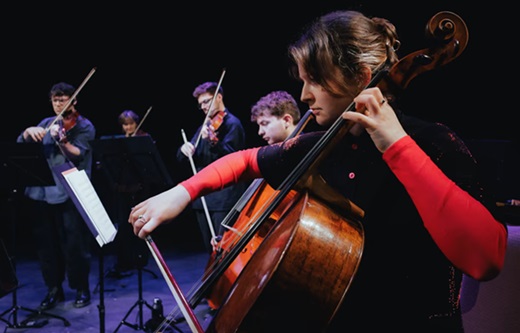
Laura van der Heijden returned to the Royal Welsh College of Music and Drama one year after her recital with the pianist Jâms Coleman, which I also reviewed for Seen and Heard International (here). This time, Van der Heijden was accompanied by the string players from Sinfonia Cymru, the Cardiff-based orchestra consisting of musicians aged under 30. The concert, billed as ‘Folk, Fire and the Cello’, was divided into fairytale and folk inspired music, and, if what follows piques your curiosity, you can listen to BBC Radio 3’s In Concert recording on 18 March.
In 2012 Van der Heijden won the BBC Young Musician competition, but she did not immediately burst onto the music scene. Instead, she went on to complete her studies at Cambridge, graduating in 2019. Her repertoire is largely twentieth-century and contemporary, so it was fitting to hear performances of Bulgarian composer Dobrinka Tabakova’s Concerto for Cello and Strings (2008) and Béla Bartók’s Divertimento for Strings (1939).
The programme, however, was not confined to post-1900 repertoire. Its eclecticism, demonstrated both Van der Heijden’s and Sinfonia Cymru’s versatility and enthusiasm for ‘quirky’ music, exemplified in their decision to perform the pizzicato ‘Plink, Plank, Plunk!’ composed as a musical joke by Leroy Anderson in 1951 (some readers may recognise this piece as the theme tune for the American TV game show I’ve Got a Secret).
Despite the pieces ranging from medieval to contemporary, jazzy to baroque, the flow from one piece to the next was seamless. This level of musicological insight on the part of both Van der Heijden and Haim Choi (leader of Sinfonia Cymru) was impressive. Moreover, the musical and personal camaraderie between these two musicians was evident; something I hope will lead to future collaboration. As fifteen pieces (including an encore) were played during this recital, in this review I shall discuss the most memorable.
Things kicked off – quite literally – in Sinfonia Cymru’s spirited performance of Élisabeth Jacquet de la Guerre’s Céphale et Procris (Act IV Scene 6: Les démons), where instrumentalists slapped their thighs and stomped their feet to add a strong percussive beat. This had the effect of taking the audience to the court of King Louis XIV, where de la Guerre originally performed her pieces. Interestingly, this piece would make de la Guerre the first female composer of an opera.
Enthusiasm was aplenty at Cardiff’s rather humbler RWCMD, but timing was not as accurate as it could have been. This issue with control and timing presented itself again in Tabakova’s rhythmically challenging Concerto for Cello and Strings.
For anyone who has not yet heard Tabakova’s concerto, it is a wonderful piece that seems at once deeply familiar and entirely new. She has an incredible ability to present imaginative and original melodies and rhythms in a way that resonates with our innate musicality.
Indeed, Tabakova was interviewed on stage by Radio 3’s Verity Sharp, who asked her about the inspiration behind the piece. In her response, Tabakova mentioned Boethius, the Roman philosopher of the Early Middle Ages. She said that she was captivated by his belief that music can bridge physical and spiritual worlds. Following Pythagorean philosophy, Boethius argues that music possesses three components: ‘musica instrumentalis’, ‘musica humana’, and ‘musica mundana’, which Tabakova cross-referenced with the words: ‘acrobatics’, ‘blood’, and ‘harmonics’. Accordingly, her concerto consists of three movements described as ‘Turbulent’, ‘Longing’, and ‘Radiant’. Despite these three distinctly titled movements, on her website Tabakova refers to the piece as ‘one seamless form – a journey’.
During the course of the piece, which lasts approximately 20 minutes, there is a predominant feeling of ascension. Its opening movement brings to mind Arvo Pärt with its vigorous and tense folk-inspired sound. The second movement is lyrical and intimate. Tabakova builds on a pentatonic mode, starting with the lower strings and creating a beautiful arc that builds in pitch, pace, and emotional intensity before falling back down to more of a lament. For the final movement, which shares some similarities with work by Henryk Górecki and Max Richter, the cello line recalls that from the first movement, but it is much lighter in texture as it begins with the cellist playing harmonics.
This is a rich, imaginative, and original composition which requires the cellist to both embed themselves into the fabric of the piece and to soar above it. Emotions run high and Van der Heijden’s impassioned performance spoke to the beating heart of the score whilst showcasing her virtuosic talent.
This said, the piece’s speed and repetitiveness almost became overbearing at times, with the first movement needing greater control and tightness. Whilst the accompaniment by Sinfonia Cymru was certainly heartfelt, on two occasions, Choi paused her own playing to conduct, reaffirming the piece’s tempo and form. All said, a recording of Van Der Heijden and Sinfonia Cymru performing Tabakova’s work would be a welcome addition to the already stunning recording on String Paths (EMI, 2012), reviewed here on MusicWeb-International.
Throughout the evening, Sinfonia Cymru were clearly more comfortable with some pieces than others. This may be due to the extensive repertoire with which they tasked themselves. It was delightful to hear an original piece by Welsh composer Patrick Rimes (Galliard-Bourree) and his arrangement of the traditional Welsh love song Ar Lan y Môr (‘On the seashore’). These pieces were fitting not only because the concert took place on the eve of St David’s Day but also because Rimes (who was sitting in the audience) teaches at the RWCMD. Upon hearing Rimes’s organic arrangement, I shall be on the lookout for more.
Two shorter yet noteworthy pieces from the evening include Hildegard von Bingen’s Antiphons and John Rutter’s First Suite for Strings (I Have a Bonnet Trimmed with Blue). Bingen’s Antiphons are extraordinary compositions. In their original form they are single-line melodies that are sung during Christian liturgy, featuring heavily in Ambrosian and Gregorian chant. Due to this monophonic texture, the music is distilled and pure. Sinfonia Cymru played these unadorned medieval Antiphons with intention and a meditative, almost improvisatory, quality. Violas performed particularly well. Although Rutter is widely known for his choral work, Sinfonia Cymru played his folk-inspired music for strings. This music is delightful, light, and folky, thereby fitting nicely into the second half of the concert, which was labelled ‘Folk Medley’. Here, Sinfonia Cymru were rhythmically in control and created a wonderfully unified sound.
The recital came to an end with Bartók’s Divertimento for Strings, which is the last work he wrote for his patron, the Swiss conductor Paul Sacher. It is also the last work he composed before fleeing Hungary for the US in 1940 due to the rise of the Nazi-aligned Arrow Cross Party. Indeed, on 1 July 1941, Hungary joined the Axis powers and entered the war. As a result, Bartók would never return to Europe. This foreboding, bleak atmosphere can be heard in the second movement (Molto adagio) which stretches tonality to its limit. There are sharp dynamic contrasts, several instances of harmonics, and double stops – all of which contribute to a jarring and unsettling soundscape. Sinfonia Cymru performed this second movement brilliantly, creating a foreboding atmosphere that seemed in step with the increasing political instability that surrounds us.
By finishing their recital with this piece, Sinfonia Cymru asserted themselves as a serious group of talented musicians unafraid of new, challenging repertoire.
Lucy Jeffery
Élisabeth Jacquet de la Guerre – Céphale et Procris, Act IV Scene 6 : Les démons (1694)
Grace Williams – The Dark Island, II. Barcarolle (1948)
Caroline Shaw – Plan and Elevation, II. The Cutting Garden (2019)
Hildegard von Bingen – Antiphons (c.1150)
Pablo Casals – Song of the Birds (1932)
Ravel (arr. Martelli) – Mother Goose, V. The Enchanted Garden (1908-10)
Dobrinka Tabakova – Concerto for Cello and Strings (2008)
Leroy Anderson – ‘Plink, Plank, Plunk!’ (1951)
Rutter – Suite for Strings: I. A-Roving and II. I Have a Bonnet Trimmed with Blue (1973)
Trad. (arr. Patrick Rimes) – Ar Lan y Môr
Patrick Rimes – Galliard-Bourrée
Trad. (arr Danish String Quartet) – Nordic Suite, II. Scherzo: Stædelil (2017)
Bartók – Divertimento for Strings (1939)