 Bulgaria Verdi, Macbeth: Soloists, Boys’ Choir, Chorus and Orchestra of Sofia Opera and Ballet / Alessandro d’Agostino (conductor). Sofia Opera, 25.2.2026. (GT)
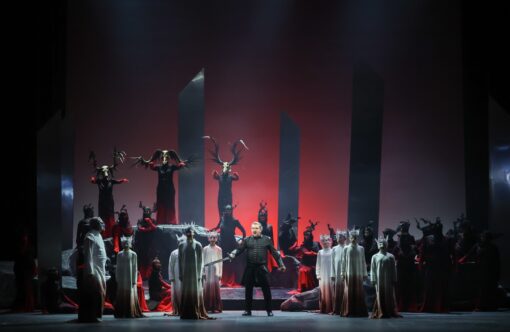
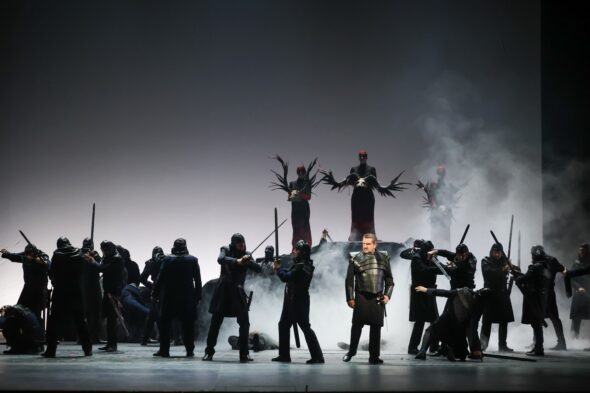
Vera Petrova’s production of Verdi’s Macbeth at Sofia Opera dates from February 2025 and includes some unique innovations. There was a more fantastical aspect, with groups of dancers led by the witches, spectacularly attired in reds and blacks with animal-horned masks in the opening scenes. However, in this staging, it took on fresh theatrical ideas as Petrova explains: ‘Our concept relates to two key points. The first is the presence of the supernatural, which is linked to the witches, the spirit of Banquo, and the child-visions, which represent a large part of the action. The supernatural and the material are part of the life perspective of each of us. […] Our working title is “Macbeth’s Nightmare”. He himself opens the gates to Hell and in the end closes them.’
At the beginning, we hear a text from Shakespeare: ‘Fair is foul, and foul is fair: Hover through the fog and filthy air.’ Maria Koleva, the scenographer, writes, ‘we came to the idea of a symbiosis between the material and the metaphysical, between light and darkness, reason and somnambulism and the imperceptible merging into one.’ Throughout the opera the Keeper of Dreams is like an alter ego materialising in a figure sculpted from silver and blood-red dyes; his image supports the idea of invisible forces and acts as a visual counterpoint to the monochrome environment.
The opening scene presented a dark assembly of rocks in the centre with the throne, surrounded by the three witches dancing, accompanied by satanic dancers, their garb was of red and black, the sets were minimal and dominated by the castle walls at the sides, with the castle chamber assuming the central background.
The finest singing of the evening was that of the bass-baritone Ventseslav Atanassov as Macbeth and the Italian soprano Alessandra di Giorgio as Lady Macbeth, who was superb both in voice and characterisation. Atanassov has a marvellous talent to impose his presence in every scene; he is a supreme actor on the stage and completely assumes the personality of the flawed nobleman who, from the outset, contemplates the nature of the prophesies given him by the witches. The Lady Macbeth of Alessandra di Giorgio offered a more positive character than that of the evil schemer often portrayed. The Italian gave a deeply emotive portrayal of her husband’s newly found opportunity to accede to the crown. Her aria ‘Nel di della vittoria … Ambizioso spirto … Vieni t’affretta … Or tutti, sorgete’ revealed her rich soprano capable of achieving great nuances in tone, ranging from dark tones to the lighter voice. The scene of Macbeth seeing the dagger suspended in the air was superbly enacted, ‘Mi si affaccia un pugnal?’ and dramatically portrayed.
The banquet scene was intensely dramatic with the guests milling around as Lady Macbeth invites them, ‘Si colmi il calice di vino eletto’ and yet suddenly interrupted by the appearance of Banquo’s ghost. This fantastic scene was magnificently staged with the witches and their accomplices in a colourfully sinister scene, with the spectral figure of the Keeper of the Dreams making a threatening appearance around the dancing satanic witches. Macbeth’s aria of ‘Fuggi, regal fantasima’ was deeply emotive and enacted magnificently by Atanassov.
Another moving scene was that of the superb chorus in ‘Patria oppressa’, yet another great opportunity for the Sofia Opera Chorus to show their world-class singing. Among the other vocal highlights was the glorious tenor of Emil Pavlov as MacDuff, in his aria ‘Ah, la paterna mano’ now appearing as the returning victorious hero. The Banquo of Daniel Damyanov, in both characterisation and deep resonant bass was magnificent.
The costumes and set design by Maria Koleva were stunning, with dominant reds and blacks presenting this dark, tragic opera fittingly mixed with the bizarrely devilish scenography fully appropriate to Vera Petrova’s production. This was enhanced by the choreography of Riolina Topalova and the lighting by Andrej Hajdinjak.
Above everything throughout was the magnificent singing of the Sofia Opera Chorus; of course, this opera lends itself to some of opera’s greatest choruses. In past visits here, I have not heard the chorus in Italian repertoire, but here they were world-class, directed masterfully by Violeta Dimitrova. The orchestra was magnificent with wonderful intonation from the flute, clarinet, oboe and the brass groups, most notably in some of the off-stage performances. The direction by the Italian conductor Alessandro D’Agostino was outstanding, because at times, the orchestra sounded at a different level from my past visits to this theatre, and the Italianate sound of the nuances, especially in the quieter passages in which the shadow of great evil is hinted at on the violins, was splendid.
In all, this was a memorable evening of great opera singing brought to life by magnificent staging and innovative conception, which evinced even more the darkness of Shakespeare’s original play and brought out some of the finest choral singing I have heard in the theatre.
Gregor Tassie
Featured Image: Sofia Opera’s Macbeth © Svetoslav Nikolov-Chapi
Production:
Direction – Vera Petrova
Assistant director – Vera Beleva
Scenography – Maria Koleva
Choreography – Riolina Topalova
Lighting – Andrej Hajdinak
Chorus master – Violeta Dimitrova
Cast:
Macbeth – Ventseslav Anastasov
Lady Macbeth – Alessandra di Giorgio
Lady-in-Waiting – Ivanka Ninova
Banquo – Daniel Damyanov
MacDuff – Emil Pavlov
Malcolm – Hrisimir Damyanov
Doctor – Angel Hristov
Servant to Macbeth – Anton Andreev
The Keeper of Dreams – Alexander Alexandrov
The Voice of the Keeper of Dreams – Apostol Milenkov
Fleance – Damian Ivanov
The Witches – Siana Miladinova, Raya Andreeva, Niya Balcheva